Affichage des articles dont le libellé est expat. Afficher tous les articles

mercredi 18 septembre 2013

It happened like this...an English family move to France, Part 2

 1989-1990. Lost in France.

As a family, we were happy in our own world.  We were closely-knit and all got along together.  The children joined in, we had little rituals and traditions that we stuck to, and family life was fine.  I am from a very large family, and both our parents and a variety of brothers and sisters, along with a collection of spouses/boyfriends/girlfriends, came to visit.   The children made friends at school and rapidly learnt to speak French, especially Pippa who learnt French extremely quickly – a matter of weeks.  Little girls are very receptive at that age.  William took  longer.  By the time Jake was seven or eight, he spoke better French than English, but as a toddler he spoke a delightful Franglish that only we could understand.
It is arguably terribly rude to not learn the language of your host country, and for me half the fun of being abroad is trying to speak the lingo.  But some people have a knack for it and others do not – it is like being able to sing, or draw or do Maths.  For Bruce it was very hard indeed and he just could not get his head round it.

  • The boys in the kitchen.  The ceiling had started to fall in so we had to put an upright in to retain it.  The previous owners had “modernized” it, and we had all sorts of plans to create a more tradtional kitchen, in keeping with the house.  But we had long since moved on before we could even think of affording it.  All the rooms very huge, except for the bathroom with was pokey, smelly, dark and had no window.

Things were very different

It took a while to adjust to how different things were.  They were very different.  We had come from the most expensive area of the UK – Sussex – to a French backwater.  Even though we had both lived abroad a great deal, to include some third-world countries, we were nonetheless taken aback by the poor standard.  The village was essentially just a collection of dark grey stone buildings with a lorry-plagued road blasting through the middle of it and dangerously narrow (broken) pavements on either side.  The shops were very poorly stocked.  There were no cereals of any sort whatsoever, no tea, no fresh milk, and chickens were sold with their heads and feet still dangling grotesquely.  Christmas, so jolly and colourful in England, regardless of one’s opinions about tat and commercialism, was a non-event with one drab Christmas tree outside the Mairie (town hall) and the local radio blaring out of loudspeakers in the street, loud enough to drive you mad.
Another thing that was so different was the overall look of each village.  A lot of British people comment on it – everything looks so utterly dead, even today.  Shutters closed, nobody on the street.  Even the shops frequently looked shut when they were in fact open.  I hasten to add that this is not a criticism of France, it was just the way it was and I think many French people from Bordeaux or Paris or the Cote d’Azur would agree. It was terribly depressing.
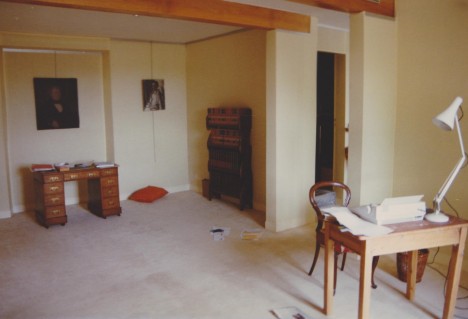
  • My office, or the Power House as I used to call it!
Our energies found their own levels, with me doing most of the viewing of properties and taking potential buyers round.  This was partly because I always know where I am – whether or not I am facing north or south, which side of the town I am on or whatever – so I found it easy enough to follow the directions and locate the property.  Also, of course, I spoke French, crucial when discussing the price with the vendor and working through the papers with the notaire.  Bruce worked on the house to make it more comfortable, and he also tended to do the shopping and fetch the children from school, look after Jake and so on.  It was a role reversal that I had no trouble with, but I think he sometimes felt a bit useless – which he was not.

We pulled out all stops to integrate.

We too made a few friends.  Not many. And they didn’t last. We discovered that for every ten couples we invited to dinner we would be invited back perhaps once.  I don’t know why that is.  Just a different way of doing things.  We got the children to join in – judo, ballet, horse-riding and so on, attended the Christmas fund-raiser and the parent-teacher picnic … and remained 100% outsiders.
Well, we were outsiders.
Sales were good and we both worked very hard.  My days were filled with driving people around, showing them in and out of houses, explaining to them how the system worked, pointing out the land boundaries, listening to them talking, smiling and listening some more.  The British snapped up properties on a regular basis, sometimes buying something idyllic and frequently (like us!) buying something completely unsuitable.  It has to be said that the British snapped up all those derelict little properties that the French didn’t want and as a direct result of this (according to an article in a French national newspaper) places like Bricomarche opened – and created employment.  And so on.  All and any business brings in trade, and our business was not an exception.
The red tape also kept me on my toes. I had to drive over to Chateauroux, the main town, about forty minutes’ drive away, over and again to fill in this form and that form.  I tried to do things professionally, properly, be correct ….
But we had been at La Haute Perriere barely four or five months when we accepted that this was not the place for us.  We fought against it for a while.  It seemed ridiculous to give up and move on already, but look at it from every angle as we might, it was clear this was not the place to be.

  • There were seriously hundreds and hundreds of grotty little properties for sale.  This one was in a village, though the British usually wanted something out in the countryside.  It sold for the French franc equivalent of £6 000 !  Unlike a UK estate agent, in France you have to accompany your client – sometimes for miles and miles. This is partly because that is expected from the vendor but also because your client would never find the property, down little lanes in tiny hamlets, in a country that is double the size of the UK.  Furthermore, properties in France could be with 10 different agents, so if you wanted to nab that sale you had to keep that client close.
There were a variety of reasons we had to go.  We were very isolated was one.  Although the little town had all essential shops, doctor and so on, it was backward and slow.  The dated telephone exchange still closed for lunch.  Everything closed for lunch, even some restaurants!   It reminded us both of the UK in the 1960s.  In fact, I think that is why the British so loved buying in the area – childhood memories.
Anything that might be entertainment was miles and miles away.  In Sussex I had belonged to a health club, complete with pool and a fully equipped gym, restaurant, huge lawns … but the nearest I could get to it in France was a keep-fit class in Chateauroux, and the keep-fit was so slow and lady-like it was not worth going.

Nothing, nobody.

There was nothing. There was nobody. The climate was dreadful. There was nowhere to go.  Nobody to meet.  Worse, we couldn’t integrate.  There should be a badge available for people like us who tried so hard to build-up friendships.  Part of the trouble was that Bruce spoke no French, and keeping company with somebody who doesn’t speak your language is tedious.  On the rare occasion we were invited out the conversation depended entirely on me, and trying to include Bruce was a chore for all concerned.  And he felt miserable, desperately attempting to join in, and one has to give it to him – he tried really hard and kept up a good, cheerful front against all odds.  But there was more, vastly more to it than that. Even though France is just the other side of the English Channel, the cultural differences are immense and it is foolish to think one can just slot in, least of all in an area like the centre of France where nothing had changed for donkeys’ years.
I missed my friends terribly.  In England the mothers used to stand around the school gate to pick up their children after school, and we would all be chatting to each other, and we would get chatting even if we didn’t know each other.  Here, the mothers stood in silence. One or two spoke.  Nobody spoke to me. I am a very open person, easy to talk with, casual and at ease with almost anybody – but I could never get a conversation going beyond the rather formal “Bonjour Madame”.  I tried really hard, and in the early days I was determined to swing in to the French way of life.  But I just couldn’t.

  •   Another house for sale.  I sold it to a Dutch couple who lived in London and who wanted it for holidays. It was a good buy and I hope they had plenty of lovely holidays there.  The lake was part of it and there were grounds of about half an acre.  I can’t remember the price but it was something in the region of £20 000.
In France in those days – and even now to a large extent – it is quite usual for a property to remain for sale for years.  La Haute Perriere had been for sale five years before we turned up. We were conscious that this was potentially a big worry.  We had decided to move on, so move on we must, but the thought of trying to sell the monster we had bought, was daunting to say the least.  But I found, slightly to my surprise, that I was now a business woman; I had experience; I knew the ins and outs of advertising; I knew how to present a property, what to avoid … we did a bit of cosmetic work, vases of flowers, a few artistic draperies, and sold the place within a few months.  The buyers were an older American couple who, years later, telephoned us and told me they had hated the place from Day 1, and asked me to sell it again – which I couldn’t, for I had long since moved on, and moved away.

  • A rare moment of relaxation in our garden, that first swelteringly hot summer in France.  My mother commented that the heat was as bad as Nigeria.
In the meantime we talked about where to go.  We discussed returning to South Africa, where I was born, and a part of me will always wish that we had done that.  We discussed Australia, where Bruce had spent his youth.  We talked about New Caledonia where I had lived, or Spain and any number of other places.  Mostly I wanted to go home, but we had lost our house and we knew that raising the funds for another would take a very long time.
And as all parents know, the children have to come in to the equation.  We had removed them from a school where they were very happy and doing well in the UK.  Pippa and William were now fluent in French.  They were part of the French education system.  And we didn’t have the funds for a big move anyway.  Oddly enough a friend asked me just the other day where I would recommend living – where in the world, that is – for we have travelled a great deal and lived in a lot of different countries.  And I replied:
“While you are young and energetic, if you are going to go to the trouble of moving country and culture, for goodness’ sake choose somewhere a bit more exotic than France!”
Odd, isn’t it ?  Although I have come to love France, I still feel that.
Part 3 to follow.
Catherine Broughton is a novelist, a poet and an artist.  Her books are available on Amazon/Kindle worldwide, or can be ordered from most leading book stores and libraries.  They can also be bought (£1.99) as e-books from http://www.turquoisemoon.co.uk
- See more at: http://www.turquoisemoon.co.uk/blog/it-happened-like-this-an-english-family-move-to-france-part-2-2/#sthash.oQM2hz8v.dpuf


mardi 17 septembre 2013

It happened like this...an English family move to France. Part 1


At the begining, 1989.

Well, to be blunt, we were broke. We had been hit by the UK property crash in 1989 and we lost everything almost overnight. And that is why we moved to France.  No other reason.
In the preceding months, before we realized how serious the financial crisis would be, we had bought a little fermette, largely uninhabitable, in the centre of France, as fashion dictated.  The intention was to develop, as the British were hungry for cheap property in France and – goodness – it was cheap!   Although, before we met, we had both lived abroad a great deal, we were not immune to the British dream-misconception that life would be “different” in France.  Like so many of our compatriots we thought it could be an “escape” of some kind … in those days France was considerably cheaper.  Surely life would be easier ?  Surely it would be different ?
Well, yes, it was different – it was French!

  This was the first property we bought, more-or-less, for the price of a garden shed in the UK.  I am standing by the door with one of the children.  The centre of France was a big mistake, though we were not to know it then. Although property was amazingly cheap, the area was bitterly cold in the winter and stiflingly hot in the summer – a horrid, heavy kind of heat that was not pleasant at all. It was also a very backward part of the country, and seemed stuck in the dark ages. Many of the locals had no indoor plumbing and used an out-house, or even a bucket.
In the UK I had been teaching and Bruce ran a building firm, buying up the last of the run-down old houses in Hastings, splitting them up in to flats and then selling them.  It was exceptionally high-risk and hard work, but we were both extremely energetic, positive and determined people.
I taught French & Spanish
I had stopped teaching while expecting our third child, born in 1988. That was the happiest patch of my life, at home with a very good baby, with whom I was utterly besotted.  Pippa and William were aged 7 and 9 respectively and they went to a local prep school.  We had a lovely house that we had purchased when William was new-born.  We bought it as a two-up and two-down derelict cottage, probably the last one in Sussex.  We had enlarged and renovated it and we were rightly very proud of it.  We had good money, a smart car, holidays abroad. Even my teaching position had been pleasant enough.

We had bought this as a derelict cottage when William was just a few weeks old.  By then it was already very difficult to find something in need of work in the south-east of England and we felt lucky to have got our hands on it.  It had been a tiny two-up two-down with a small kitchen extension.  It was in such a bad state that a health visitor came round to see what sort of conditions I was keeping the children in!  We turned it in to a 5 bedroom, 3 bathroom house.  Our blood, sweat and tears were in it.


  • On the patio in Sussex, England.  I loved that house and left my heart there.  It took me a long time to recover.

Sometimes when I look back on that energy I can hardly believe it.  I used to pop home during my lunch break at school to mow the grass – at first a half acre of derelict shrubbery and scrub and, bit by bit, as I cut the growth back and seeded, mowed and re-seeded, it turned in to lovely green grass, English grass.  I don’t know why I mention it here, for I have never been interested in gardening, but I suppose because it was one of the things I missed the most when we were in France.  My English garden with London pride growing in the borders.

Me standing in the front garden in Sussex, the azaleas and rhododenrons in bloom, a few days before Jake, our third baby, was born. 


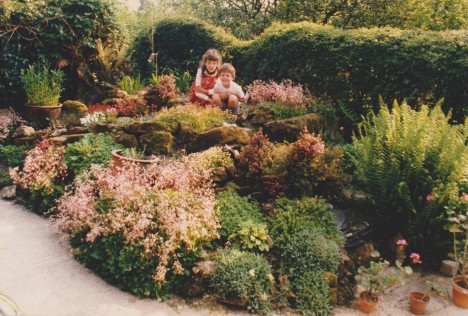
My rock garden with Pippa and William crouching at the top and the  London Pride in bloom. 

I had loads of friends.  I have always been a chatty, up-front person.  I like girls, I like women.  I always had a chum with me when I went shopping or when I took the children out.  It is part of the very heart and structure of an English woman’s life, and another thing that I missed dreadfully once we moved to France where it was much harder to make friends, and to find the time to maintain any potential friendships.

We worked as a team.

Unable to meet bills or pay the mortgage on our home in England, we were just one more family amid hundreds and hundreds who lost out badly in 1989, many of whom reformed their lives around Council houses and menial jobs to survive.  What made us different was that we believed very strongly in ourselves.  We had had a lovely lifestyle and we wanted it back. We were hard-working and willing to take a risk.  We got on really well together and worked as a team, always.  We had huge energy, and we didn’t mind roughing it when we had to.  Bruce could turn his hand to almost anything, he was exceptionally skilled, and I could do the rest.  When I look back I realize we were multi-talented, but it didn’t occur to me then.  The main things were our enthusiasm, our determination and our energy.  We had three little children, but we scooped them up in to whatever situation we were in, and just got on with it.
We decided to let our lovely home, so we put a tenant in and we moved to France.  I will always remember the removal man telling me he moved a UK family to France every week.  As he made his notes he looked straight at me as added: “and every week I move a family home again”.  He was trying to warn me.
The tenant’s rent paid the worst of the mortgage.  About four months later he announced that he would like to buy the property and, although we’d by far have preferred to have kept it, we really had no choice but to sell.  And then, for no reason, he changed his mind, bought elsewhere, the bank forclosed and we lost the house.  I cried for weeks – for years.

Speaking French.

Periodically somebody will say to me “how lucky you could speak French!”.  Being able to speak French was, of course, a huge advantage compared to most foreigners trying to set up a new life in France.  Conversely, however, it was a disadvantage in more ways than one would imagine.  Had neither of us been able to speak French we’d have bumbled along together.  But as I spoke it well, thanks to childhood years in New Caledonia, everything fell on to my shoulders.  Talking to the teachers, helping with homework, opening a bank account, dealing with mortgage applications, insurance policies, the endless red tape provided by the French bureaucratic system, answering the phone, finding an accountant, applying for child allowance – all of a sudden I was no longer a housewife-cum-teacher.  It was exhausting.  Jake was still getting us up in the night from time to time, the children were confused and lost in school, and we had to find a way of earning money very quickly indeed.
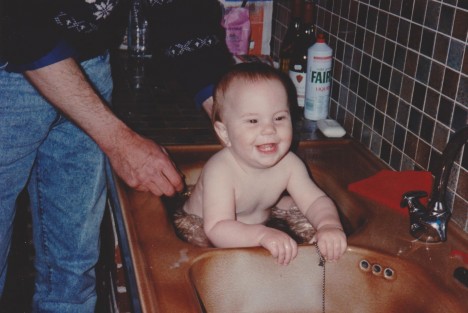
  • Bruce washing Jake in the kitchen sink – we had no bath, though there was a cold shower.

French banks

The other key to our success was the French banking system.  It was extraordinarily naive at the time, and in no time at all we were able to buy a bigger and better property called La Haute Perriere with 100% loan from a French bank.  They simply wanted to know how much we had earned the previous year, and that had been a lot.  They wrote it down on a piece of paper, got us to sign it, and were not interested in the fact that we had lost that income for good.
Now, one has to understand that, although on the one hand it was utterly crazy – crazy! – to buy such a big property, there were reasons behind it.  Folly, sure, but good reasons too.  Both Bruce and I always had a feeling of “just round the next corner … ” and “in just a month or two …”  We had complete confidence that things would work out well. Considering our ambitions, and the state we were in, that confidence sometimes beggared belief.  There was no question of things not working out well.  A possible failure didn’t enter in to the equation.  A big house like La Haute Perriere gave us a level of kudos, not for the local people but to our very selves.  It is a bit like looking smart when you go out – you somehow just feel better, even though you are the same person.  Our frame of mind, our mindset and our whole personal aura was go for it! Make it happen! get there!
That is what drove us on.
I love this picture because I can just see Jake toddling as fast as his little leggies would carry him, towards the camera. Behind him I am just moving forwards to catch him.  The middle floor of this property had been arranged as a 3 bedroom flat, and that is where we lived.  There was a top floor which was accessed via a steep staircase at one end of the property; we called this The Tower.  There was a new roof but apart from that no work had been done on that floor and it was just a huge long attic that the children played in.  There were all sorts of relics up there, the strangest of all being five or six massive oriental rugs, laid out on the floor, one on top of the other.  They were doubtless worth a fortune, but there was no way of getting them down the stairs and we puzzled as to how they got up there.  It must have been when the roof was removed.   The bottom floor was three massive, bare rooms, decorated and boasting 18th Century tiled floors and a huge fireplace at one end.  The property had full central heating which was unusual for that part of France in those days – and gosh, was that needed that first bitter bitter winter!  This huge house had just the one bathroom and toilet, which was also typical of French homes at that time.  There were several acres of fenced garden, a tennis court, and endless outbuildings to include a lovely 17th Century dove cote.
We sold our little fermette in Palluau to some ambitious Brits who were seeking “the easy life”, and we made a good profit.  Doing this was clearly the way to make some good money and to move forwards.  We had befriended a local notaire who was very keen to sell to les anglais, and thence very keen to see me set up an estate agency.  In those days it was more usual to have an office and a shop-front to give us a high street presence, but we didn’t even consider this as it was unwanted overheads.  We arranged one of the large and more comofrtable downstairs rooms as an office and, along with my old typewriter, a phone, a filing cabinet and a second-hand photocopier, we set up business.  Bruce built two long “desks” that covered two walls, and on these we were able to lay out the photocopies of the properties, address envelopes and so on.
  • One of the ground floor rooms

Success.

We were successful right from the word go.  No, not big success, but enough to live on, pay for the house and run the car. Thanks largely to the notaire, the jungle-drums worked like magic and we soon had a big file of properties for sale, mostly run-down fermettes, which was what the Brits were generally after.  We ignored the French market – they had estate agents of their own – and concentrated on the UK market, placing ads in The Lady and the Telegraph.  There was no internet in those days, so enquiries came in by phone or by fax, sometimes ten enquiries in one day and then none for a month.  The property details had to be posted to the UK, and then after a few follow-up calls we’d wait for people to come to France and view.  For every 100 potential buyers I got in to my car, and drove them round the countryside showing them any suitable houses,  about 3 would actually buy something.  I took as large a commission as I could, for those that did buy had to make up, financially, for those who didn’t buy.
  • grounds LHP 001
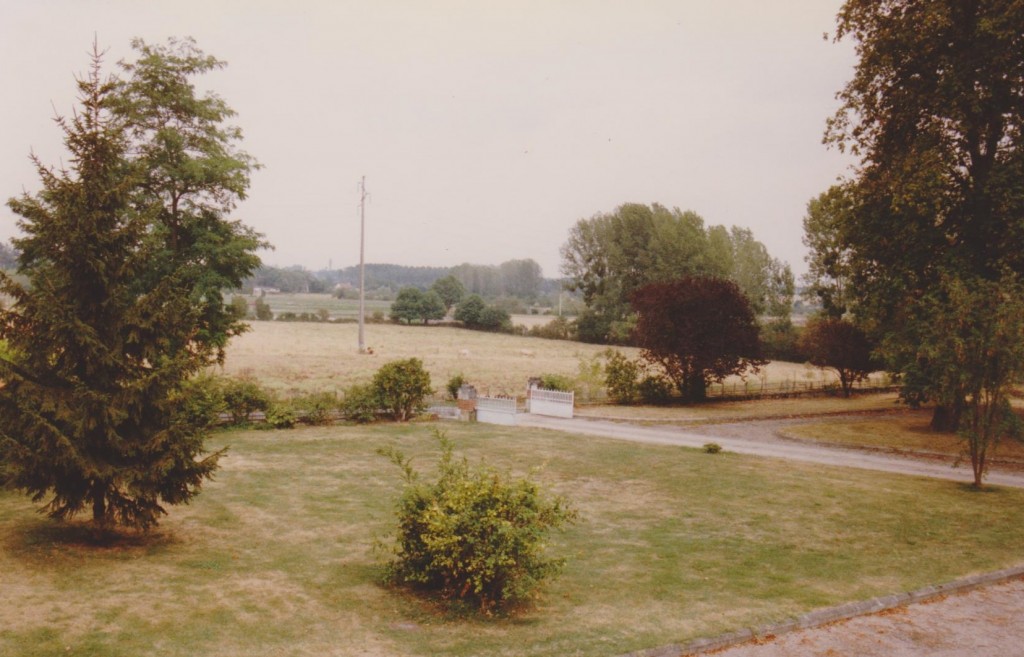
    The countryside was generally flat.  This was the view from the kitchen balcony.  Years later William told me that he used to look at the horizon and imagine England over there, beyond the trees.  He also told me that for years and years he slept facing England.  He and I were both very homesick.
My property sales were dealt with by the same notaire , who benefitted from the transactions, of course.  He, in turn, kept one ear to the ground for suitable properties for me.  He supplied me with sales papers in English that I should get my clients to sign, and was a good source of support and general information at a time when I was paddling in the dark.
He didn’t trouble to mention to me – and perhaps he genuinely didn’t think of it – that there are very strict laws about conveyancing in France and that, what you could at that time do in all freedom in the UK was illegal in France, and carried a prison sentence.
Part 2 to follow.
Catherine Broughton is a novelist, a poet and an aritst.  Her books are readily available on Amazon/Kindle, or can be ordered from any leading book store or library.  They are also available as e-books on this site
- See more at: http://www.turquoisemoon.co.uk/blog/it-happened-like-this-an-english-family-move-to-france-part-1-2/#sthash.cZTr383X.dpuf


lundi 12 août 2013

People in my books: Ashley


One of his girlfriends once described him as looking like a poet.  Ashley had liked that.  Indeed, he was fine to look at, bordering on good-looking if caught at the right angle … yet … yet there was something wimpish about him.  It was impossible to put a finger on.  It wasn’t because he was not very tall.  That in itself doesn’t matter any more.  Nor was it that he was not well-built.  And it certainly wasn’t his lack of hair though it would have been better had he shaved it off properly.  Yes, perhaps that was it – that he tried to comb his thin wispy hair over his scalp.  It was also in the drooping shoulders and the fractionally petulant expression on his face.  That was it.  Had he put his shoulders back and stood up straight, altered the expression on his face to one of positive cheerfulness, and shaved his hair off totally, he’d have been a good-looking man.
But Ashley had never been overly concerned about his looks.  Clean, clean clothes, ironed clothes, clean finger-nails, order and organization. That summed him up.
Had anybody predicted what was going to happen he’d have laughed.  That was not his kind of thing at all. Not at all. No way.  He hated anything like that. All that messy stuff, the intrigue, the ducking and diving, hell – the blood, the running and hiding.  That was not his kind of thing at all.  Never, ever would he be involved in that sort of thing …

Extract from “The Man with Green Fingers”, a novel set in Cyprus:-

“She gave me this,” said John delving rapidly in to his shirt pocket and producing an envelope, “forty pounds – she wanted to pay you anyway and she apologizes.”
The monk, his mouth open still, took the envelope from John’s hand.
“Thank you,” he said. “May I ask – are you a friend of Mrs Platt? She seemed so eager to rest here a few weeks. In fact,” he reached in to a drawer – “ a letter has arrived for her.”
John took the letter, trying hard to not snatch. He instantly recognized Kirsty’s handwriting.
“I’ll give it to her,” he said.
The monk seemed to hesitate, his hand still poised in mid-air, fingers slightly apart where the envelope had been, then shrugged slightly.
“Very well,” he conceded.
“Goodbye,” said John a little curtly, and turned from the monk back towards the car park. The monk didn’t reply.
Back in his car he ripped the envelope open.
“Dear Stella,” it read, “I hope you have a lovely rest. Don’t worry – I won’t turn up! Thought a letter would cheer you along, however. If you do decide to pop off to England do please please phone me because there are several things you could bring back for me – if you don’t mind, that is. Anyway. See you next term. Love from Kirsty.”
Stella would have murmured “sweet child” but John found the card irritating and tore it in to several pieces. Revving too hard, he reversed quickly and drove away back down towards Paphos, taking the bend rather too fast. In his rear-view mirror he could see the monastery recede in to the distance, its imposing stone walls and pine-encrusted mountain backdrop like a scene from a picture post-card. He sped rapidly down past Kamares – he had once toyed with buying a villa here – and on to the Limassol road just north of Paphos. Here he pulled in next to a bin where he threw the torn shreds of Kirsty’s letter. Tourist traffic was building up and John was glad of the air-conditioning and the blue-grey shading of his windows. Above Paphos he skirted the centre, taking the Ktima road and reaching the dual carriageway further east. He eased on to it, swearing under his breath at other drivers. He was glad to get away from the Paphos area and the past two weeks had, for the first time, seemed very long. Was he perhaps tiring of Stella ? The very thought was alien to him…………. yet he could not deny that it was on his mind.
He picked up speed once on the main road, his teeth grit and his fists clenching the steering wheel, and sped the half hour to Limassol where he veered left above the city and headed off in to the mountains. The buildings and the glaring city fell away behind him and, a little at a time, first the low hills and the brown and shallow valleys, the mountain scenery encompassed him, and his shoulders relaxed and his grip on the steering wheel began to loosen. Not till he reached Trimiklini did the sensation of irritation and impatience totally leave him, replaced almost instantly with a feeling of peace and tranquillity; he slowed his speed and meandered confidently up the mountain pass, smiling slightly in to the hills, noting the flora as he passed, and looking forward to seeing Pia.

order your copy as an e-book here:-

or from Amazon/Kindle here:-

- See more at: http://www.turquoisemoon.co.uk/blog/people-in-my-books-ashley/#sthash.ii2umswn.dpuf

lundi 15 juillet 2013

People in my books: Kirsty


Kirsty was in her early-to-mid twenties, a post graduate with a degree in English.  She moved to Cyprus with Tom, also an English graduate and, like him, had been to some minor Uni somewhere in the Midlands.
She was a clever enough girl, but no intellectual.  She had acheived her degree simply by reading and writing the right stuff and, like her fellow post grads that hailed from the same – and similar – places, had no proper knowledge or understanding of English literature apart from the books that had been studied on her course.
But that was okay. She was sharp enough to know that it was a mediocre qualification and bright enough to know that, for her at any rate,  it really didn’t matter that much.  She claimed that most teachers were over-paid and over-qualified, but she had the good sense to enjoy the long school holidays and the relatively short hours without questioning too many issues.
She was pretty in a straight-forward and uncomplicated sort of way. She had a lovely figure and a natural manner.  She had a ready smile and was kind.  More than anything, she loved Tom.  She knew it wouldn’t last, and in some ways she broke her heart over it. She befriended Stella mostly because she felt sorry for her – Stella was a fish out of water and – worse – would be a fish out of water wherever she went and whatever she did.  Stella was one of those awkward people, a tall gangly woman who desperately wanted to fit in and to be feminine.  And Kirsty felt genuinely sorry for her.
When the police came to her door it all became obvious, appallingly obvious, but at the time, it hadn’t occured to her …
Extract from “The Man with Green Fingers”:-

It had all been so easy, so amazingly easy.
Stella stretched luxuriously. Well, of course, not many people would have been able to do it. Very few would have known where to even begin. So from that point of view it was ridiculous to say it had been so easy. In fact, it had taken six months, slightly more. The planning had been meticulous. Every angle of every possibility was studied. Every scenario examined. She had had to be absolutely certain, could risk nothing.
And she had pulled it off. Brilliant. Quite simply, she was brilliant. She lay back in her chair, her head resting against the wall behind her, and closed her eyes against the sun. She could hear the small movements of a bird on the roof and the background sounds of the city beyond the confines of her yard walls. A satisfied smile crossed her face. She would rest here a while, then have a beer or two before changing her clothes and wandering back out in to the town. These little sorties were almost daily and never ceased to send a thrill of anticipation through her. The entertainment value of it was massive. She was aware that one day it would quite possibly pale and become boring, but for now it was hilarious and she loved it.
The shrill ringing of her telephone jolted her upright. She pressed her hands on to her knees as she rose and, her feet bare on the scorching brickwork underfoot, she went rapidly indoors and picked up the receiver.
“Hello?” she said in English.
“Stella – it’s Kirsty!” Kirsty had a delightful way of putting a touch of excitement in to her voice…

Catherine Broughton is a novelist, a poet and an artist.  Her books are available from Amazon/Kindle or can be ordered from most leading books stores and libraries.  You can also buy them as e-books by clicking on the links below:-
Posted by Catherine Broughton on 14 July 2013
- See more at: http://www.turquoisemoon.co.uk/blog/people-in-my-books-kirsty/#sthash.JB6Orf48.dpuf

mercredi 26 juin 2013

Illustrations for my books


Extract from “A Call from France” by Catherine Broughton

I was happier at Les Cypres.
I was physically, if not mentally, considerably less isolated. It was only once we’d moved in that I realized just how much the distance between Tulips and everything else had added to my work load, just in sheer driving time. I hadn’t even been able to post a letter or buy a stick of bread without getting out the car and, worse, any form of entertainment or relaxation – beaches, restaurants, cinemas – were all miles away.
Les Cypres offered us more and at closer proximity. As the months flit by we tried a variety of things from jazz sessions to yoga, from archery to Amnesty International. It may be that we asked too much of life, but we were never able to become immersed in any way and remained permanently sitting at the edge. One of the things we got involved in was the village committee for saving the patrimoine – the local heritage – and we attended several village meetings where the restoration of an ancient bread oven was discussed. I suppose the problem was that it was not our country, not our village – hey, not even our language! – and we found it difficult to take any realistic interest in renovating a bread oven, not least because we had an ancient bread oven of our own.
I can’t say I actively enjoyed the proximity of the village shops or the supermarket in Arabor, but I was aware it was an advantage. St Sylvain , the village, offered the basic essentials, despite being closed half the time, and Arabor was at least a town with real live people around, if not very many. It’s funny how you just don’t see French people in the streets in a French town, the way you do in England.
On a Sunday morning, particularly in winter, Euan and I went to the supermarket in Bourcefranc, some five minutes in the car. Afterwards we walked on the beach. I loved looking out over the sea to the island of Oleron opposite, seeing the boats bobbing about in the estuary and the cars passing by over the bridge.
There is something undeniably exhilarating about walking along a beach, even in the winter when that wind whipped in off the Atlantic, searing like a knife through our cagoules and thrashing my hair into a tangled nest. We always parked at the eastern end of the beach, at that time little more than a dirt road and utterly stinking with seaweed and shell fish, and walked directly along the shore line as far as the little sailing club at the far end. We walked briskly, breathing deeply, trying to counteract the stress and strains of the punitive week we had terminated. Big Harry always came too and would charge along that beach barking and leaping through the waves. We still walk on that beach, quite regularly. Sometimes we see Big Harry’s shadow, his ghost, still leaping joyfully in the sand. Bernie joined the little sailing club in the summer and spent many a sunny day out in the estuary, sailing sometimes beyond the bridge and out in to the huge ocean.
Our move to Les Cypres coincided with my little estate agency fizzling out. That is the only way to describe it: it just fizzled out. That last summer at Tulips I had made many sales and had had clients almost every day; by the following spring it was over. At that time the expression “burn out” hadn’t been coined but, looking back on it now, I realize I was all burnt out. Competition was greater, of course, for the proximity of civilization also meant not only proximity of other agents but sparsity of properties available: the abandoned little farmhouses simply didn’t exist, people moved house less frequently, abandoned their houses never, and there was generally little of any interest on the market. My great strength as an agent had been that I was willing and able to drive around all the isolated little hamlets in the countryside, spotting the potential for British clients in the huge old beams and stone fireplaces, which at that time were the very things the French were abandoning. I had seen how to play the market. But it wasn’t just that: somehow the energy and enthusiasm had gone. The need to earn money kept my agency limping along for a while, perhaps six months.
“I’m not doing this any more,” I said aloud as I drove home one day, “I’ve finished.”
And that was it: I finished.
- See more at: http://www.turquoisemoon.co.uk/blog/illustrations-for-my-books-chateau-des-cypres/#sthash.fV6OjFmh.dpuf