Affichage des articles dont le libellé est books. Afficher tous les articles

samedi 14 décembre 2013

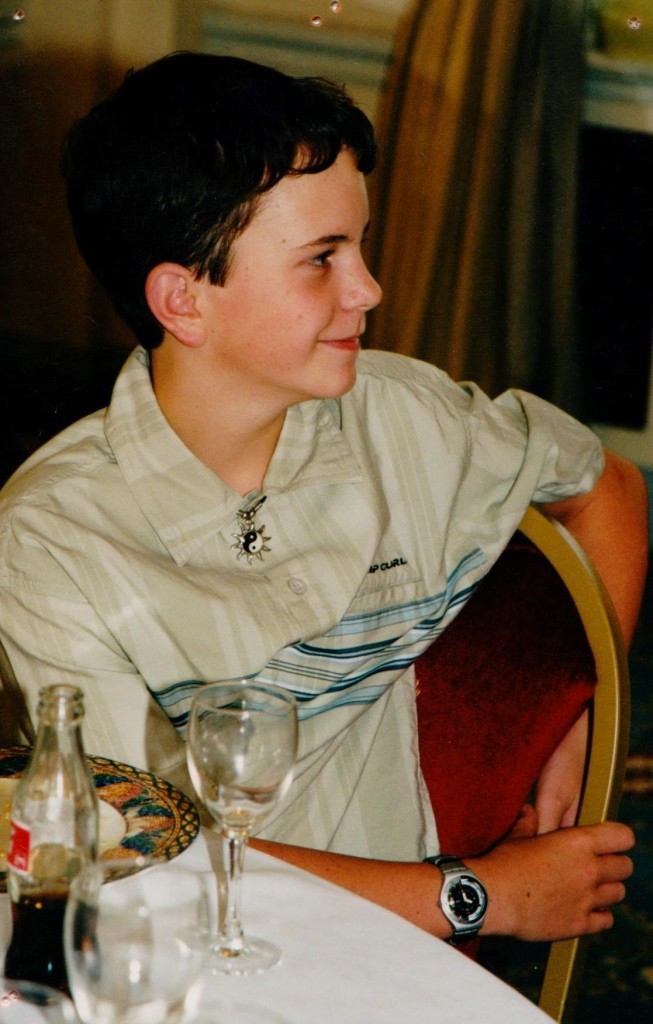
jakey 001  Jake when he was about 10.
The children were growing up.  The elder two caused that usual adolescant mixture of joy and fury, temper and sulks, utter and complete selfishness and sudden and unexpected spurts of kindness and cooperation.  And more.  Much more.  I won't say those years were "normal" because they weren't, and some of the events took me years to recover from - in fact, were the greatest tests of my life - but I have written a whole book about it and I won't go in to it here.
I continued with my rounds of the banks. Phoned to see if they had got an answer for me, phoned the next one, then the next.  I saw a financier in La Rochelle who put far more energy in to trying to (unsuccesfully!) get me in to bed with him than dealing with my dossier, and another on the island here who told me that no bank anywhere in the world was ever going to loan anybody such a massive sum.
"It's not a massive sum!" I wailed, "it is the price of a very ordinary house in England!"
"But this is France," he replied with a logic that was infuriating.

Money laundering

My father put up some money so that we could continue with the work.   It was now March.  The first signs of spring were arriving and, if we didn't start to advertise the cottage holiday lets very soon, we would miss the season altogether.  And then another year would go by.  I was beside myself.  We owed so much money to the men, to my father, to the suppliers, and to our very selves.  We had to get this loan one way or another and we even travelled to Paris to see a north African gentleman who, we discovered, wanted to launder his money through us.
" Typical!" I spat. "At last we find somebody willing to put up the money - and he has to be a b....y criminal!"
My mother, bless her, trying to encourage me, said:
"Don't worry about your looks, my dear, they will come back once you can relax again."
Oh, thanks mummy!  I had no idea my looks had "gone" !
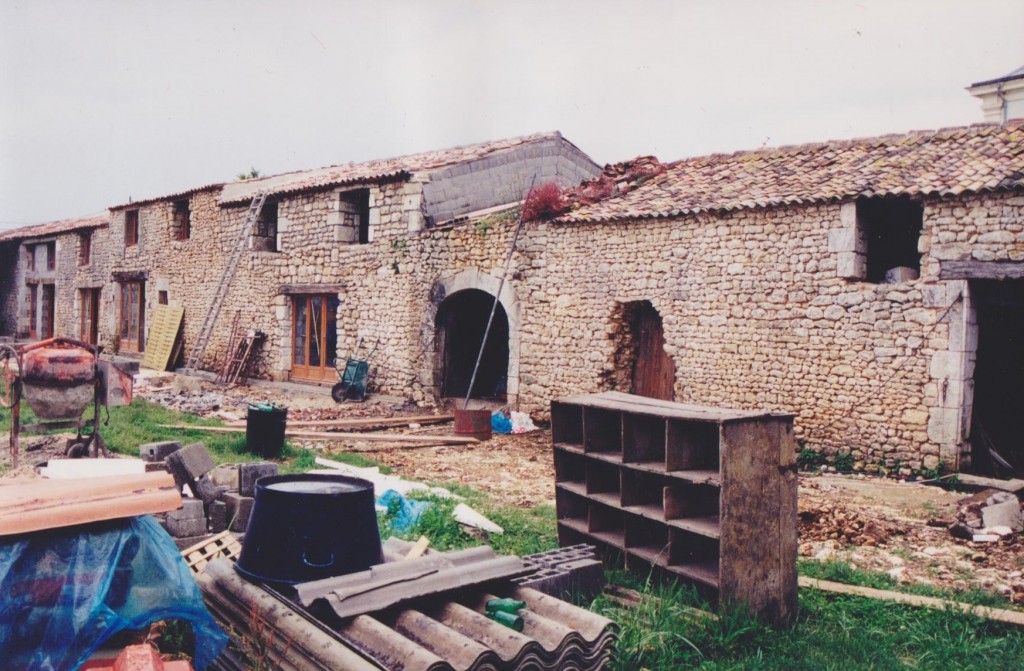
renov 3 001  The stone walls.  Each and every stone had to be picked around the joints so that it could be re-pointed, and then cleaned off.  This picture shows about two thirds of the extent of the walls - it was a labour-intensive job.  And just clearing away all the junk ! - there were mountains of it.
And it was that same week that at last we got the loan.  Of all the big nationwide banks I had applied to, and all the local banks, it was a small unheard-of bank in Rochefort.
We have never moved so fast.  We placed advertisements in the UK and very rapidly had bookings for all the cottages for the summer.  Internet was in its infancy and ads went in to glossy magazines.  The phone rang constantly.  We even rigged up a loudspeaker outside for the phone so that we could hear it ring and rush to deal with an enquiry.  We worked day and night, seven days a week, for three months.  And in those three months we created six cottages - floors, ceilings, roof, plumbing, wiring ... all of it, to include raising the roof in two places.

Major building work

There were two really very major works.  One was with the drainage because the land is solid rock.  I spent time phoning round to find the appropriate builder - they call that sort of work terrassement in France - you need to know this kind of stuff because you can waste hours and hours phoning the wrong people.  Initially a man said he would do it with a mini-digger.  He came round to look at the site, but Bruce told him he wouldn't be able to do it, the ground was far too hard. And sure enough the man couldn't and made only a five-minute attempt.   More time wasted. So Bruce hired a big compressor and two road drills - more phone calls, more trips in to town, more time - and it took 4 men 4 days to dig the trenches through solid rock.  We were amazingly lucky that there was mains drainage to connect to in the road that ran past.
renov 4 001
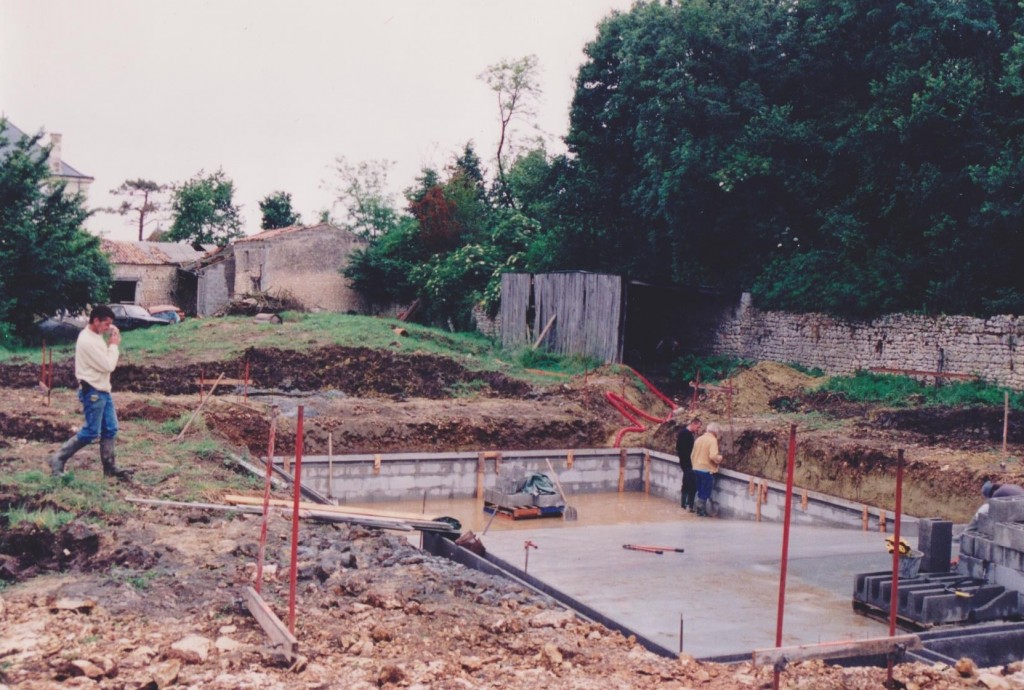
 The pool on the cottage side, and also the one on the chateau side, are situated in the only two places in the entire property where there is no rock. When the first lot of guests arrived the pool wasn't quite ready.  Mercifully they all had that good old British stiff upper lip, and they just bore with us till, on the third day of their stay, we were able to fill the thing up with water.  It took an entire day and night to fill.  The "hill" the far side of the pool is, of course, simply the earth that was dug out.  It now has a children's fort on the top of it, built by regular holiday-makers.  Loads of things like the derlict shed behind and the broken wall to one side had to be left for several years till we could afford it.
The second major item was the pointing and rendering of the exterior walls - and some of the interior ones too.   It was a massive job and big old Michel had already started hacking out the old, blackened render.  We had thought we would do this ourselves but mercifully one of our labourers had a brother who had all the specialist equipment precisely for that.  It cost a huge amount and made a serious dent in our budget, but it was well worth it for it saved many weeks in time, plus a great deal of energy and hassle.   Actually, they were a really good team - from Saintes I seem to remember - who turned up promptly every morning and worked hard and fast till the job was done.
All roofs had to come off, already broken or otherwise,  to be insulated and then laid with  flexible waterproof material before putting the old Roman tiles ontop.
Inside partition walls that we built had a  timber frame, then laid with insualtion & plasterboard, incorporating wiring and  plumbing as we went.   I loathe glass fibre - it gets everywhere - in to your clothes and eyes, and it feels itchy and uncomfortable and the only solution is not only a shower but a complete change of clothes too.   The French call it "laine de verre", meaning glass wool.
Some weeks we had up to fifteen extra people on the site, to include Michel's daughter who came to help me make curtains, and Corinne, the gipsy I mentioned earlier with her little girls.  The little girls ran around the site playing in the debris.  I bought a second-hand buggy for the baby and carted her back and forth with me when Corinne couldn't.  We put table and chairs in what is now cottage 2, a fridge and an old cooker, so that the men could make coffee and eat as they wished.  While the weather remained cold they lit a fire on the floor, there in the middle of the derelict room.
These were good, fruitful, positive days.
ouitside of our barn 001  The corner barn with a huge hole in the roof became our home for several years till we were able to convert it.  We sort-of camped in there from April-ish to mid-September or so, when the Chateau became available again.  The Chateau lettings went very well, despite several initial mistakes, and it was almost always full.  
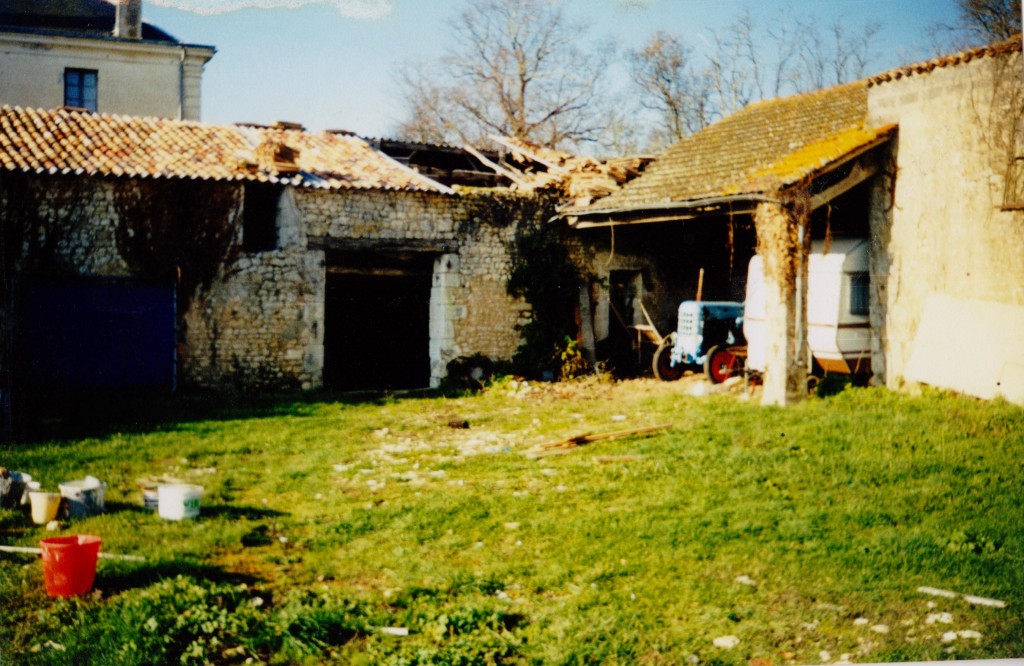
All around was beaten earth and that summer was extremely hot.  Jake and I flung grass seed down in all the little front gardens - too late realizing that one packet was wheat !! - and it is surprising how much of it took - both the grass and the wheat!  Grass is good stuff.  It grows in all sorts of places, hot or cold,  and survives all sorts of abuse.  I like grass.
Jake and I were also in charge of buying the wherewithall to furnish the cottages, and we dashed about after I had picked him up from school, frantically ordering beds and mattresses (you couldn't do things on line), dozens of cups and plates and pillows.  We had a Chrysler Grand Voyager at that time and we were able to pile a great deal in, Jake frequently balancing buckets and plants and curtain rails on his lap.  We would unload it in to one of the cottages, where it always got in the way of the workers, and dash back to the shop for the next load.  Back and forth, half an hour in each direction.  Sometimes things were delivered, but usually delivery was too expensive or - more importantly - too slow.
Jake was great company, a smiley, happy little guy who joined in all this activity with as much energy as I did.
Everything had to be inexpensive and serviceable; it also had to be easily replaced.  A year later a really good shop opened in a neighbouring village, where you can buy almost anything and everything needed for a holiday cottages - from teaspoons to floor tiles and more.  But at that time I had to drive to Royan or Saintes and make my way to the relatively few suitable stores there were.
wm on sofa 001

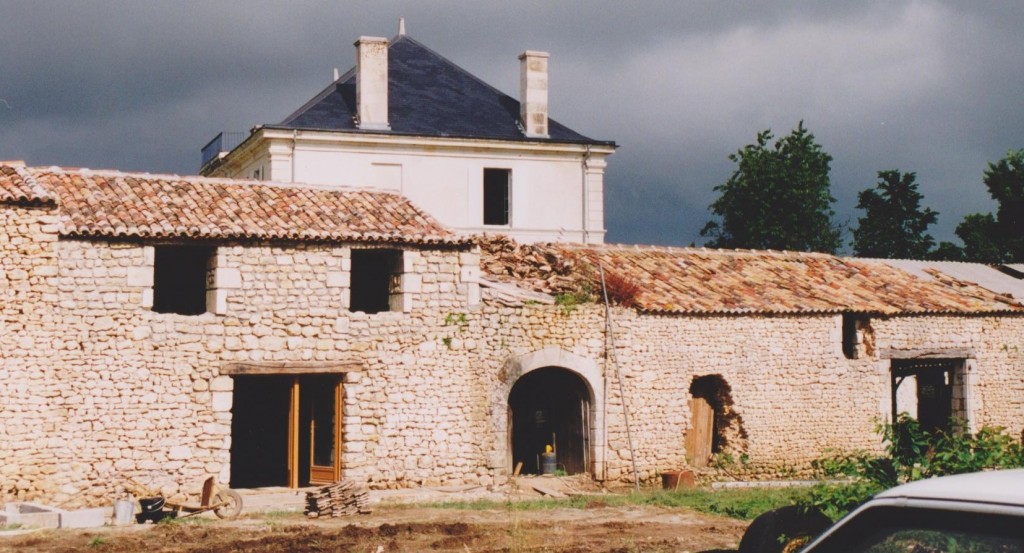
Thundery-looking day that spring. A large part of the roof re-done and the exterior stonework cleaned up. I see there is a new door-frame in place (cottage 5), though none of the windows are in.  Mud and/or dirt everywhere.  When Jake and I were finally able to clear up the grounds, the cigarette ends alone filled a bucket or two despite my constantly asking the men to dispose of their butts properly.  
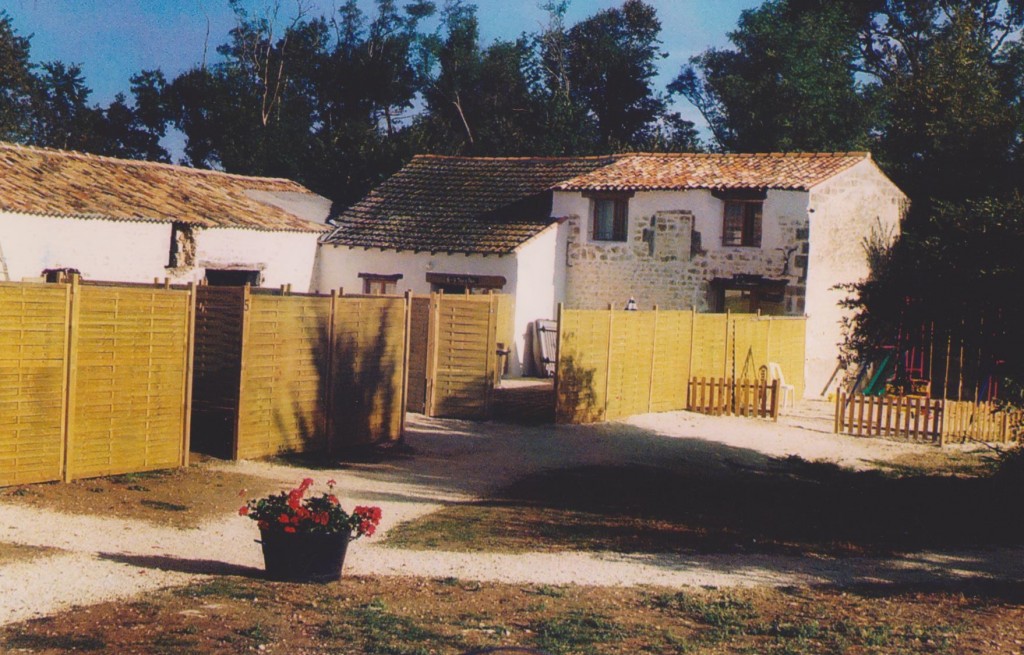
gites B 001  Ready for occupation. We made a mistake with that fencing, and once guest said it looked like pig-pens!!!  We cut them down to a better height the following year.  No grass - just scrub really.  It is interesting to look at this picture now when the trees we planted along the fencing have all grown up and the hollyhocks provide splashes of colour all summer long.  It was so bare then.
I opted for either yellow, orange or green everywhere downstairs and blue in the bedrooms.  All crockery had to be easily replaced, bearing breakages in mind, and for the same reason had to be cheap.  The cuttlery suffered from Yuri Gellar syndrome but - despite its flexible abilities - it is still going strong to this day.  Saucepans and bowls, bottle openers and kitchen implements, bins and doormats ... it is amazing how much we had to buy.
The furniture was inexpensive flat-pack pine - much to the fury of the men when they realized it all needed to be assembled.  Amid a hearty mix of grumbles and laughter, they cracked on with it.  William did a lot of it himself ... he'd have been 16 I think.  He was a brilliant help.  Sun loungers, garden furniture, parasols.  Pots of geraniums, curtains, tea towels. Bedding!  That first year - in fact for the first three years I seem to recall - the sheets, towels and pillow cases were all bought in charity shops when we were in the UK, and were an extraordinary mixture of colours and patterns.  It was all we could afford.  When guests arrived they were somewhat taken aback, but very few minded.
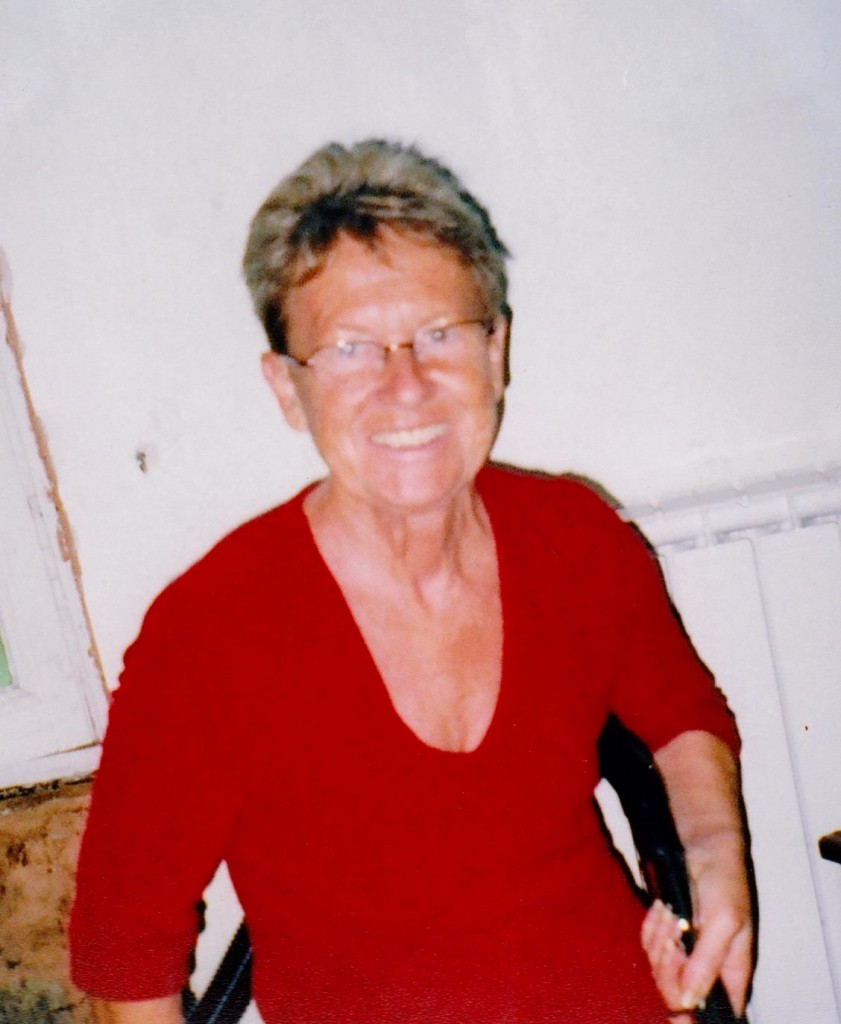
francoise 001  The first few years were incredibly hard work. With little money to spare I did all the cleaning of the cottages and Francoise (here, in red) did the Chateau.  Gosh, she was a tough little thing, tough as nails, hard working and strong even though she was small.  We went hell-bent-for-leather on changeover days.  During the week all the bedding had to be washed and ironed, regardless of the weather.  Nowadays I have an entire batallion of cleaning and outdoor staff and I farm-out the laundry.  But those first few years it was extraordinarily hard work.  But fun.  Lucrative fun.
The last cottage was ready just half an hour or so before the guests arrived.  The previous night we had worked till very late, painting walls, assembling furniture, putting curtains and pictures up.  We decided the simplest thing was to sleep in there and I stained and varnished the staircase as I worked my way backwards upstairs.  In the morning they were still sticky and I used a hair dryer to dry them off!
People could see we were working very hard.  The weather was great and the beach not far, so most guests were satisfied.  That first year there was just one woman who complained - I hadn't thought of coat hangers and she made a major issue out of it.   It is a pity when people make an issue over something small for it sort-of devalues any other issues that may crop up.  Oddly enough it is always the same type of person too.
At the end of that first week we stood in the darkening grounds one evening and looked at the lights in the pool and the barbeques sizzling in the little individual gardens, and listened to the low drone of voices of people as they cooked their meals and talked about their day ... and we felt proud.  Very proud indeed.

Part 21 to follow
 Catherine Broughton is a novelist. Her books are available on Amazon/Kindle or can be ordered from most stores & libraries.

mardi 29 octobre 2013

It happened like this...an English family moves to France. Part 8


  • William in his home-made go-cart.  Although he was only 11, he wrote an article about it which got published in an engineering magazine.

The land tax office

The letter stated, quite simply, that we owed this huge sum of money and that it should have been paid at the time of the purchase.
I phoned the appropriate office but the person at the other end of the line had no idea what I was talking about and the reference number on the letter didn’t seem to help.  In fact, she said the reference was nonsensicle, even though I read it out carefully two or three times.  She suggested I phone back later, which I did, but that didn’t seem to make any difference.  We went through the same introductions and I finally asked her why she had suggested I phone back later ?
The British Consulate had once given me a good tip – always ask for the person in charge because a) it makes the one who answered your call jump to attention (his words) and b) the person in charge likes to feel s/he is indeed In Charge and does his/her best to have the appropriate information for you.   Thus I was eventually passed on to somebody else (ne quittez pas!) who then passed me on to The Man Who Had Signed The Letter.  All this took ages, and I waited through a variety of tunes, to include the inevitable Green Sleeves.
When The Man came on the line, he explained to me that an “agent” had seen the house and it was clearly worth a great deal more than the 350 000 francs (£30K) we had paid for it.   (Somebody had been round to spy ?!!)
“I should hope it is!” I exclaimed, “we have done a great deal of work on it!”
“At the price you paid, it would mean it was a ruin when you bought it,” replied the man dryly.
“It was!” I said crossly, “it was a ruin and we have done it up, and now it is worth a great deal more!”
“Nobody can do that amount of work in so short a time,” he replied with a sigh of impatience.
“Well we did!”
I made an appointment to see him.  He was off on holiday and couldn’t see me till he got back, three weeks hence.  It was maddening.

  • In my brother-in-law’s microlite on a nearby air field.

Frais de notaire

I knew what had happened and had, in fact, dealt with a similar problem for one of my clients earlier that year.  You see, when you buy a property in France, you pay what are usually referred to as les frais de notaire.  This is a misnomer because only a fraction of the fee goes to the notaire; the rest are government taxes, like land tax in the UK.  These taxes depend on the value of the property.  Because Primrose was now worth considerably more than 350 000 francs, the powers that be, in their wisdom, decided that we had given cash to the vendor and only allowed the 350 000 francs to appear on paper, thus saving us thousands in land taxes.  In small village communities and with a people who don’t move house very often, this was quite possibly fairly common practice.  With computerization I expect all this kind of shinnannigans is impossible now, but when you consider that the local notaire was quite plausibly the brother of the buyer or the vendor, or the godparent or something … it doubtless happened more that the authorities cared to admit.
Anyway, it had not happened with us.
Irritated and, of course, concerned, I waited for The Man’s holiday to expire.  We still had the Court case for the Carte Professionelle hanging over us, work to be seen to, irritations and upsets with clients, the children to raise, stuff … you know how it is.  We led busy, active lives.

Emmaus

Finally, armed with a mercifully huge collection of before-and-after photos, I went to see The Man. The office was near the station in Rochefort close to an Emmaus which has since closed down – a pity because it was really good.  To this day the Emmaus in St Agnant, in aid of the homeless, is one of my favourite afternoons out – I love bric-a-brac and old furniture and what other people consider junk.  Nowadays, however, you can only rarely pick up real goodies for a song because, like charity shops in the UK, an expert comes in to value things.  But if you have got an eye for possibilities, it is a fun place to go.  As far as I am aware it is the only charity shop in France – but I may be wrong about that.  Emmaus is Biblical –  it is the name of a hamlet just outside Jerusalem, and a couple of pilgrims saw Jesus there, after Jesus had died.  It features in the gospel of St Luke.

The history of Art is my totally favourite subject; this painting is by Caravaggio, dated 1601, and named The Supper in Emmaus.  It is a lovely example if chia oscuro, ie use of light and shade.
Anyway, I diverge …  I made my way to the appropriate room, up a flight of tiled steps and in to a spacious office overlooking the railway.  There I was greeted by a pleasant-looking man in his forties.  He wore half-moon glasses.  An enormous weariness came over me and I flopped in to a chair without being asked and flung, perhaps a tickle rudely, the photos down on to the desk.  He raised an eyebrow at me.
“I am terribly tired,” I said, and I was.
He didn’t respond.  He probably thought he had misheard.. . or perhaps he thought it was something English women say, the way the French say “bonjour” and kiss each other.  Perhaps all English women sit without being asked and announce whether they are tired or not.
He picked up the packet and tipped the contents out on to his desk.  He looked through the pictures with genuine interest and, to my surprise, said (but in French):
“Yes, I have heard that les anglais are very good at restoring our old properties …”

  • The larger of the two  guest rooms.  It was on the ground floor and boasted double doors on two sides, one out to the courtyard and the other to the woods.  When we bought the house an underground stream had seeped up through the floor, which had half an inch of muddy water on it almost all the time.  Bruce, with his habitual savoir-faire, dug a trench to divert the stream; it took a long while to get rid of the overall damp smell.  After a year we moved the beds so that we could make a doorway on that far wall, and that led through to a bathroom.  The bathroom was originally a disused bread-oven – you’d be amazed at how big the inside of a bread oven is!
He flicked through the photos, occasionally asking a question, and was quite interested in which room was which, how we had repaired the staircase, did I think the staircase was original, and he was so glad we’d kept the fleur-de-lys floor tiles in the hall … and so on.  He said he’d love a house like that but that his wife would never agree to living in such an isolated spot.
“It was nonetheless exceptionally cheap,” he said finally, putting the photos to one side.
“You are not telling me that one is not allowed to do a good deal in France, are you?!” I asked.
He smiled.
“No, of course not …”
He handed the photos over to me and told me he would reach his final decision in due course.  And that was the end of the interview.  I wanted to thump my fist on the table and yell … but I just smiled and left … as one does.
About six weeks later a letter arrived from The Man, telling me that all charges were dropped and that we had nothing to pay.
“I could have told you that for free!” I shouted in to the empty room.

  • We took on the kind of projects that most people shied away from.  We were both very good at it. In the early days I would sometimes help with carrying buckets of cement and shovelling rubble, but I haven’t gone anywhere near that sort of thing for years now – and don’t intend to!  I can’t remember this man’s name … Jean-Something I expect.

The Tribunal

We finally appeared in Court about a year after the gendarme episode.  It had eaten at me almost constantly, and I had been veering from panic about going to prison to what-fun-going-to-prison-how-jolly-interesting-that’ll-be!  Most of the time that inbred positivity remained with me and I didn’t think for one moment I would go to prison or anything like it.  In fact, in many ways most of me just considered the whole thing massively tedious at a time when I already had too much to do.
I don’t know what I expected once I got in to the Court room – if I had expected anything at all – but one thing that did strike me was that, as each person’s turn came round, there was no notable calling-out of the name: Dupont v. Renaud!  That sort of thing.  Names of people, banks, businesses or whatever were sort-of half-mumbled by somebody sitting at the judge’s table, so when our turn came I had no idea we had started till I saw Vincent, our dear little lawyer, stand up and point to me.
 I couldn’t hear much of what was being said and Bruce couldn’t understand much of what was being said.  It seemed to be a fairly casual sort of conversation and, finally, I saw Vincent smile and he came over to us and said we should follow him out.  Gosh, thought I, are they going to put hand-cuffs on me?  I wished I had brought a camera.
But no.  Nothing quite so dramatic.  Vincent explained that I had been given two days’ suspended sentence.  And that was the end of that.  That was simply the end of that.  It made me really cross. I wanted to storm back in to the judge and shout “after all this TRAUMA, all these months of waiting, all you can manage is 2 days’ suspended sentence ?!!!!!!!!!!!!!!!   What an insult !”

  • ile de Re, near Ste Maire

The Ile de Re

We went off to the Ile de Re camping that week-end.  We lay on the beach with the children, and we splashed in the cold Atlantic waters.  We tried to wash it all away in the sea and bask it all away in the sun.  In the evenings we almost always ate out, overlooking the little port at St Martin or the little place at Ste Marie.  We cycled for miles and miles, along the pistes cyclistes that wound past the beaches, through the marais and in and out of the villages.  Miles of cycling.   I needed to work it out of me somehow; I was furious, relieved, stunned, weepy ….I saw a young man bareback on a huge shire horse.  I saw fishing boats pulling lobsters in.  I saw my children play on the sand.   I watched the sun drop over the horizon to the places where I was born and had lived. I listened to the waves splashing on the beach all night.
I felt it was time to move on.
Join Catherine on Facebook: https://www.facebook.com/catherinebroughton2
Catherine Broughton is a novelist, a poet and an artist. Her books are available of Amazon/Kindle worldwide or can be ordered from most leading book stores and libraries.  They are also available as e-books on this site.
- See more at: http://www.turquoisemoon.co.uk/blog/it-happened-like-this-an-english-family-move-to-france-part-8/#sthash.dVkZA1da.dpuf


lundi 12 août 2013

People in my books: Knooden


A large, heavy-set man, Knooden was honest and hard-working to the core.  Salt of the earth.  An uncomplaining, staight-forward man.  What you see is what you get.  He expected no truck with people and few people had reason to give him any.  He knew everybody and everybody knew him.
His mother had tried to send him to school when he was a boy, but he had bunked off almost every day, preferring to join his dad fishing – and his dad preferred it too, for there were a great many mouthes to feed.  He could write his name in a crooked, unsure way, and he recognized some of the letters and numbers he saw around him.  But he had no reason to read or count, he managed fine as he was.  He was sharp. No fool.  He saw things. Heard things. He knew stuff.
He chewed a bitter fruit he called a valledi.  It looked slightly like a large sycamore pod, and left Knoorden’s teeth yellow.  He barely ever changed his clothes and, indeed, owned only two or three T-shirts and shorts. He was always barefoot and had huge, flat feet with the soles like elephant hide. His hands were like great hams, tough as timber, calloused and covered in dozens of small scars.  His large jaw and small, sharp eyes, gave him a slightly dog-like look that was not unpleasant.  As a young man he had been considered good-looking by the local island girls.  He was not interested in that, however, but took a wife when he was nineteen and fathered a great many children.   He had a lot of siblings of his own, and his family stretched over the island, and over neighbouring islands, over five hundred of them in all, and all of them loyal to their elders. That was just as well under the circumstances.

Extract from “French Sand” by Catherine Broughton, a novel set in the South Pacific:-

“Which reminds me,” Melanie pulled her bag out from under the desk and took out some cash which she gave to Mat. “Your pay to date,” she said.
“You know where would be a good idea for you to go ?” asked Mat as he stuffed the notes in to a pocket. “The prison. No harm in it. You just say you want to see Delahaye – give the real reason if they ask you.”
Melanie thought for a moment.
“As you say – why not ? There’s nothing to lose and we might learn something.”
Noumea’s prison was situated next to the police station in the centre of the oldest part of the town. Looking at the sombre walls, it must have been one of the first buildings ever erected on the island. There were only seven cells. Tricot was not there, but Melanie was seen aimiably enough by a gendarme calling himself Berton. He explained that prisoners sentenced to more than five years generally got transferred out of Noumea to a more secure prison in Mayotte.
And that Delahaye was one of the men who was to be transferred. He had served only six weeks of an eight-year sentence. Berton didn’t ask why Melanie wanted to see Delahaye, but escorted her through the office rooms at the back of the gendarmerie and out in to a large courtyard walled-in with very high stone walling and barbed wire. Despite the heat, Melanie shuddered. Inside the prison block her eyes took a few moments to accustom to the sudden darkness. There was a strong smell of urine and black tobacco. The gendarme stopped at a cell on the left. A noise that sounded like some kind of snorting came from the cell beyond, which told her that only one other seemed to be occupied.
“Debout!” ordered the Berton in to a small dark window cut in to the door, “you have a visitor.”
There was a sudden rush of movement from within the cell and Melanie could hear feet shuffling rapidly along the stone floor.
“No, it’s not your wife! But it’s a lady, so be polite.”
Berton opened the heavy wooden door, beyond which was a set of bars.
Delahaye’s face appeared. Berton stepped to one side, his back to the wall, and indicated with his head that Melanie could speak. She had hoped he’d go away. Looking at Delahaye, his face expressionless, she saw a man in his early forties, his skin thick with sweat and grime that had mixed together, unwashed, for six weeks. His eyes behind the spectacles were dull and looked – hunted. His eyes in the newspaper had been those of a criminal – these eyes were those of a man whose life had been shattered. Melanie held up her photo of Greg.
“Do you know this man?” she asked bluntly.
“He’s dead,” replied Delahaye.
“I know. He was my husband. How did you know him? It is important.”
Catherine Broughton is a novelist, a poet and an artist.  Her books are available from Amazon/Kindle or can be ordered from most leading book stores and libraries.  They can also be ordered as e-books from this site:-
https://payhip.com/b/tEva    “A Call from France”
https://payhip.com/b/OTiQ    ”French Sand”
https://payhip.com/b/BLkF    “The Man with Green Fingers”
https://payhip.com/b/1Ghq    “Saying Nothing”
“French Sand” from Amazon:-
For more about New Caledonia:-
- See more at: http://www.turquoisemoon.co.uk/blog/people-in-my-books-knooden/#sthash.Qlbgubk2.dpuf

mercredi 7 août 2013

People in my books: Ignacio


Marie-Carmen’s father said she quite simply fell in love with the first handsome young man that walked in the door.  And there was some truth in that. Not that he minded. Better by far that she fall in love – and marry – a young man who was in the right place at the right time, than leave things to chance. As it was his life was too full of chances.  Every step he took, every corner he turned, was another risk, another inch to where he shouldn’t be.
Ignacio was the new chief of police at Lima Police Headquarters, young for the post, strong, highly intelligent, sharp, fundamentally honest – and ruthless when he needed to be.  We was a good man, would be good to Marie-Carmen, loved her too. What more could a father ask?
Ignacio saw through it all at an early stage.  The wealthy businessman he found as his father-in-law was already well-known and linked to a great many dark dealings. But that was OK, for it was the case with the vast majority of wealthy people at that time, Ignacio included.  He was a multi-millionaire in his own right and didn’t care to question where his money – all inherited – had originated.  He adored Marie-Carmen.  Ten years older than she, she was like a fluttering bird his his arms, a porcelaine, white, silken beauty, untouched by another man.
He badly wanted to create a new world for his country, for her, for all of them.
He also knew, from an early stage, that it would probably all go wrong.  Unless he was exceptionally lucky, outstandingly smart, unless he could outwit and outrun the sharpest of the sharp, they would come to grief.  Perhaps the mistake that he made … if it was a mistake … was that, although he was strong, both mentally and physically, he was not as strong as he thought.
Extract from “Saying Nothing”, a novel set in Spain, by Catherine Broughton:-
Marie-Carmen tipped forwards slightly on the back seat as the taxi driver swore under his breath and halted at the San Pedro junction.  It was most unusual these days to see a donkey and cart on the road, and this donkey and cart trundled along slowly slap bang in the centre of the road. The driver’s head, even from behind, looked proudly defiant.  In front of it was a tractor.  Both looked totally incongruous on the paved and palm-lined streets.   Farms in the hills were common enough, and to see farm workers here on the coast took the local people back to the old days, and some old folk stood and watched, nodding to themselves as they remembered the times fifty years ago.
“It ought to be forbidden!” spat the taxi driver.
“He has to go somewhere,” said Marie-Carmen reasonably, remembering  that she was to speak in English only.
“Well, he should go some other time – not at peak traffic time!”
The driver was bordering on rude but Marie-Carmen was aware that the rudeness was not directed at her.  Of course, she reflected, he wastes his time sitting behind a donkey.  She had never worked.  Her mother had never worked.  In fact, it was slightly shocking to think of her mother working!  Both Ignacio and her father had always been involved in politics and the police.
She watched silently as the taxi driver waited for his moment to overtake.  He revved the engine up, impatient, slipped into first, second, then back into neutral with another little expletive under his breath.  The man with the donkey seemed not to notice, or, if he did, he didn’t care.  The sun beat down onto the top of the tattered straw hat he wore, and he sat hunched forward over the reins, making little clicking sounds with his tongue.
Looking out of the rear window, Marie-Carmen saw that a line of cars was building up behind them, with another line moving in, hooting now, from the right which led up to Estepona.  In the other direction, traffic was moving swiftly and it was impossible to overtake.
The driver growled that they would be late in Malaga.
“No importa,” she replied – ‘it doesn’t matter’.
To her left people sat drinking at a pavement cafe, watching with mild interest the fracas that was building up at the junction.  A couple of drivers leaned out of their car windows to shout at the man with the donkey.  She longed for a cold juice.
In Peru, they often – almost always – carried cold water in an “eski” in the boot.  Prisca used to put it there.  Of course, there were not the bars and cafes where one could stop so easily and more often than not tap water couldn’t be drunk anyway.  She remembered her mother was always dubious about eating or drinking anywhere other than at home, though standards had improved, of course, and in recent years there was a really attractive place on the paseo where they would often stop for a coffee.
Marie-Carmen gazed absent-mindedly out of the taxi window, her eyes scanning lightly the brown mountains against the blue sky; there were little white farmhouses dotted in the hills, just visible beyond the buildings of San Pedro.  Tall palms waved lightly in the sea breeze and she noted vaguely that there were no seagulls – she had disliked intensely the squawking, screeching cries of the seagulls in Brighton.  When was that?  Months ago now, a day trip while they were staying in London.
In some ways she’d have liked to go somewhere rather more sophisticated than the south of Spain.  New York, Manhattan would have been great!  They had friends in Manhattan.  Wow, the Americans know how to do it!  Paris, perhaps, or London, Vienna, but Ignacio was right, they could mingle in here with no trouble; they were not discernible in these crowds.
Beyond the bar, a man came out of a small side street where she could see the police station.
For e-books click below:-
https://payhip.com/b/tEva    “A Call from France”
https://payhip.com/b/OTiQ    ”French Sand”
https://payhip.com/b/BLkF    “The Man with Green Fingers”
https://payhip.com/b/1Ghq    “Saying Nothing”
From Amazon/Kindle click below:-
- See more at: http://www.turquoisemoon.co.uk/blog/people-in-my-books-ignacio/#sthash.plDdvGnV.dpuf

lundi 5 août 2013

People in my books: Greg


Greg was a man’s man.  He liked boats, engines, tractors, fishing nets, wet and oily things.  He was serious, but brilliant at telling a joke.  He was hard-working but enjoyed a couple of drinks with his friends.  He was honest, but open to ideas for making a quick buck.  The cold didn’t bother him and he had spent many an hour working on a car engine in some frozen Sussex garage in the depths of an English winter.  Likewise the heat didn’t bother him and he was totally at home under the South Pacific sun at the hottest time of the day.  He didn’t burn, he enjoyed working up a thirst. Mosquitoes droning around his head at night didn’t bother him.  It would never have occurred to him to be afraid of a snake … or a dog … or a shark.

Tall, strong and good-looking, he had had plenty of girl friends.  But when Melanie announced she was pregnant, he married her with no hesitation, the way one did in those days.  He accepted his lot reasonably graciously, barely noticed the advancing pregnancy except when he wanted to have sex with his wife, and was most certainly no where near the hospital at the time of the birth.

Baby matters were no concern of his, but he was proud of his little son and, asked if he loved him would have said yes, of course.  Or perhaps he’d have felt awkward and said that he didn’t go in for all that lovey-dovey stuff.  It was way too late in the day when he realized just how much he loved Melanie and the child. Way too late.

- See more at: http://www.turquoisemoon.co.uk/blog/people-in-my-books-greg-2/#sthash.r5z6PH4S.dpuf

mardi 30 juillet 2013

People in my books: Mana-oua-oua

Born and raised on the island, Mana-oua-oua (meaning seagull) was an unaffected, straight-forward girl with no particular aspirations except to be good, honest, and to one day marry and have children.  It was all she wanted in life and, although the cinema had come to Noumea and she sometimes saw posters for films and pictures in discarded magazines, she had no wish to be anybody other than the person she already was.
And that was a nice person.  She was good-looking in the Polynesian way, slender, slightly coy, with a quiet but self-assured voice.  She spoke French fairly well and had a good smattering of simple English, but she did not regard these attributes as anything other than the norm.   Like most islanders she was slow-moving, never rushed, uncomplaining.  A small smile invariably played about her mouth and she had smooth coffee skin which she treated with palm oil as her mother and her grandmother had done before her.
Mana did own some European-style clothes.  There was a yellow cotton frock that she had bought in the second-hand stall in the market, also a skirt and blouse.  She saved these items for best but, if asked, she would have been unable to tell you what “best” was all about.  She was almost always dressed in a lava-lava, and she had some twenty or even thirty of these, which were shared with her sisters and other close female relatives.  When at home she wore the lava-lava around her waist, and when she stepped outside she hoisted it up under her arms.  She was always barefoot.
When Greg stepped in to her life he brought trouble with him.  She supposed she loved him, but knew automatically and instinctively that he was not for her.  He was a different league … not necessarily a better league, but a different one … and she looked forward, in her uncomplicated way, to meeting an island boy to marry.  But first, there was the problem of Greg.
- See more at: http://www.turquoisemoon.co.uk/blog/people-in-my-books-mana-oua-oua/#sthash.XKfrGLXl.dpuf

lundi 15 juillet 2013

People in my books: Kirsty


Kirsty was in her early-to-mid twenties, a post graduate with a degree in English.  She moved to Cyprus with Tom, also an English graduate and, like him, had been to some minor Uni somewhere in the Midlands.
She was a clever enough girl, but no intellectual.  She had acheived her degree simply by reading and writing the right stuff and, like her fellow post grads that hailed from the same – and similar – places, had no proper knowledge or understanding of English literature apart from the books that had been studied on her course.
But that was okay. She was sharp enough to know that it was a mediocre qualification and bright enough to know that, for her at any rate,  it really didn’t matter that much.  She claimed that most teachers were over-paid and over-qualified, but she had the good sense to enjoy the long school holidays and the relatively short hours without questioning too many issues.
She was pretty in a straight-forward and uncomplicated sort of way. She had a lovely figure and a natural manner.  She had a ready smile and was kind.  More than anything, she loved Tom.  She knew it wouldn’t last, and in some ways she broke her heart over it. She befriended Stella mostly because she felt sorry for her – Stella was a fish out of water and – worse – would be a fish out of water wherever she went and whatever she did.  Stella was one of those awkward people, a tall gangly woman who desperately wanted to fit in and to be feminine.  And Kirsty felt genuinely sorry for her.
When the police came to her door it all became obvious, appallingly obvious, but at the time, it hadn’t occured to her …
Extract from “The Man with Green Fingers”:-

It had all been so easy, so amazingly easy.
Stella stretched luxuriously. Well, of course, not many people would have been able to do it. Very few would have known where to even begin. So from that point of view it was ridiculous to say it had been so easy. In fact, it had taken six months, slightly more. The planning had been meticulous. Every angle of every possibility was studied. Every scenario examined. She had had to be absolutely certain, could risk nothing.
And she had pulled it off. Brilliant. Quite simply, she was brilliant. She lay back in her chair, her head resting against the wall behind her, and closed her eyes against the sun. She could hear the small movements of a bird on the roof and the background sounds of the city beyond the confines of her yard walls. A satisfied smile crossed her face. She would rest here a while, then have a beer or two before changing her clothes and wandering back out in to the town. These little sorties were almost daily and never ceased to send a thrill of anticipation through her. The entertainment value of it was massive. She was aware that one day it would quite possibly pale and become boring, but for now it was hilarious and she loved it.
The shrill ringing of her telephone jolted her upright. She pressed her hands on to her knees as she rose and, her feet bare on the scorching brickwork underfoot, she went rapidly indoors and picked up the receiver.
“Hello?” she said in English.
“Stella – it’s Kirsty!” Kirsty had a delightful way of putting a touch of excitement in to her voice…

Catherine Broughton is a novelist, a poet and an artist.  Her books are available from Amazon/Kindle or can be ordered from most leading books stores and libraries.  You can also buy them as e-books by clicking on the links below:-
Posted by Catherine Broughton on 14 July 2013
- See more at: http://www.turquoisemoon.co.uk/blog/people-in-my-books-kirsty/#sthash.JB6Orf48.dpuf