Affichage des articles dont le libellé est cottage. Afficher tous les articles

samedi 14 décembre 2013

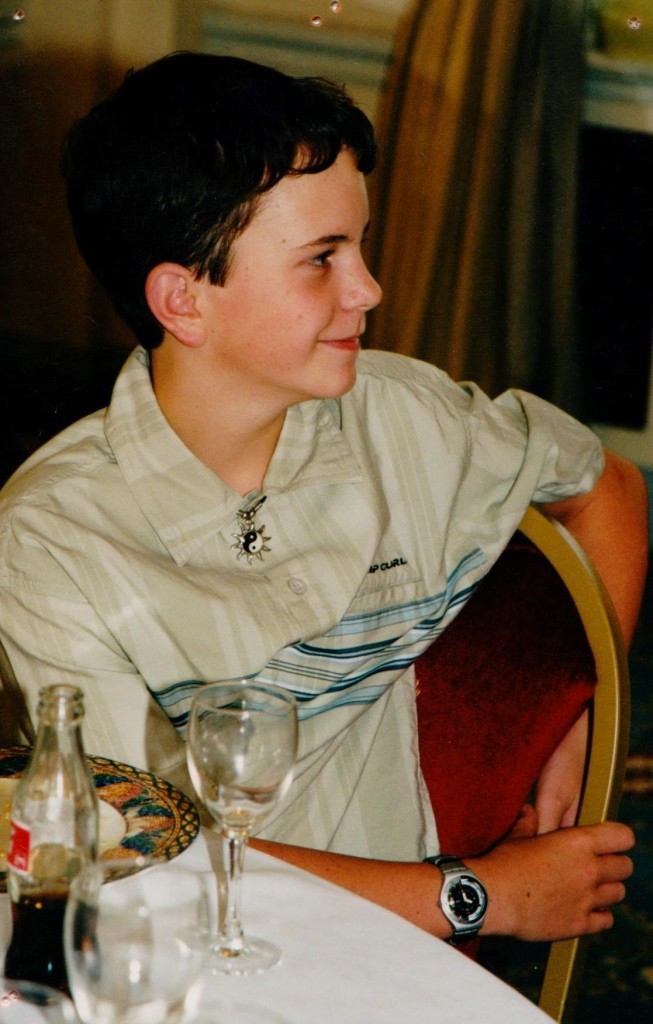
jakey 001  Jake when he was about 10.
The children were growing up.  The elder two caused that usual adolescant mixture of joy and fury, temper and sulks, utter and complete selfishness and sudden and unexpected spurts of kindness and cooperation.  And more.  Much more.  I won't say those years were "normal" because they weren't, and some of the events took me years to recover from - in fact, were the greatest tests of my life - but I have written a whole book about it and I won't go in to it here.
I continued with my rounds of the banks. Phoned to see if they had got an answer for me, phoned the next one, then the next.  I saw a financier in La Rochelle who put far more energy in to trying to (unsuccesfully!) get me in to bed with him than dealing with my dossier, and another on the island here who told me that no bank anywhere in the world was ever going to loan anybody such a massive sum.
"It's not a massive sum!" I wailed, "it is the price of a very ordinary house in England!"
"But this is France," he replied with a logic that was infuriating.

Money laundering

My father put up some money so that we could continue with the work.   It was now March.  The first signs of spring were arriving and, if we didn't start to advertise the cottage holiday lets very soon, we would miss the season altogether.  And then another year would go by.  I was beside myself.  We owed so much money to the men, to my father, to the suppliers, and to our very selves.  We had to get this loan one way or another and we even travelled to Paris to see a north African gentleman who, we discovered, wanted to launder his money through us.
" Typical!" I spat. "At last we find somebody willing to put up the money - and he has to be a b....y criminal!"
My mother, bless her, trying to encourage me, said:
"Don't worry about your looks, my dear, they will come back once you can relax again."
Oh, thanks mummy!  I had no idea my looks had "gone" !
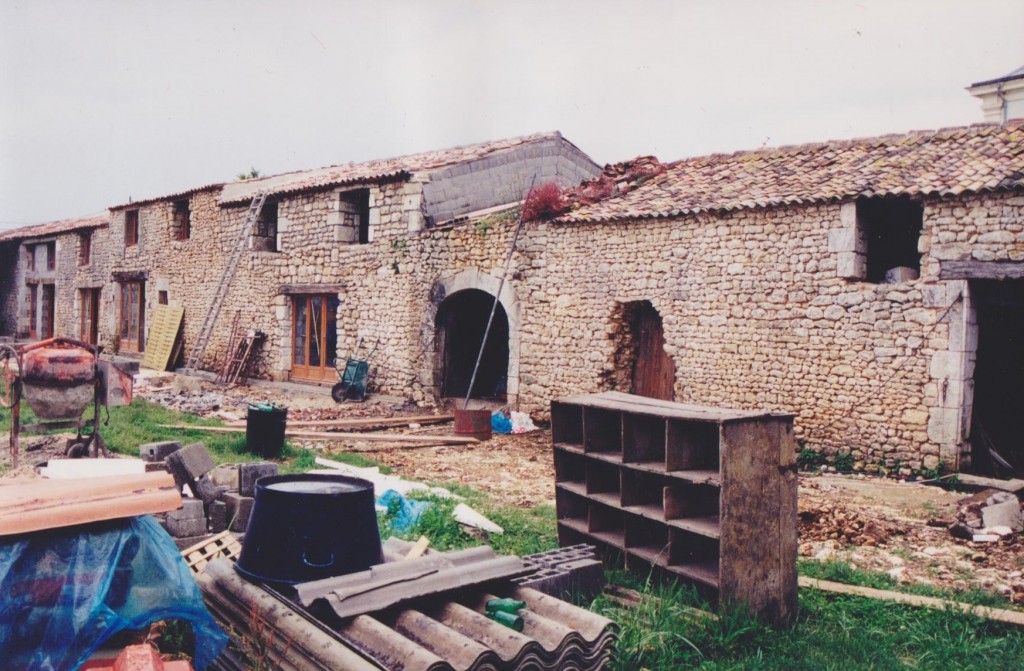
renov 3 001  The stone walls.  Each and every stone had to be picked around the joints so that it could be re-pointed, and then cleaned off.  This picture shows about two thirds of the extent of the walls - it was a labour-intensive job.  And just clearing away all the junk ! - there were mountains of it.
And it was that same week that at last we got the loan.  Of all the big nationwide banks I had applied to, and all the local banks, it was a small unheard-of bank in Rochefort.
We have never moved so fast.  We placed advertisements in the UK and very rapidly had bookings for all the cottages for the summer.  Internet was in its infancy and ads went in to glossy magazines.  The phone rang constantly.  We even rigged up a loudspeaker outside for the phone so that we could hear it ring and rush to deal with an enquiry.  We worked day and night, seven days a week, for three months.  And in those three months we created six cottages - floors, ceilings, roof, plumbing, wiring ... all of it, to include raising the roof in two places.

Major building work

There were two really very major works.  One was with the drainage because the land is solid rock.  I spent time phoning round to find the appropriate builder - they call that sort of work terrassement in France - you need to know this kind of stuff because you can waste hours and hours phoning the wrong people.  Initially a man said he would do it with a mini-digger.  He came round to look at the site, but Bruce told him he wouldn't be able to do it, the ground was far too hard. And sure enough the man couldn't and made only a five-minute attempt.   More time wasted. So Bruce hired a big compressor and two road drills - more phone calls, more trips in to town, more time - and it took 4 men 4 days to dig the trenches through solid rock.  We were amazingly lucky that there was mains drainage to connect to in the road that ran past.
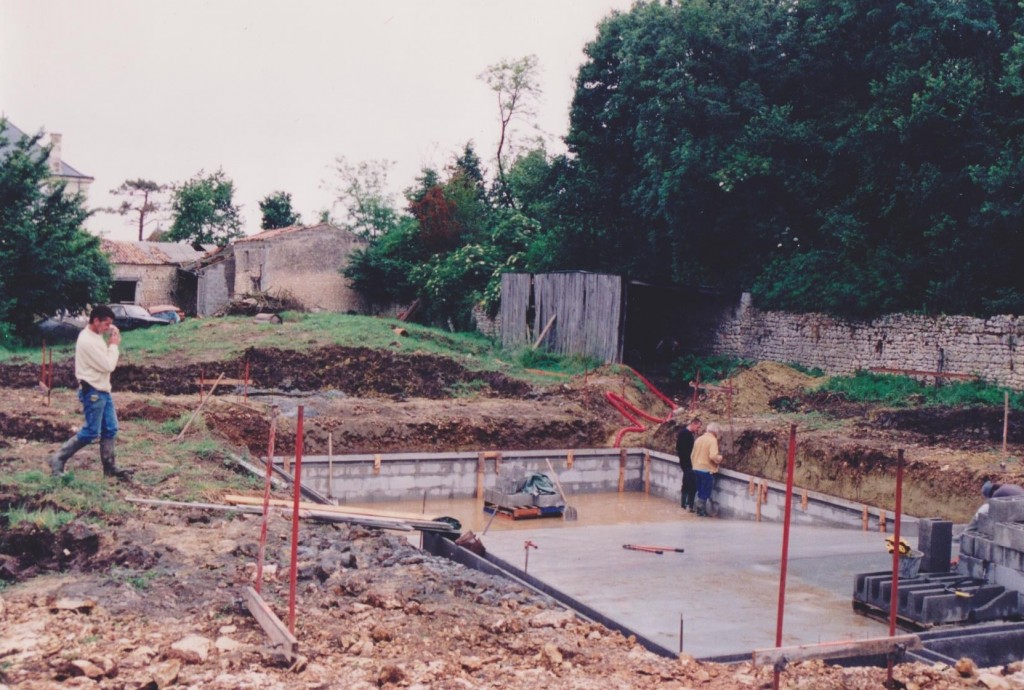
renov 4 001
 The pool on the cottage side, and also the one on the chateau side, are situated in the only two places in the entire property where there is no rock. When the first lot of guests arrived the pool wasn't quite ready.  Mercifully they all had that good old British stiff upper lip, and they just bore with us till, on the third day of their stay, we were able to fill the thing up with water.  It took an entire day and night to fill.  The "hill" the far side of the pool is, of course, simply the earth that was dug out.  It now has a children's fort on the top of it, built by regular holiday-makers.  Loads of things like the derlict shed behind and the broken wall to one side had to be left for several years till we could afford it.
The second major item was the pointing and rendering of the exterior walls - and some of the interior ones too.   It was a massive job and big old Michel had already started hacking out the old, blackened render.  We had thought we would do this ourselves but mercifully one of our labourers had a brother who had all the specialist equipment precisely for that.  It cost a huge amount and made a serious dent in our budget, but it was well worth it for it saved many weeks in time, plus a great deal of energy and hassle.   Actually, they were a really good team - from Saintes I seem to remember - who turned up promptly every morning and worked hard and fast till the job was done.
All roofs had to come off, already broken or otherwise,  to be insulated and then laid with  flexible waterproof material before putting the old Roman tiles ontop.
Inside partition walls that we built had a  timber frame, then laid with insualtion & plasterboard, incorporating wiring and  plumbing as we went.   I loathe glass fibre - it gets everywhere - in to your clothes and eyes, and it feels itchy and uncomfortable and the only solution is not only a shower but a complete change of clothes too.   The French call it "laine de verre", meaning glass wool.
Some weeks we had up to fifteen extra people on the site, to include Michel's daughter who came to help me make curtains, and Corinne, the gipsy I mentioned earlier with her little girls.  The little girls ran around the site playing in the debris.  I bought a second-hand buggy for the baby and carted her back and forth with me when Corinne couldn't.  We put table and chairs in what is now cottage 2, a fridge and an old cooker, so that the men could make coffee and eat as they wished.  While the weather remained cold they lit a fire on the floor, there in the middle of the derelict room.
These were good, fruitful, positive days.
ouitside of our barn 001  The corner barn with a huge hole in the roof became our home for several years till we were able to convert it.  We sort-of camped in there from April-ish to mid-September or so, when the Chateau became available again.  The Chateau lettings went very well, despite several initial mistakes, and it was almost always full.  
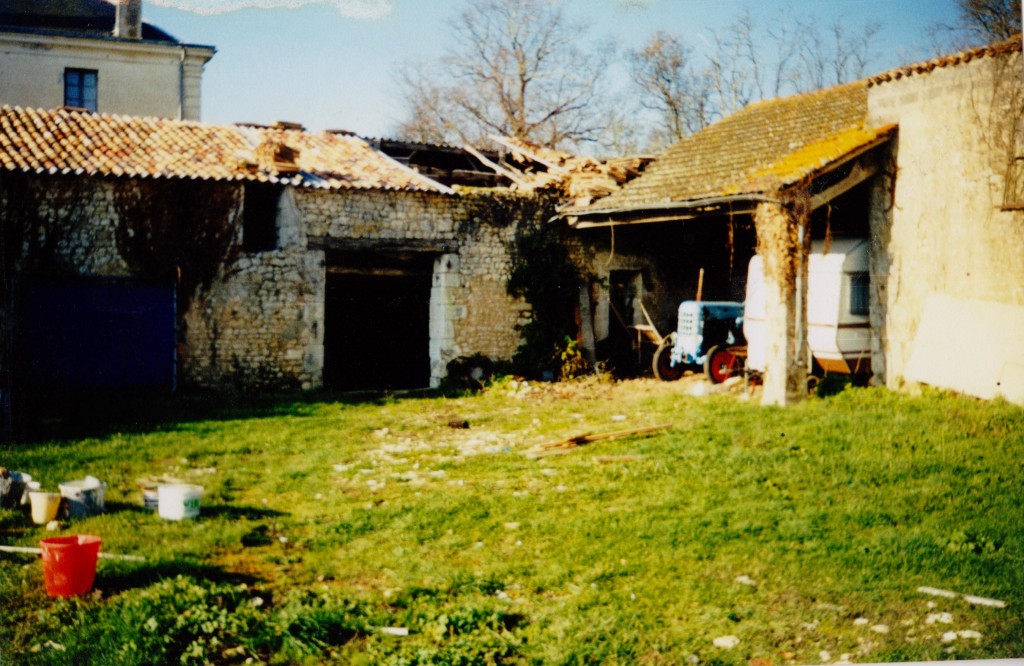
All around was beaten earth and that summer was extremely hot.  Jake and I flung grass seed down in all the little front gardens - too late realizing that one packet was wheat !! - and it is surprising how much of it took - both the grass and the wheat!  Grass is good stuff.  It grows in all sorts of places, hot or cold,  and survives all sorts of abuse.  I like grass.
Jake and I were also in charge of buying the wherewithall to furnish the cottages, and we dashed about after I had picked him up from school, frantically ordering beds and mattresses (you couldn't do things on line), dozens of cups and plates and pillows.  We had a Chrysler Grand Voyager at that time and we were able to pile a great deal in, Jake frequently balancing buckets and plants and curtain rails on his lap.  We would unload it in to one of the cottages, where it always got in the way of the workers, and dash back to the shop for the next load.  Back and forth, half an hour in each direction.  Sometimes things were delivered, but usually delivery was too expensive or - more importantly - too slow.
Jake was great company, a smiley, happy little guy who joined in all this activity with as much energy as I did.
Everything had to be inexpensive and serviceable; it also had to be easily replaced.  A year later a really good shop opened in a neighbouring village, where you can buy almost anything and everything needed for a holiday cottages - from teaspoons to floor tiles and more.  But at that time I had to drive to Royan or Saintes and make my way to the relatively few suitable stores there were.
wm on sofa 001

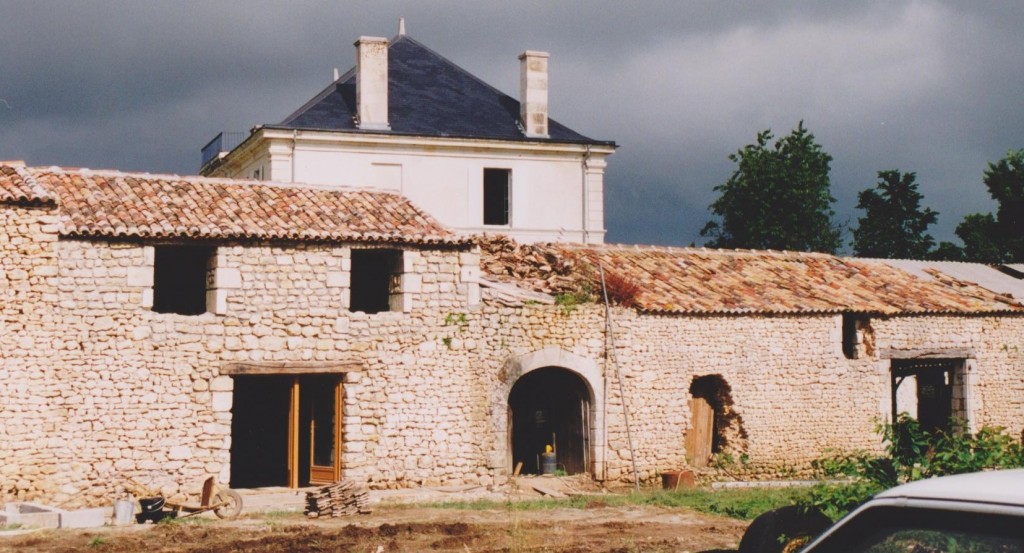
Thundery-looking day that spring. A large part of the roof re-done and the exterior stonework cleaned up. I see there is a new door-frame in place (cottage 5), though none of the windows are in.  Mud and/or dirt everywhere.  When Jake and I were finally able to clear up the grounds, the cigarette ends alone filled a bucket or two despite my constantly asking the men to dispose of their butts properly.  
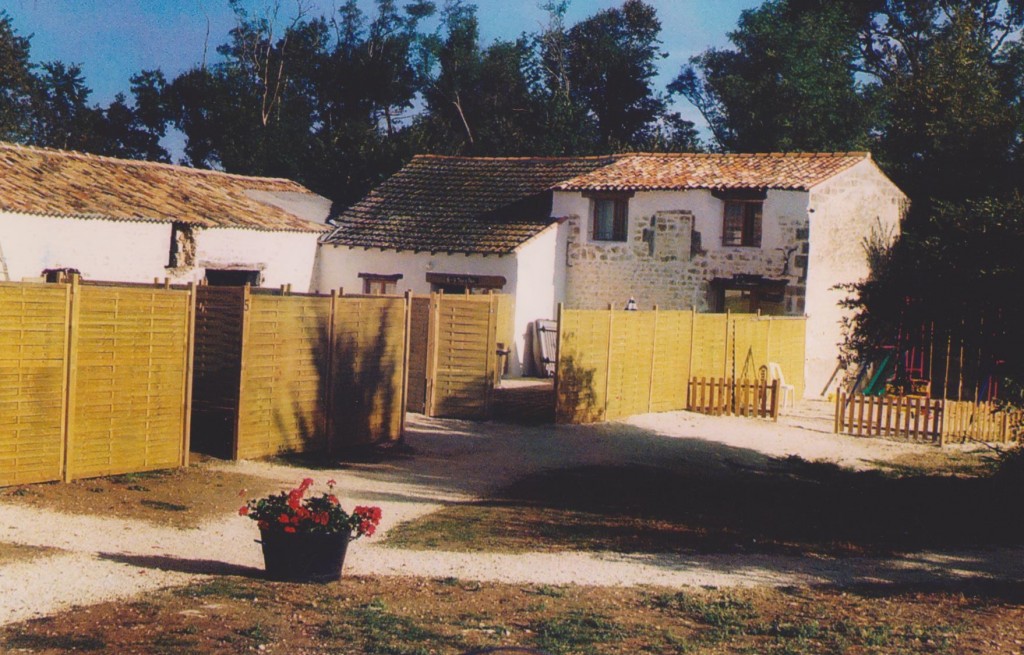
gites B 001  Ready for occupation. We made a mistake with that fencing, and once guest said it looked like pig-pens!!!  We cut them down to a better height the following year.  No grass - just scrub really.  It is interesting to look at this picture now when the trees we planted along the fencing have all grown up and the hollyhocks provide splashes of colour all summer long.  It was so bare then.
I opted for either yellow, orange or green everywhere downstairs and blue in the bedrooms.  All crockery had to be easily replaced, bearing breakages in mind, and for the same reason had to be cheap.  The cuttlery suffered from Yuri Gellar syndrome but - despite its flexible abilities - it is still going strong to this day.  Saucepans and bowls, bottle openers and kitchen implements, bins and doormats ... it is amazing how much we had to buy.
The furniture was inexpensive flat-pack pine - much to the fury of the men when they realized it all needed to be assembled.  Amid a hearty mix of grumbles and laughter, they cracked on with it.  William did a lot of it himself ... he'd have been 16 I think.  He was a brilliant help.  Sun loungers, garden furniture, parasols.  Pots of geraniums, curtains, tea towels. Bedding!  That first year - in fact for the first three years I seem to recall - the sheets, towels and pillow cases were all bought in charity shops when we were in the UK, and were an extraordinary mixture of colours and patterns.  It was all we could afford.  When guests arrived they were somewhat taken aback, but very few minded.
francoise 001  The first few years were incredibly hard work. With little money to spare I did all the cleaning of the cottages and Francoise (here, in red) did the Chateau.  Gosh, she was a tough little thing, tough as nails, hard working and strong even though she was small.  We went hell-bent-for-leather on changeover days.  During the week all the bedding had to be washed and ironed, regardless of the weather.  Nowadays I have an entire batallion of cleaning and outdoor staff and I farm-out the laundry.  But those first few years it was extraordinarily hard work.  But fun.  Lucrative fun.

The last cottage was ready just half an hour or so before the guests arrived.  The previous night we had worked till very late, painting walls, assembling furniture, putting curtains and pictures up.  We decided the simplest thing was to sleep in there and I stained and varnished the staircase as I worked my way backwards upstairs.  In the morning they were still sticky and I used a hair dryer to dry them off!
People could see we were working very hard.  The weather was great and the beach not far, so most guests were satisfied.  That first year there was just one woman who complained - I hadn't thought of coat hangers and she made a major issue out of it.   It is a pity when people make an issue over something small for it sort-of devalues any other issues that may crop up.  Oddly enough it is always the same type of person too.
At the end of that first week we stood in the darkening grounds one evening and looked at the lights in the pool and the barbeques sizzling in the little individual gardens, and listened to the low drone of voices of people as they cooked their meals and talked about their day ... and we felt proud.  Very proud indeed.

Part 21 to follow
 Catherine Broughton is a novelist. Her books are available on Amazon/Kindle or can be ordered from most stores & libraries.

mardi 5 novembre 2013

It happened like this...an English family moves to France. Part 14


Jake in the hall.  I can tell he is aged seven simply because his front teeth are missing!  That means this would have been after June 1996.  We moved in to the house in December 1995, and the photo shows electric wiring still being chased in to the walls and the floors thick with dust – those tiles are in fact a beautiful red-brown.  I think perhaps almost a year went by before I was able to start cleaning in any proper sense.  On the left you can see the staircase which is made of stone.  Some of the steps had worn so much that there were dips in the centre, making it easy to miss your footing.  Bruce filled these dips with an ingenious concrete mix, so that it looks just like the stone.
I enquired about teaching.  I had already made a few enquiries when we first moved to France, now six years ago, and had been told that my teaching qualifications from the UK were not valid in France.  Despite an evolving “Europe” this was still the case and I was disappointed because teaching, compared to running my own business, seemed like a doddle!   On the other hand I had become accustomed to earning significantly more money, and that had to be taken in to consideration too.  Indeed, as a teacher I would earn no where near enough to help us realize our ambitions.
But it was also really rather irritating.  Being allowed to teach would have been a quick and easy stop-gap, if only a temporary one.  I don’t know how English is taught in French schools nowadays, though I think it is taken seriously, but in those days it was abysmally badly taught, and both the elder children used to come home from school with giggling stories about how their teacher had pronounced this word or that, not to mention entire nonsensicle sentences.  Anyway, the local education authority didn’t want me, wouldn’t even try me, and I declared somewhat loudly that it was thier loss.
So another business it had to be.

Visitors from home.

Meanwhile visitors from home came and went.  The guest bedrooms, of which there were 4, were the last to be decorated of course, and they were in varying states of repair with odd assortments of furniture in them, as and when we came across something to put in them.  One of my brothers-in-law, Big-Andrew, so named because he is 6’6″, slept on a child’s mattress on the floor for some time.  My mother slept on an old iron army bed and, right in to old age, long after the house was totally restored and good furniture installed, she preferred that old army bed.

  • Big-Andrew is a sculptor, going by the name of Qadir.  He helped Jake make a model of George.  We kept it for years and years till, a bit at a time, a paw fell off, then an ear …
Visitors fell fairly neatly in to two categories – those who could cope and those who could not.   Or perhaps it is those who “get it” and those who don’t.  With a family such as ours was, it was essential to take us as you found us.  Dust, tools, planks, noise …. I remember some friends, Pete and Liz, who stayed a long week-end and who were really quite horrified at my odd assortment of crockery, not to mention the sheets I had rigged up at their bedroom window in lieu of curtains.  They were bemused and confused by the choices we made.  Things like faded old wallpaper hanging off the wall and broken window panes were the least of our concerns.  For several years my kitchen work surface was an old table, about 3′ x 2′ I suppose, with a small chunky drawer in the front.  In this I found a mouse with several new-born baby mice.  That sort of thing has never revolted me.  I’d rather not have mice, of course, but at that stage both the table and the house itself had been unused for a great many years, so the mouse thought she was in luck.  She had probably been nesting there for years.  I can’t remember what I did with them – I think I asked William to transport them somewhere more suitable.    The table turned out to be early 17th Century.  That mouse knew her antiques!
At week-ends we often set off with our bikes and our tents, though we soon progressed to a caravan.  Picnics (preferably not on the beach – I hate sand in my food!) and walks with George became a regular pass-time on our days off during the summer.  When you are working very very hard, and no matter how pressing the job in hand is, it is essential to not only take time off but to get right away from the work and do something totally different.

  •   The children growing up so fast!  Picnic at La Palmyre.  Our daughter, opening the picnic basket, already very tall.  I see I am holding a bottle of beer – I have never liked beer.  Perhaps I picked it up for the photo.

    • This became the dining room.  Pipes for the central heating running under the floor.  We would love to cover the floor with oak parquet, but it is such a huge area (65 sq metres) that our budget won’t stretch to it easily.  We had a fitted carpet over it for a long time but, what with three children + all their mates, a dog and all the building work, it was soon replaced by vinyl … yes, yes, heartbreaking, but there you have it …

    Buying property in France

    We decided to buy a second property in a nearby village called Corme Royale.  The aim was to let it.  At that time it was just another backwater, but sufficiently close to Saintes to attract lettings.  There was the inevitable boulangerie and a small post office – nothing else I think.  Like the other villages in the area it was grey and brown and dead.  But also like the other villages, it soon entered the appropriate century and got modernized and cleaned up.  Corme Royale is nowadays quite a sweet little town with all essential shops and an exceptionally good restaurant on the place there.
    We needed 100% loan from the bank plus the money to convert the building in to three self-contained flats.  The money for the building work would have to cover a “commission” for me and a good wage for Bruce and his team for doing the work.   We would then sell one flat to pay-off the bank and let out the other two.   It needed some careful calculations and some clever ducking and diving.  It was crucial that there was enough to live on immediately, crucial there was enough to pay for the building work, and crucial the building work be finished, advertisements placed and the property tenanted as quickly as possible.  Speed was of the essence because the first installment at the bank was only a month after the loan – and we couldn’t pay the first installment till we got a tenant … and we couldn’t get a tenant till the place was finished.  And so on.  This sort of juggling of figures and of situations was something I became very adept at.
    If we could pull this off – this would be the way forward.

  • The church of St Nazaire in Corme Royale was a damp and cavernous lump of masonry for a long time.  Nowadays you can see how pretty is this 12th Century church which was originally built as a monastry for Benedictine monks, attached to the Abbey Notre Dame in Saintes.
  • I don’t know why we didn’t first go to our own bank.  There must have been a reason, though for the life of me I can’t remember what.  Perhaps they didn’t do “buy-to-let” loans, though as far as I recall French banks in general didn’t categorize their loans in the same way as their British counterparts.   The Societe Generale, after some 3 or 4 weeks of examining our dossier, gave us the loan for the Corme Royale property – 100% purchase + notaire‘s fees, plus enough for Bruce and his men to convert the building.  The call came through on my mobile phone while I was in a book shop, and I remember a feeling of elation, of “we’re getting there!”, of making great strides forwards.

     Mobile phones in France

    Mobile phones hit France a long time after the UK.  The first one we looked at was in 1990, while we were still living in House Number Two.  It is funny to think of it now, but the whole concept of a mobile phone seemed odd to us and, more surprisingly, we couldn’t imagine that it was really particularly necessary.  However, as my job at that time involved a great many miles on the road, we decided it could be a good thing.
    It took a lot of effort to locate a person who knew something about mobile phones, but after some time he and a colleague turned up at the house and opened the boot of their car.  Inside sat a large contraption, using up most of the boot space, and this was the mobile phone.
    Worse, they couldn’t demonstrate it because there was no local reseau.  To top it off, the cost was the equivalent of about £2000.
    “Forget it,” said Bruce.  And we did.
    Then, in 1996 we heard that mobile phones were getting smaller and that there were more reseaux.  One of my sisters was with me, and together we set off to France Telecom in Saintes, where I was able to purchase my first mobile phone, about the size of a shoe box, and at the cost of £500.  My sister’s mobile, which she had with her, was not much larger than a packet of cigarettes.
    “Ah!” exclaimed the monsieur at France Telecom, “you need this one (taps mine) here because it will otherwise not be powerful enough to pick up the signal, and will therefore not work.”

    • My very first mobile was similar to this – the size of a shoe box, perhaps a bit smaller.
    • They didn’t anyway sell anything else.  We set off home again, me wondering if I would ever use the thing, and certainly never dreaming I’d use one daily for the rest of my life.  That big clumpy one was excruciatingly expensive, but I did use it a great deal, despite it being not only way too big for a handbag, but it also had a separate antennae that I had to screw in to either make or take a call.  I wonder if I have still got it somewhere ?   I tend to throw things out if they are not useful, not sentimental or not beautiful, but I have a feeling I kept that phone.

    Merchants in France.

    We decided – somewhat reluctantly – to not sell the ground floor flat after all – partly because of the complications involved in legally dividing the property, which entailed a whole world of criteria (which in turn meant added expenses) that we did not wish to meet, and partly because – wait for it – there were strict regulations about  re-selling.  In some ways this scuppered the sums, but the project was still worth doing.
    We had by this time – 1996  - been in France seven years.  In that time we had bought five houses and sold four.  That was a great deal of moving by French standards.  We  found out that in order to keep buying and selling, especially if the properties were not for our own residential use, we had to be registered as Marchands de Biens - Merchants of Goods.
    I made the appropriate enquiries.  My mother posted me a dictionary of business and technical vocabulary, and this became my bible for a while, as I negotiated my way in and out of government buildings and offices.   I very rapidly discovered that being registered “merchants” involved precisely the sort of bureaucratic red-taped nightmare that we both avoided at all costs.  We had already been through far too much of that kind of thing.

    I loved my father very much indeed.  I loved both my parents.  My mother embarked on the walk to St Jacques de la Compostella and my father would come to stay with us while she was gone.  He was a constant source of enthusiasm, ideas, positivity and advice. He was a doctor, but he was also a good DIY man and helped with all sorts of odd jobs around the house.  I loved those days when he stayed with us.  His admiration and praise spurred us forwards.  I’d love to see him again.
    The top floor of the Corme house was converted from an attic in to a nice little two-bedroom appartment.  The staircase went all the way up to the top, so it was ripe for this kind of conversion.  The one on the middle floor was also a two-bedroom, and the one on the ground floor, because of the hallway and the staircase, a one bedroom, though it did have a good-sized courtyard at the back.   I suppose it took two months before the first flat was finished.  I found a tenant, the bank got paid, and so on …

    Tenancy laws.

    Like in the UK, the tenant has everything in his favour.  I agree that they are now protected from nasty landlords and unfair rents, but it has gone way too far in the other direction.  Many many properties remain empty because the owners do not, understandably, wish to be lumbered with tenants who are not paying, or who are wrecking the place.  Going by the book it can take years, seriously years, to get rid of an unwanted tenant.  And that is a shame because housing is not easy for many people, yet there is really a lot available.
    I located a hole in the market.  Most letting agents and landlords insist on a “CDI” which is a permanent work contract plus at least one, if not two or three months’ rent as deposit, bank statements, references and so on.  There was -and still is – a huge section of the population who are perfectly able and willing to pay their rent, who have access to money for the rent, but who do not fulfill the usual requirements.
    That was a gap that we filled.

    Part 15 to follow.
    Catherine Broughton is a novelist, an artist and a poet.  her books are available on Amazon/Kindle worldwide or can be ordered from most leading book stores and libraries.  They are also available as e-books on this site.
    - See more at: http://www.turquoisemoon.co.uk/blog/it-happened-like-this-an-english-family-move-to-france-part-14-home-renovation-corme-ok/#sthash.dtGdNvPU.dpuf


  • mercredi 18 septembre 2013

    It happened like this...an English family move to France, Part 2

     1989-1990. Lost in France.

    As a family, we were happy in our own world.  We were closely-knit and all got along together.  The children joined in, we had little rituals and traditions that we stuck to, and family life was fine.  I am from a very large family, and both our parents and a variety of brothers and sisters, along with a collection of spouses/boyfriends/girlfriends, came to visit.   The children made friends at school and rapidly learnt to speak French, especially Pippa who learnt French extremely quickly – a matter of weeks.  Little girls are very receptive at that age.  William took  longer.  By the time Jake was seven or eight, he spoke better French than English, but as a toddler he spoke a delightful Franglish that only we could understand.
    It is arguably terribly rude to not learn the language of your host country, and for me half the fun of being abroad is trying to speak the lingo.  But some people have a knack for it and others do not – it is like being able to sing, or draw or do Maths.  For Bruce it was very hard indeed and he just could not get his head round it.

    • The boys in the kitchen.  The ceiling had started to fall in so we had to put an upright in to retain it.  The previous owners had “modernized” it, and we had all sorts of plans to create a more tradtional kitchen, in keeping with the house.  But we had long since moved on before we could even think of affording it.  All the rooms very huge, except for the bathroom with was pokey, smelly, dark and had no window.

    Things were very different

    It took a while to adjust to how different things were.  They were very different.  We had come from the most expensive area of the UK – Sussex – to a French backwater.  Even though we had both lived abroad a great deal, to include some third-world countries, we were nonetheless taken aback by the poor standard.  The village was essentially just a collection of dark grey stone buildings with a lorry-plagued road blasting through the middle of it and dangerously narrow (broken) pavements on either side.  The shops were very poorly stocked.  There were no cereals of any sort whatsoever, no tea, no fresh milk, and chickens were sold with their heads and feet still dangling grotesquely.  Christmas, so jolly and colourful in England, regardless of one’s opinions about tat and commercialism, was a non-event with one drab Christmas tree outside the Mairie (town hall) and the local radio blaring out of loudspeakers in the street, loud enough to drive you mad.
    Another thing that was so different was the overall look of each village.  A lot of British people comment on it – everything looks so utterly dead, even today.  Shutters closed, nobody on the street.  Even the shops frequently looked shut when they were in fact open.  I hasten to add that this is not a criticism of France, it was just the way it was and I think many French people from Bordeaux or Paris or the Cote d’Azur would agree. It was terribly depressing.

    • My office, or the Power House as I used to call it!
    Our energies found their own levels, with me doing most of the viewing of properties and taking potential buyers round.  This was partly because I always know where I am – whether or not I am facing north or south, which side of the town I am on or whatever – so I found it easy enough to follow the directions and locate the property.  Also, of course, I spoke French, crucial when discussing the price with the vendor and working through the papers with the notaire.  Bruce worked on the house to make it more comfortable, and he also tended to do the shopping and fetch the children from school, look after Jake and so on.  It was a role reversal that I had no trouble with, but I think he sometimes felt a bit useless – which he was not.

    We pulled out all stops to integrate.

    We too made a few friends.  Not many. And they didn’t last. We discovered that for every ten couples we invited to dinner we would be invited back perhaps once.  I don’t know why that is.  Just a different way of doing things.  We got the children to join in – judo, ballet, horse-riding and so on, attended the Christmas fund-raiser and the parent-teacher picnic … and remained 100% outsiders.
    Well, we were outsiders.
    Sales were good and we both worked very hard.  My days were filled with driving people around, showing them in and out of houses, explaining to them how the system worked, pointing out the land boundaries, listening to them talking, smiling and listening some more.  The British snapped up properties on a regular basis, sometimes buying something idyllic and frequently (like us!) buying something completely unsuitable.  It has to be said that the British snapped up all those derelict little properties that the French didn’t want and as a direct result of this (according to an article in a French national newspaper) places like Bricomarche opened – and created employment.  And so on.  All and any business brings in trade, and our business was not an exception.
    The red tape also kept me on my toes. I had to drive over to Chateauroux, the main town, about forty minutes’ drive away, over and again to fill in this form and that form.  I tried to do things professionally, properly, be correct ….
    But we had been at La Haute Perriere barely four or five months when we accepted that this was not the place for us.  We fought against it for a while.  It seemed ridiculous to give up and move on already, but look at it from every angle as we might, it was clear this was not the place to be.

    • There were seriously hundreds and hundreds of grotty little properties for sale.  This one was in a village, though the British usually wanted something out in the countryside.  It sold for the French franc equivalent of £6 000 !  Unlike a UK estate agent, in France you have to accompany your client – sometimes for miles and miles. This is partly because that is expected from the vendor but also because your client would never find the property, down little lanes in tiny hamlets, in a country that is double the size of the UK.  Furthermore, properties in France could be with 10 different agents, so if you wanted to nab that sale you had to keep that client close.
    There were a variety of reasons we had to go.  We were very isolated was one.  Although the little town had all essential shops, doctor and so on, it was backward and slow.  The dated telephone exchange still closed for lunch.  Everything closed for lunch, even some restaurants!   It reminded us both of the UK in the 1960s.  In fact, I think that is why the British so loved buying in the area – childhood memories.
    Anything that might be entertainment was miles and miles away.  In Sussex I had belonged to a health club, complete with pool and a fully equipped gym, restaurant, huge lawns … but the nearest I could get to it in France was a keep-fit class in Chateauroux, and the keep-fit was so slow and lady-like it was not worth going.

    Nothing, nobody.

    There was nothing. There was nobody. The climate was dreadful. There was nowhere to go.  Nobody to meet.  Worse, we couldn’t integrate.  There should be a badge available for people like us who tried so hard to build-up friendships.  Part of the trouble was that Bruce spoke no French, and keeping company with somebody who doesn’t speak your language is tedious.  On the rare occasion we were invited out the conversation depended entirely on me, and trying to include Bruce was a chore for all concerned.  And he felt miserable, desperately attempting to join in, and one has to give it to him – he tried really hard and kept up a good, cheerful front against all odds.  But there was more, vastly more to it than that. Even though France is just the other side of the English Channel, the cultural differences are immense and it is foolish to think one can just slot in, least of all in an area like the centre of France where nothing had changed for donkeys’ years.
    I missed my friends terribly.  In England the mothers used to stand around the school gate to pick up their children after school, and we would all be chatting to each other, and we would get chatting even if we didn’t know each other.  Here, the mothers stood in silence. One or two spoke.  Nobody spoke to me. I am a very open person, easy to talk with, casual and at ease with almost anybody – but I could never get a conversation going beyond the rather formal “Bonjour Madame”.  I tried really hard, and in the early days I was determined to swing in to the French way of life.  But I just couldn’t.

    •   Another house for sale.  I sold it to a Dutch couple who lived in London and who wanted it for holidays. It was a good buy and I hope they had plenty of lovely holidays there.  The lake was part of it and there were grounds of about half an acre.  I can’t remember the price but it was something in the region of £20 000.
    In France in those days – and even now to a large extent – it is quite usual for a property to remain for sale for years.  La Haute Perriere had been for sale five years before we turned up. We were conscious that this was potentially a big worry.  We had decided to move on, so move on we must, but the thought of trying to sell the monster we had bought, was daunting to say the least.  But I found, slightly to my surprise, that I was now a business woman; I had experience; I knew the ins and outs of advertising; I knew how to present a property, what to avoid … we did a bit of cosmetic work, vases of flowers, a few artistic draperies, and sold the place within a few months.  The buyers were an older American couple who, years later, telephoned us and told me they had hated the place from Day 1, and asked me to sell it again – which I couldn’t, for I had long since moved on, and moved away.

    • A rare moment of relaxation in our garden, that first swelteringly hot summer in France.  My mother commented that the heat was as bad as Nigeria.
    In the meantime we talked about where to go.  We discussed returning to South Africa, where I was born, and a part of me will always wish that we had done that.  We discussed Australia, where Bruce had spent his youth.  We talked about New Caledonia where I had lived, or Spain and any number of other places.  Mostly I wanted to go home, but we had lost our house and we knew that raising the funds for another would take a very long time.
    And as all parents know, the children have to come in to the equation.  We had removed them from a school where they were very happy and doing well in the UK.  Pippa and William were now fluent in French.  They were part of the French education system.  And we didn’t have the funds for a big move anyway.  Oddly enough a friend asked me just the other day where I would recommend living – where in the world, that is – for we have travelled a great deal and lived in a lot of different countries.  And I replied:
    “While you are young and energetic, if you are going to go to the trouble of moving country and culture, for goodness’ sake choose somewhere a bit more exotic than France!”
    Odd, isn’t it ?  Although I have come to love France, I still feel that.
    Part 3 to follow.
    Catherine Broughton is a novelist, a poet and an artist.  Her books are available on Amazon/Kindle worldwide, or can be ordered from most leading book stores and libraries.  They can also be bought (£1.99) as e-books from http://www.turquoisemoon.co.uk
    - See more at: http://www.turquoisemoon.co.uk/blog/it-happened-like-this-an-english-family-move-to-france-part-2-2/#sthash.oQM2hz8v.dpuf


    mercredi 20 mars 2013

    Holiday Rentals - The Chateau and Cottages of Rochebonne


    www.holidaychateaufrance.com 
    Situated near La Rochelle, magnificent beaches, ideal for families.
    Places still available for this summer!!