mardi 14 janvier 2014

The English in France, Part 2. Driving through Italy.

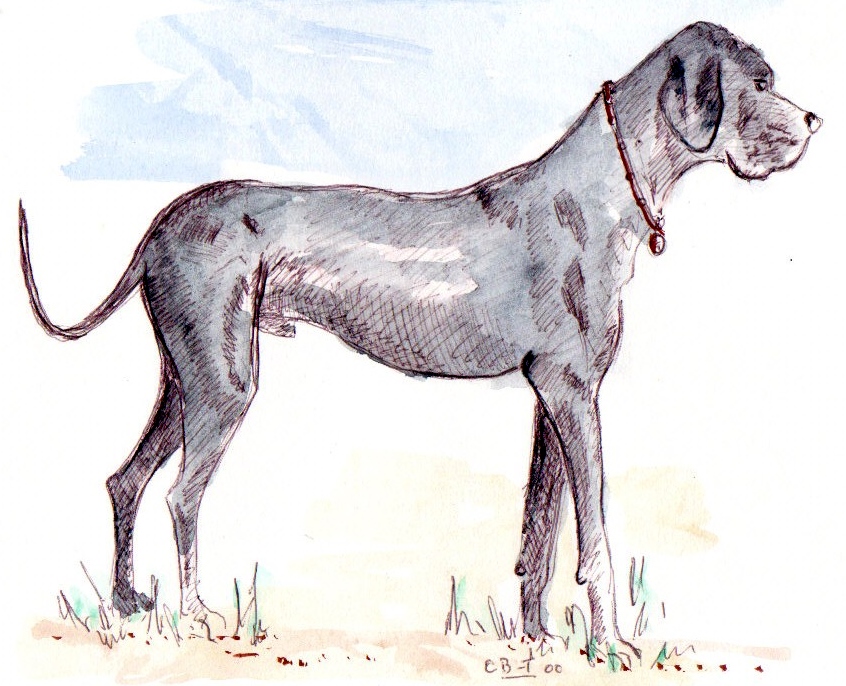
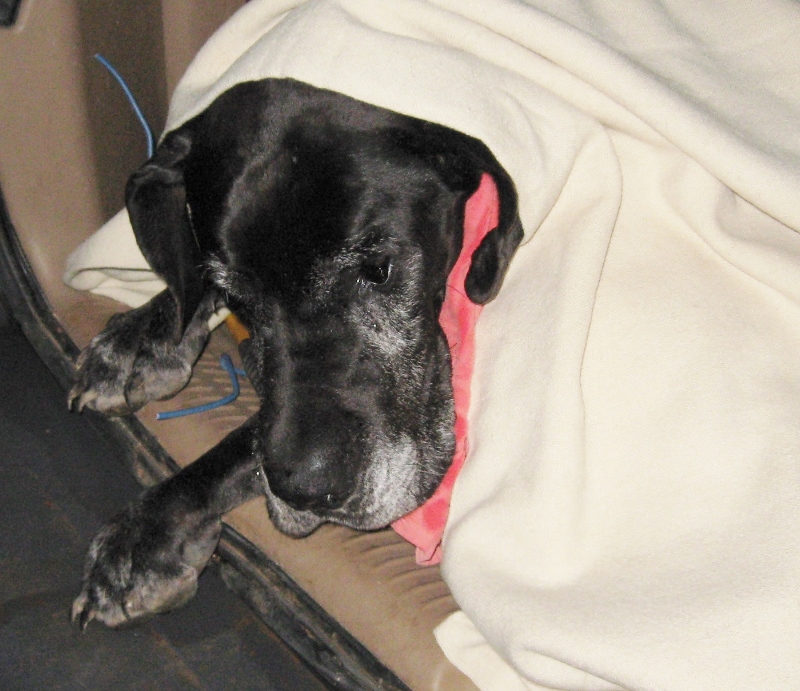
George  An early sketch of George. I didn't catch the size of him at all.  I've forgotten what he weighed now, but it was something like 70 kgs - over 10 stone.  He was extremely intelligent, as Great Danes are, exceptionally obedient.  We didn't even need to put him on a lead once he'd got past the silly I'm-a-puppy-I'm-gonna-run-after-it stage.  When we walked around, people would exclaim at the size of him and sometimes ask if they could pat him.  He was always very good-natured but considered the car his own property and would bare his teeth quite nastily if anybody other than us or the children approached.
We blew hot and cold about whether or not to set off.  Bruce had been so unwell that I was concerned about driving that huge rig and looking after him and an old dog.  But he seemed generally better and was getting up most days now.  He felt he would be able to drive small distances and we both felt that the trip would do him good.
We waited.  He went through a bad patch.  We can't go, we said.  He seemed better.  OK, we're off, we said.  Weeks slipped by and the summer holiday lettings finished. We closed the gites for the winter and moved from our barn, which was just a tad chilly in the mornings now, back in to the chateau.  It was still very hot during the day, however,  and it was difficult to imagine another bleak winter looming up.  We peered at maps and atlases.  We traced routes across France and in to Italy.  We talked about nothing else.
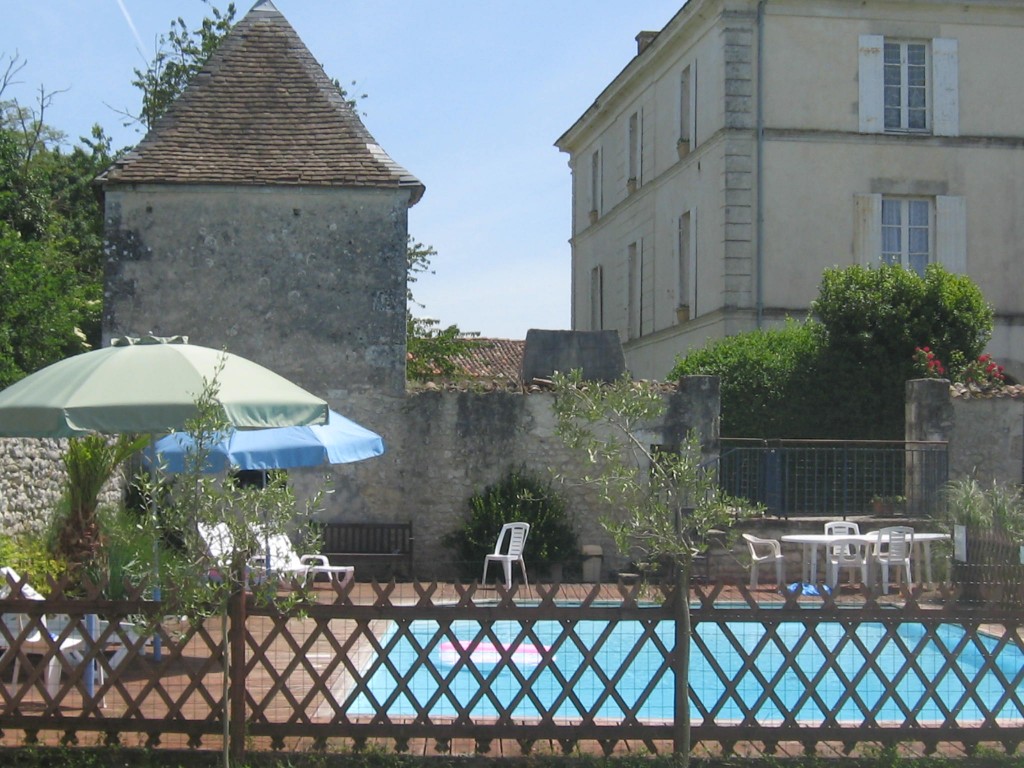
ch pool   We discovered that the dizziness Bruce suffered eased considerably if he was swimming, which he did almost every day if he was up to it that summer.  We told the Meniere's Society about it and I wonder if anybody else has benefitted from that as a therapy ...  (For more about this property go to http://www.holidaychateaufrance.com)
On good days Bruce altered a few things in the caravan - well, a lot of things, actually.  He installed a hot water system (which we never used!) and a microwave.  He widened the bed to accomodate proper mattresses.  He sorted hose pipes and electrics, a heater, a larger fridge, the WC ... and at last it seemed he was feeling better more frequently than he was feeling ill and, excitedly, we packed.  We took a minimum of belongings, and I have stuck to that rule ever since - two things to wear if it is hot, two for if it is cold and two if it is medium.  The bulk of our equipment was tools in case of a breakdown (little did we know what was to happen - that'll be in about Part 8 I expect) and the things we needed for life to be comfortable - table and chairs, parasol and that sort of thing. If we were short of anything, we would buy it.
It was a very hot day, the day we set off, towards the end of September.  That gorgeous weather followed us for months.  Henri and Edith waved goodbye and we knew we left the property in good hands.  George lay down on his mattress in the back of the car and slept.  As long as he was coming too, he really didn't mind.  He could still get in and out of the car by himself and still loved a walk - would even run a few steps if he was on a beach.  He ate well and seemed happy enough.  He was stiff, but not in pain.  We had him checked over by the vet before we left, who declared "c'est un veillard" - he is an old man.
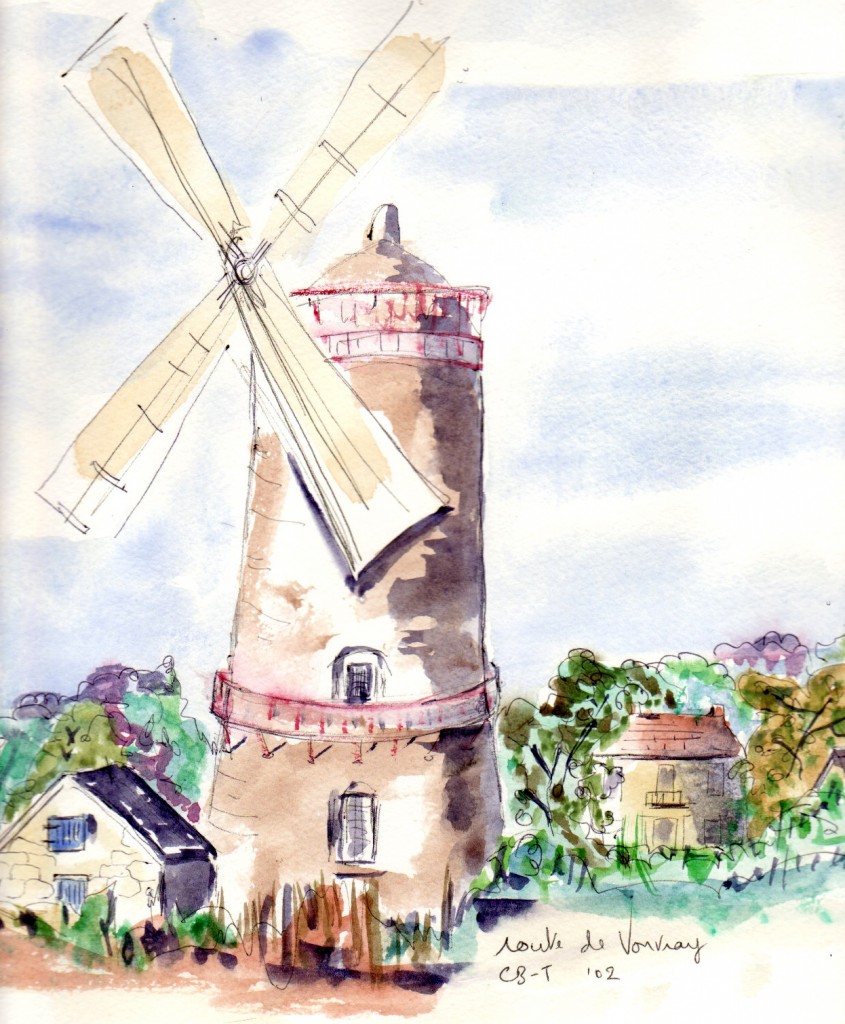
moulin   An early sketch of a windmill, done during that first week away.
However, even in a big caravan like ours there really was not enough room for a Great Dane.  Poor old boy.  He so wanted to come in with us at first, and we had to leave the upper half of the caravan door open (it was one of those split affairs) and reverse the car right up to the door, the boot open,  so that he was virtually in with us.  He seemed happy with that.  We had no fear of leaving the back of the car unlocked because nobody in their right mind would approach a huge dog they don't know, and George had a magnificent - and utterly terrifying - growl.  He was able to get out and do his doings if he needed to during the night, right by the car because he knew he had to STAY.  He'd look a bit mournful about it in the morning and seemed to breathe a sigh of relief when Bruce cleared it up with no ticking-off.
We motored down through France, stopping regularly.  I was all right if I could drive in a straight line, but manoeuvring that huge rig, sometimes in to the tightest spots, was only for an expert like Bruce.  We both wanted to get out of France as quickly as we sensibly could - not, I hasten to add, because we didn't want to be in France, but because we were both eager to get gone, as it were, to start on our adventure.
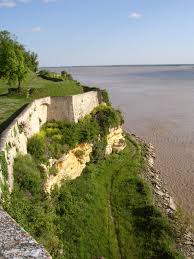
Blaye  Blaye.  There are a lot of fortifications all along the coast here, built in the 17th and 18th centuries to keep the English out.  Fair enough!
We spent the first night near Blaye, barely an hour's drive away. We reached it by 10.00 that morning but couldn't go any further.  We talked about turning back and instantly decided against it.  We had a good medical insurance, and Bruce seemed happier than he had in ages.  We went for a gentle walk, tried to relax.  I am not accustomed to sitting around.  During that afternoon of waiting for the dizziness and nausea to abate I started on my second book "French Sand" ("A Call from France" was by now published); I sketched, I did patchwork, I wished I could knit.
The second day we were up bright and perky and made it as far as Avignon, with several stops en route.  It was slow going but it was fine - we were not in a rush ... we had months!
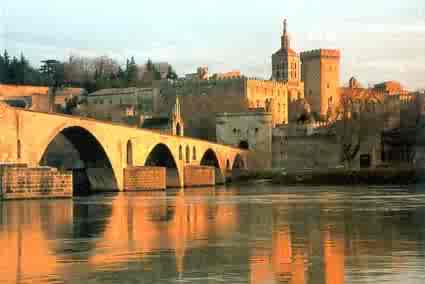
avignon2  Avignon is the largest city in the Vaucluse in the south-east of France. It is often referred to as the City of Popes because it was the home of the popes for over 100 years, from 1309 to 1423.  It is a UNESCO World Heritage Site, well worth a visit.
A slow and careful start in the morning, tasking it easy, taking our time, making sure everything was pleasant and stress-free, brought us to the Italian border during the next afternoon.  It was only once we had crossed the broder in to Italy that we felt our adventure had started.
With us we had an Italian phrase book, a big map where I marked in fluorescent pen the route we had taken, and a book from the UK caravan club.  This book told where most - though not all - campsites were.  The details in the book depend, of course, on feed-back from campers.  I always think it is really unkind to submit a bad report just because it didn't suit you; and a bad report written a year earlier and published in the book does not mean that the camp site is no good.  If we feel very strongly about a place being bad, we should write to the owner and tell him, but to have it published where it cannot be changed no matter how much the owner tries to improve things, is really very unfair.
Anyway, that first night in Italy, somewhere near St Remo, we pulled in to what seemed like a very nice camp site.  There was a sign at the gate saying "NO DOGS".  This problem had never occurred to either of us.  Lie down, I told George.  He always stood up, somewhat clumsily, in the back if he thought we were stopping somewhere.  He lay down and put a paw over his eyes.  Don't move, I told him.  Surely they won't mind a nice old dog like George ?
"We don't take dogs," said the man at reception.
"We didn't know," I explained as rapidly as I could, tripping over my words as I ploughed forwards, "and he is very good very good and quiet and my husband is sick and we need to settle for the night supper and stuff and we cannot drive any further and it is getting dark and I need a drink and I have to walk old George no no no I won't walk him I'll keep him in the cravan the car ..."
"That's as may be," said the man, "but we still don't take dogs."
"He's only a Great Dane ... " I pleaded stupidly, as though the man might suddenly exclaim "Oh!  Thank goodness you said !  Great Danes are welcome!"
Part 3 to follow
Catherine Broughton is a novelist. Her book s are available from Amazon/Kindle and most usual sources.

lundi 6 janvier 2014

2008 127 (800x691)  George was getting old.  Ten is quite an age for a Great Dane.   During our travels he slept in the back of the car on a sequence of foam mattresses with a sequence of blankets - all of which got flung out and replaced regularly because it was easier than washing them.  In Dubrovnik I bought him a blanket with bunnies on it.  I swear he was cross!
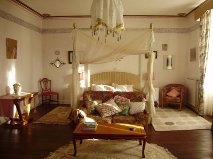
master bedroom 1  Our bedroom. Because Bruce's Meniere's was so bad, we spent many months back in the old house where he could rest.  We rattled around in that huge place.  Most of the property remained empty, and on the whole we used just the kitchen and a bathroom.

Because the barn (see http://www.turquoisemoon.co.uk/blog/it-happened-like-this-an-english-family-move-to-france-part-22-the-story-closes/) was suitable only for camping in during the summer months, we lived in the Chateau again.
It was odd, rattling around alone in that huge house.  All three children were in England and wanted to stay there, though within two or three years the two boys had moved off - one to Belize (http://thefunkydodo.com/ ) and the other to Amsterdam.   They say that if you have been raised as an expat, as indeed I was, you have difficulty ever truly settling anywhere.  I think that is true.
Bruce was very unwell.  On more than one occasion his Meniere's was so bad that he was taken in to hospital, and on many occasions he'd get himself as far as the sofa and be completely unable to move again.  Sometimes he would allow himself to slide off on to the floor because he said he couldn't fall off the floor.
At the time the treatment for Meniere's in France was SERC and Tanganil.  Neither ever seemed to help and they have since been discontinued.  Xanax seemed effective sometimes, also perhaps aspirin.  There is no known treatment or cure for the disease because, I suppose, it varies so much from one individual to another.
footer-logo menieres  Logo for the Meniere's Society - though there are lots of self-help groups.  We joined one and received a monthly newsletter for some time, but Bruce found it very depressing reading about how bad it could get, and we both decided it was better to concentrate on recovery
For those who are not sure what Meniere's is - it is a disease of the inner ear and it causes vertigo.  For Bruce it was like living on a boat on a rough sea.  Seasickness, nausea, tinnitus, deafness, headache and the infernal dizziness.  Sometimes it seemed to calm down and he would sit and perhaps watch TV for a while, then at other times it was so awful that I would call the doctor who would have him hospitalized.  The disease was identified by a French doctor called Propser Meniere  in 1861, and although there can be all sorts of triggers - noise, flashing lights etc., Bruce's main triggers were stress-related.
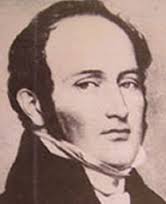
prosper Prosper Meniere 1799-1862
We had been through such a lot of stress for so many years, and it had eaten away at him.  For myself, though I dealt with a huge percentage of the stressy situations alone, I was less affected.  I am a very positive person.  I love a joke, I enjoy company, I like happy chatty people, and I think any doctor will agree that frame of mind has a major effect on health.
Henri and Edith, (see link as above in the first paragraph) were worth their weight in gold.  They lived in the cottage by the road and gave me such support and friendship at a time when I needed it very badly.  They had also run their own businesses and been through many stressy situations, and could relate to me and my odd situation, alone with a sick husband in a Chateau where I didn't want to be.  I spent many a lovely evening having supper with them and after supper Henri and I would always do the Mots Fleches.
That is a funny thing about speaking a foreign language.  It is as though one's brain operates only in one language, because if I do Mots Fleches in English (I can't think what it is called - like a crossword but with clues in little boxes within the puzzle) I generally find it facile and silly.  Doing it in French, however, presented a challenge because my brain operates in English.  Some years later I broke my leg in a skiing accident and Henri posted Mots Fleches to me, and I sat in bed with a big dictionary and waded successfully, but slowly, through them.
 henri  Henri
These were quiet days.  As we had found ever since our arrival in France, if we invited people round we were usually not invited back.  I have to confess that it was largely because we probably seemed "posh" to a lot of people, with our huge house and big car.  I think a lot of people - the local people at any rate - were put off by that.  Also, I think the French tend to meet in restaurants rather than in each other's houses.  Cetrtainly in this area they stick to family and very close friends.  Not that I minded.  I didn't really want to see anybody anyway and Bruce was often just not up to it.  Henri and Edith were like a thousand friends, and that was all I needed.
I took summer-time bookings for the cottages and the Chateau.  They poured in.  There are not many inexpensive holiday places close to sandy beaches and we have been full every year since we started in 2000.  I did a few tentative water-colour sketches. I kept myself busy also with re-decorating and re-making curtains, re-covering cushions and chairs.  It is amazing what a lot of improvements one can do on a very tight budget!  A bit of gold paint, a strip of lace ... you can change the whole look of an entire room very cheaply in no time at all.
I also started writing my first book, "A Call from France".
cff from jesse
I was recently interviewed by a US magazine, and they asked me if it was difficult to write on such a personal subject about something so traumatic.  At the risk of sounding pleased with myself (which was not my aim), I replied that the story just fell out of the end of my fingers.  It was like a catharsis for me and I needed to write it down.  The book emerged in no time at all, though modifications went on and on for well over a year.  The title also changed several times from "Shelter of Wings" to "The Calling Bell" and at least one other.
As Bruce started to feel better we decided to buy a big caravan and set off on a tour.  We have always enjoyed caravanning and camping and, rather than spend another bleak winter alone in the Chateau, we decided to set off on a tour of southern Europe.   Actually, our initial idea was to spend the winter in Cyprus - why Cyprus, I don't know - we had been before, I suppose, and enjoyed the winter sunshine.  But George, who was by now ten years old, could not be left.  And it is simply not possible to take an elderly Great Dane on a flight.  We didn't want to sit there and wait till he died, so we decided to drive to Cyprus.
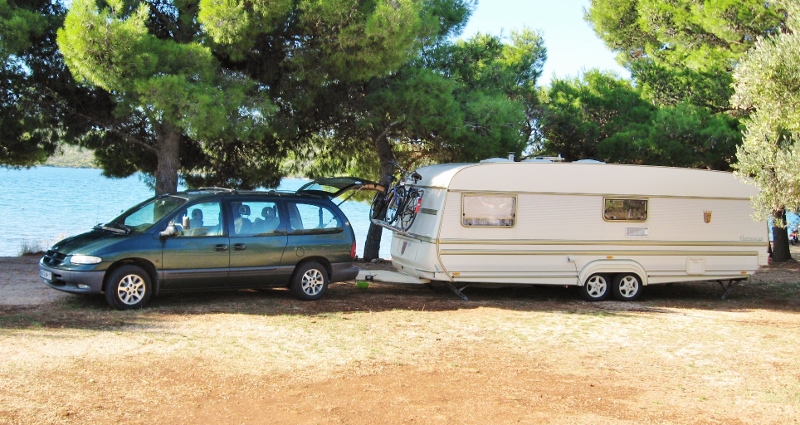
 2008 003 (800x425)  We bought a ten year-old caravan.  I suppose it was a gypsy caravan, though the people we bought it off lived in quite a nice house.  It needed to be big because we intended to be gone (and indeed were gone) for five months.   We were able to leave a double bed up permanently and the other end had a table and chairs large enough for 6 people (with a squeeze).    Note the boot open at the back - that was George's den.
Part 2 to follow.
Catherine Broughton is a novelist.

samedi 21 décembre 2013

An English family move to France. Part 22. End of the series.


la chouille 001  William eating his breakfast!
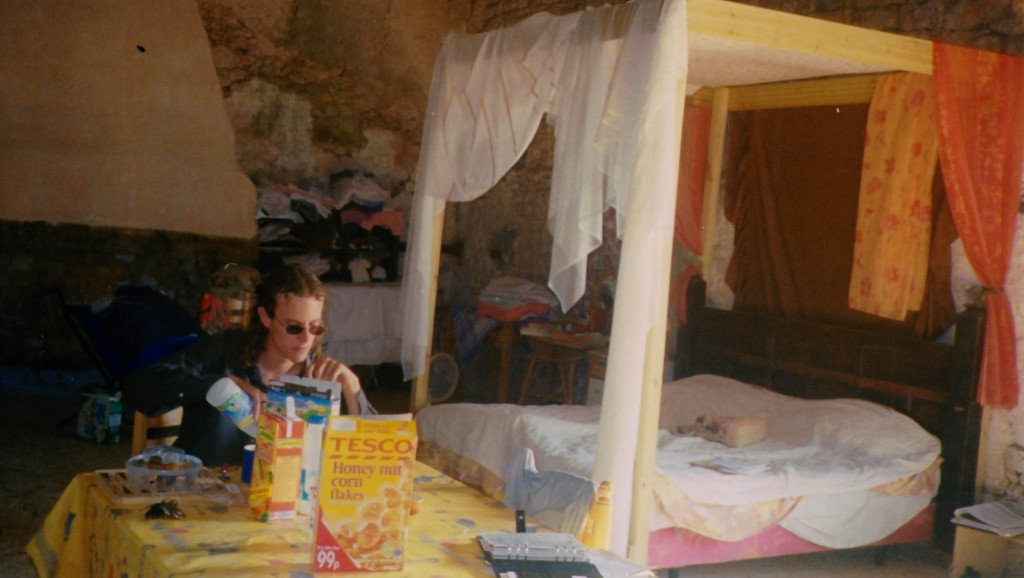
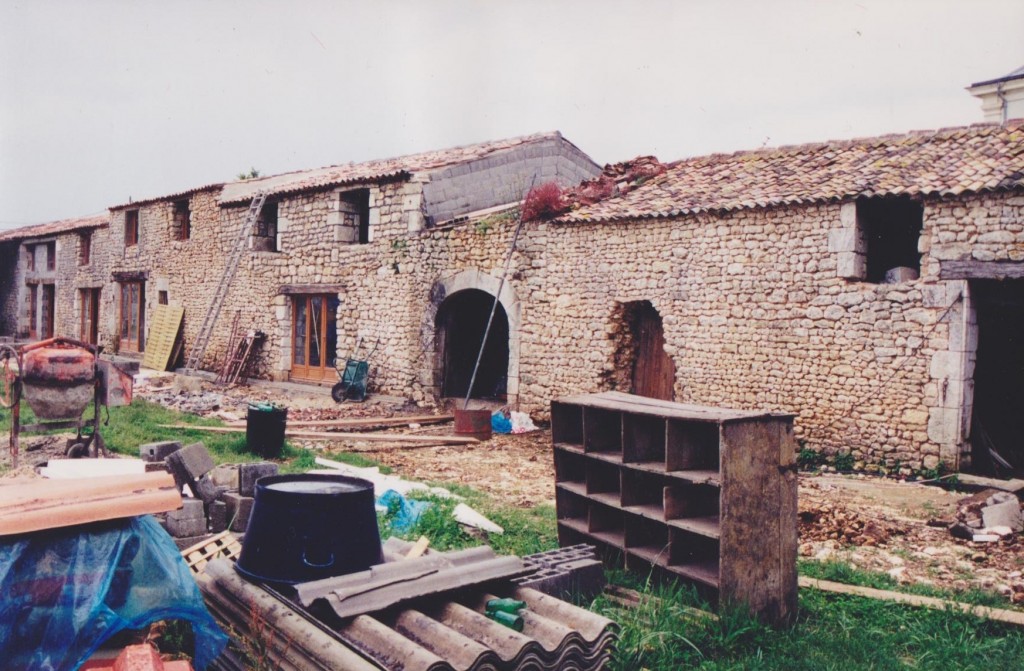
We lived in a barn.  Seriously, it was a barn.  There was just one huge room approx 12 meters x 7 meters.  Underfoot was the earth dirt which we covered with a screed of concrete.  Above was just the underside of the roof tiles.  The walls were stone, the same stone as in the cottages but ours was neither cleaned nor re-pointed.  All along one wall, where there are now French doors leading to a walled garden, Bruce rigged up a work surface, some shelves, and plumbed in my washing machine and dishwasher.  We also had an old fridge that was so rusty that Jake and I cellotaped magazine pictures over it.
I didn't mind at all.  It was fine.  We lived in our barn from April through to September, then we would move back in to the chateau as the last holiday-makers left.  In fact I took a kind of pride in living in the barn, which I decorated with left-over bits of fabric draped castle-style over the stone and bunches of dried lavender.  Everything was make-shift.  Our bed was two single beds shoved together, over which Bruce rigged up a timber frame.  Over that I flung a couple of old net curtains and such like, more to keep bat droppings and dust off us than anything else.  The children slept in the caravan.
I didn't mind the bats - the only objection I had was when I woke one night to find a bat drinking out of my glass of water by the bed!  After that I kept water in a bottle with a lid!

self 001

At one end of the barn, next to the fireplace (which William restored) we hacked out an opening in to a smaller barn on the other side.  It had almost no roof and one wall was on the point of collapse so we had to rig a kind of buttress affair, which we tripped over regularly, to stop the wall falling in totally.  In there we had a shower, a loo and a basin.  There was so little roof  we had to take a brolly if it was raining - though having a nice hot shower when it is raining is great.   And summer in the Charente Maritime is usually good.
We invited friends round for dinner in our peculiar abode.  Many of them were taken aback by the way we lived and probably thought we were extremely eccentric.  We had a huge table and chairs  (the table was planks over a couple of trestles) and a couple of old wardrobes for our clothes.  All the sheets and towels for the cottages were housed in the barn with us till William built me a laundry room several years later.  It was difficult to keep things tidy - and dust was a never-ending problem.  But as I say, it was fine. It was even fun.
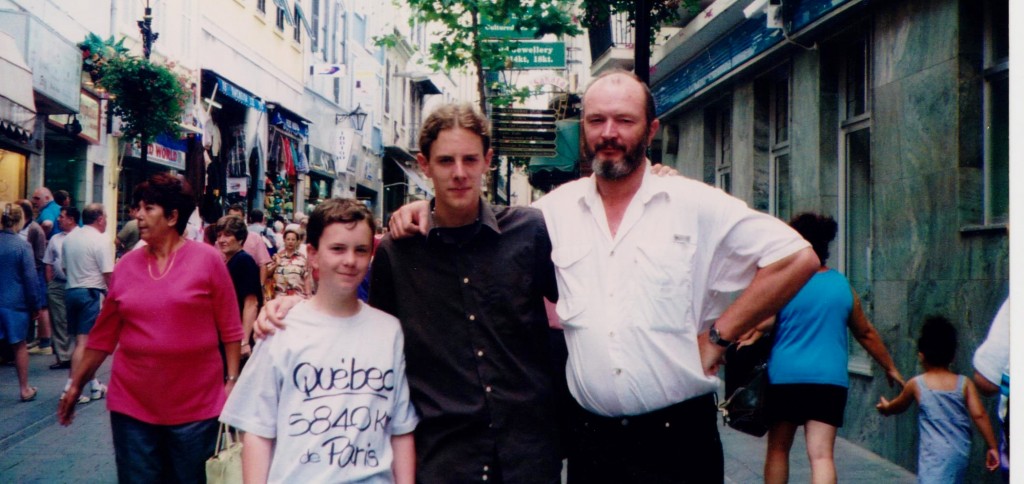
gib 001A long week-end in Gibraltar; as has always been our wont, if there is money to spare we spend it on travel.

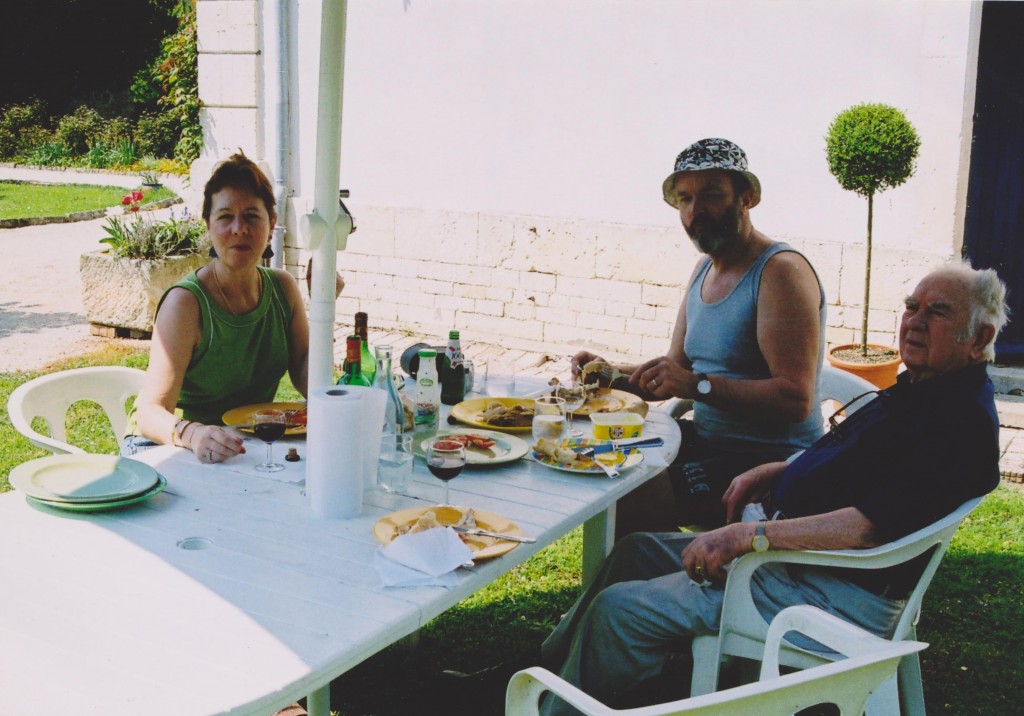
eating outside 001  Sitting outside with my father-in-law.

front drive 001
It always surprises me when I look at photos like this how bare everything was !  Of course, we had had the big storm, so all our trees were gone and the new ones not yet grown.  That wall has since been raised by three or four feet, and there are now trees all along the edge.
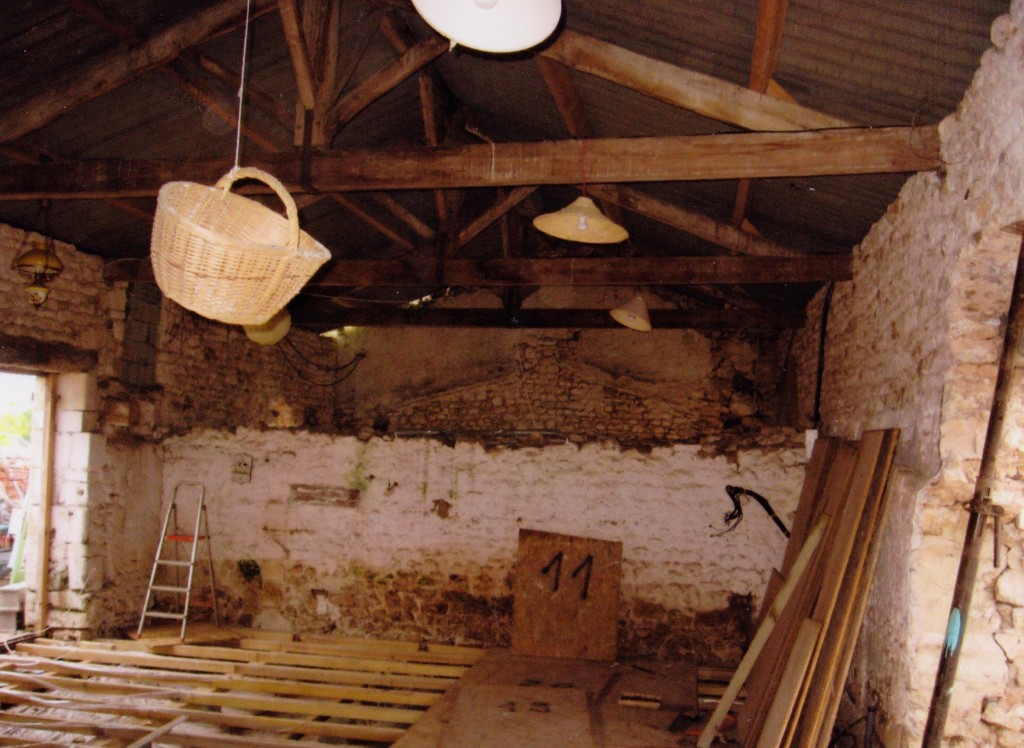
barn 1 001  Our barn ready for the floor.  Why is there a basket hanging there ?  - oh, I have no idea!  I expect there was a good reason for it at the time.  That white section of wall now has a door in it which leads to our bedroom where the workshop was.  We didn't convert the barn for several years, and that wall turned out to be three feet thick.  A staircase now runs up near where the ladder is, and that is now my office up there on the mezzanine.

part barn 4 001  My office in the barn days

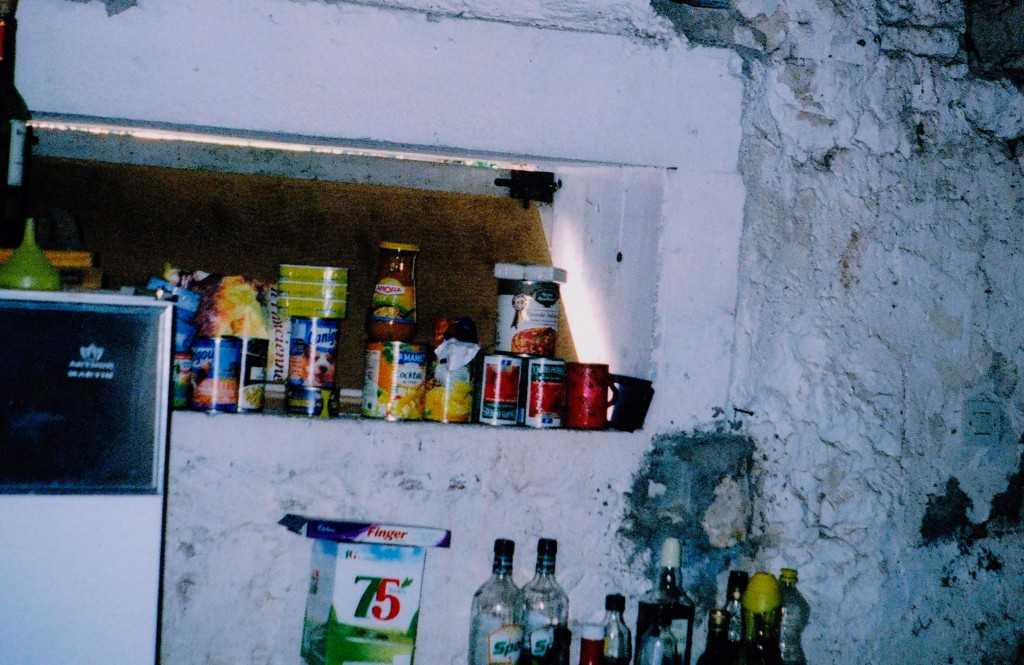
wall 001  The food storage area !

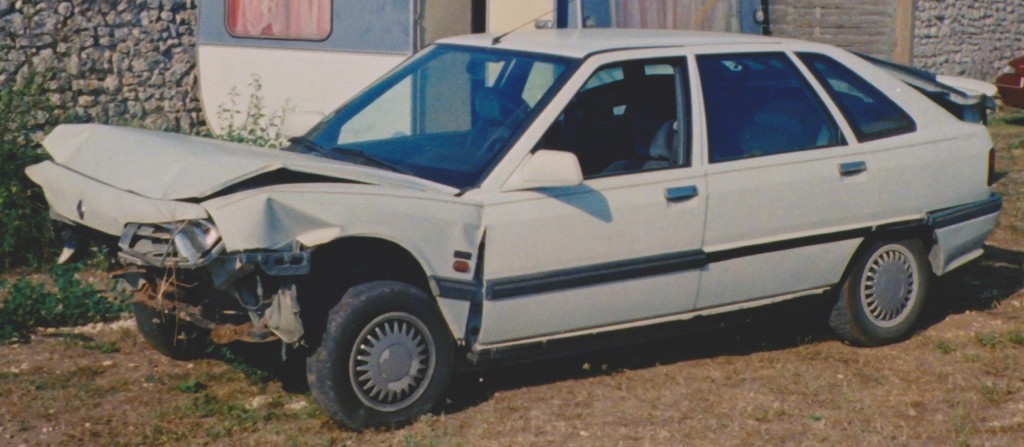
old car 001  William's first "real" car about a month after we bought it.  Kids!

henri & edith 001  From left to right, Michel's elbow (yellow T-shirt), Edith, me, one of the cleaners, Bruce, Henri.  At the end of the season we always took the staff out for dinner till we realized that quite often they only came because the felt they had to - they didn't consider it a treat at all!
It was at this time that Henri and Edith came in to our lives.  The most unexpected things happen at the most unexpected moments.  Henri and Edith, both from the north of France, were the very best friends anybody could ever wish for, and they stood by me through many many traumatic situations to follow, frequently going way beyond the call of duty.  They lived for ten years in our roadside cottage and acted as caretakers when we were not there, and as very dear friends whether we were there or not.  And we were there less and less over the next few years, as we at last bought a place back in England, and also set off with our caravan on a five-month trip around southern Europe and Turkey, with many more trips to follow.   My lovely old daddy died very suddenly when he was 85, and it was to Henri I turned when I needed outside comfort and opinion as I faced more tests ...
And now ?  Now, as I close my story ...
The children grew up and left home, as they do.  None live in France.   We all meet at Les Cypres in the summer, now with grandchildren and partners of our off-spring.  Bruce and I travel a great deal.  We are residents of France, and France is a lovely country of which to be a resident.  We have lots and lots of friends, both French and British, but will always tend to veer towards British friendships - well, birds of a feather and all that.  I think most expats would agree.  It is just easier, if only from the language point of view.  My great chum in France, actually, is Mexican.
Bruce's Meniere's got a great deal worse for a while, and he spent almost an entire year lying down.  He has since had mild, medium and bad attacks, sometimes so bad that he is hospitalized, but usually more unpleasant than anything else.  Touch wood, he has not had an attack for over a year now, though the tinnitus and deafness never leave him.
I had my first book published within a few years, and the other books followed quickly.  I write regularly for a variety of web sites and magazines about life in France.  I am sometimes criticized for my out-spoken manner, but find that those who can imagine or who have "been there" relate to my story - those who react  negatively to my series (and there are just a few, perhaps less than 1% of my readers) are those who really do not know - they think they do, of course, but they don't.  You know what I mean.
THE END
Catherine Broughton is a novelist.  Her books are available on Amazon/Kindle and book stores.

mercredi 18 décembre 2013

It happened like this ... an English family move to France. Part 21.

bread oven 001  This is the remains of a bread oven in what is now cottage 6.  I had forgotten there was a connecting door there.  I see the concrete screed is down, ready for floor tiles.  This area was thick with creeper and broken stone, bits of wood, stinging nettles ...
DSCF0208
 The interior of cottage 7 - you can just see the upper part of  the manger hanging on the right hand wall.  All the cottages are more-or-less identical so that furniture, crockery or whatever can be moved from one to another if the need arises.
renov 2 001  The exterior of cottage 7 when we started - and William's old car!

DSCF0247  A bedroom in cottage 4.  We kept some of the old stone work (on the right by the window) but we covered a lot of it up because it is dusty stuff and, although people use it to give character, it is really a nonsense because no house would ever have had bare stone work indoors unless the people inside were exceptionally poor.

cottage 5  The exterior of cottage 5.  Because of the rocky grounds not a great deal will grow, but I did manage to get mimosas growing along the front of these fences, but they were destroyed by frost one very cold winter.  Almost all plants are in pots.  Hollyhocks ready to bloom in the front there.

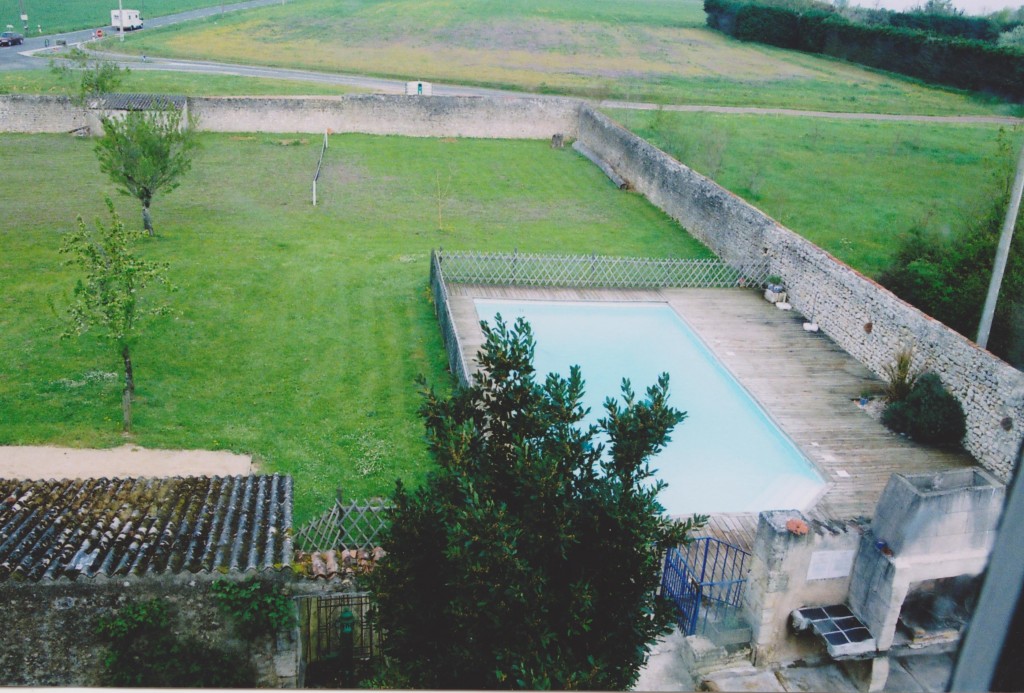
cott pool  The pool is always very popular, of course.  We sometimes use it, but not often.  That first summer a little boy, the son of some guests, learnt to swim in there and years later he became a swimming champion.   We put decking all around rather than tiles  because we had had trouble with the tiles shifting around the pool in our previous house.  Also, of course, decking isn't so unforgiving if you trip over.  We do have to go round with a stanley knife regularly and shave off splinters, and recently all the decking had to be replaced, but on the whole we have been very pleased with it.
 renov 4 001  Creating the pool.  I chose the pool liner in two seconds flat.  The man was flabbergasted. "But Madame!  You need to spend time choosing!"  I have chosen, I said, I don't need time.  After all, blue is blue, and whether the edging is diamond patterns or circles or squares, it really doesn't matter.  
workshop 001  The workshop in one of the small barns - it is still a work shop today

bed no 3  Bedroom in no. 3

big grounds  As time went by the muddy and derelict grounds turned in to lawn.

grounds cotts  By the end of August the lawn is almost always parched yellow.  We are not allowed to water it, not even from our wells, but I don't mind it at all - it reminds me of childhood in Africa.
DSCF0215   Play area for little kiddies.  I painted the lower half of the back wall, which had old concrete over it, with bunnies and ducks and things.  It all needs re-painting now.  I'll see to that in the spring.


bedroom no.5 001 Another small bedroom, this one with a skylight rather than a window because we couldn't get permission for windows on the chateau side.
The guests arrived and many came back year after year.  Then their children got older and they didn't come back any more but are replaced by other families with little kiddies who, in turn, return again and again.  That first year we got some things wrong, of course, but basically it was fine.  Money was a constant problem and we had to buy as cheaply as we could, or make do with re-painted second hand ... that kind of thing.  The remains of what had been a building site, where the concrete mixer had stood and where skips and trucks had passed back and forth, took a full year to grow over, and in every cottage without fail I found a section that I had forgotten to paint or a shelf I had forgotten to cover; or perhaps it was a light bulb missing or a curtain rails the wouldn't stay put ... with eight cottages, you'd be amazed at how much there is to do.
We made mistakes with the chateau too that first year - what to us seemed so wonderful after the derelict ruin we had worked in for so long, was not always wonderful to people who were spending their main holiday there.  But it got righted with time and we have nothing but good reviews.
There is a "type" of guest who complains or writes a bad review.  Mercifully they are few and far between, and nowadays the property owner can retaliate in no uncertain terms.  These "types" are invariably after a freeby of some sort.  It is a great shame.  The reviews system evolved in order to protect people from unscrupulous owners who would advertise something that was not - in the south of Spain there were many very traumatic stories about the dreadful accommodation.  But the review system got out of hand so that, in time, people were writing nasty things about perfectly nice people and places just for the heck of it.  Their little moment of power, I suppose.  People who do that regularly now get blacklisted - and quite right too.
latest 014

Bits of work dragged on for well over a year and we kept the two Michels on for probably four years.  I found a job for the younger Michel, working on the property of a notaire friend, but the older Michel had become dangerous - climbing on to unsafe things, wielding a pickaxe too close to somebody else, and the final crunch came when he started shooting moles in our garden.  He was furious and very distressed when we told him it was time to retire.
Bruno found work elsewhere and we run in to him from time to time.  His son has become a heavyweight champion - strange when you think what a small, wiry man Bruno was!  The others moved away or moved on.  I kept Francoise for a long time, and I used to say she was my favourite charity because she became undeniably less and less useful, more and more dotty, but she'd have been heartbroken to lose her place at the chateau.  When she stopped coming she was already not really properly aware of what was going on.
Part 22 to follow: the end of my story.

 Catherine Broughton's books are available from most book stores as paperbacks or as e-/Kindle books

samedi 14 décembre 2013

jakey 001  Jake when he was about 10.
The children were growing up.  The elder two caused that usual adolescant mixture of joy and fury, temper and sulks, utter and complete selfishness and sudden and unexpected spurts of kindness and cooperation.  And more.  Much more.  I won't say those years were "normal" because they weren't, and some of the events took me years to recover from - in fact, were the greatest tests of my life - but I have written a whole book about it and I won't go in to it here.
I continued with my rounds of the banks. Phoned to see if they had got an answer for me, phoned the next one, then the next.  I saw a financier in La Rochelle who put far more energy in to trying to (unsuccesfully!) get me in to bed with him than dealing with my dossier, and another on the island here who told me that no bank anywhere in the world was ever going to loan anybody such a massive sum.
"It's not a massive sum!" I wailed, "it is the price of a very ordinary house in England!"
"But this is France," he replied with a logic that was infuriating.

Money laundering

My father put up some money so that we could continue with the work.   It was now March.  The first signs of spring were arriving and, if we didn't start to advertise the cottage holiday lets very soon, we would miss the season altogether.  And then another year would go by.  I was beside myself.  We owed so much money to the men, to my father, to the suppliers, and to our very selves.  We had to get this loan one way or another and we even travelled to Paris to see a north African gentleman who, we discovered, wanted to launder his money through us.
" Typical!" I spat. "At last we find somebody willing to put up the money - and he has to be a b....y criminal!"
My mother, bless her, trying to encourage me, said:
"Don't worry about your looks, my dear, they will come back once you can relax again."
Oh, thanks mummy!  I had no idea my looks had "gone" !
renov 3 001  The stone walls.  Each and every stone had to be picked around the joints so that it could be re-pointed, and then cleaned off.  This picture shows about two thirds of the extent of the walls - it was a labour-intensive job.  And just clearing away all the junk ! - there were mountains of it.
And it was that same week that at last we got the loan.  Of all the big nationwide banks I had applied to, and all the local banks, it was a small unheard-of bank in Rochefort.
We have never moved so fast.  We placed advertisements in the UK and very rapidly had bookings for all the cottages for the summer.  Internet was in its infancy and ads went in to glossy magazines.  The phone rang constantly.  We even rigged up a loudspeaker outside for the phone so that we could hear it ring and rush to deal with an enquiry.  We worked day and night, seven days a week, for three months.  And in those three months we created six cottages - floors, ceilings, roof, plumbing, wiring ... all of it, to include raising the roof in two places.
Major building work

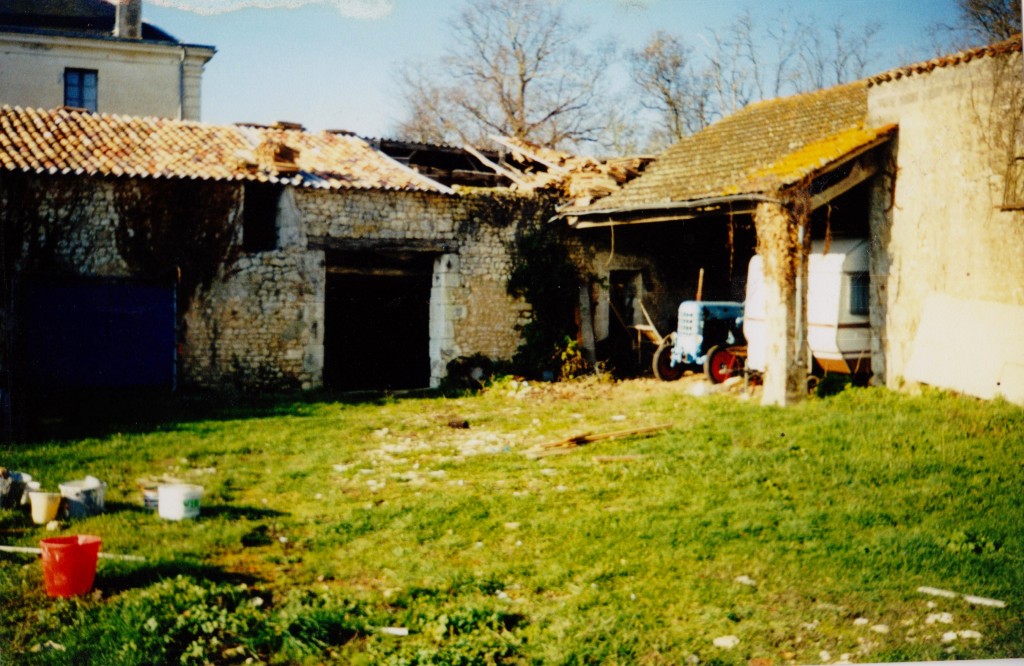
There were two really very major works.  One was with the drainage because the land is solid rock.  I spent time phoning round to find the appropriate builder - they call that sort of work terrassement in France - you need to know this kind of stuff because you can waste hours and hours phoning the wrong people.  Initially a man said he would do it with a mini-digger.  He came round to look at the site, but Bruce told him he wouldn't be able to do it, the ground was far too hard. And sure enough the man couldn't and made only a five-minute attempt.   More time wasted. So Bruce hired a big compressor and two road drills - more phone calls, more trips in to town, more time - and it took 4 men 4 days to dig the trenches through solid rock.  We were amazingly lucky that there was mains drainage to connect to in the road that ran past.
renov 4 001
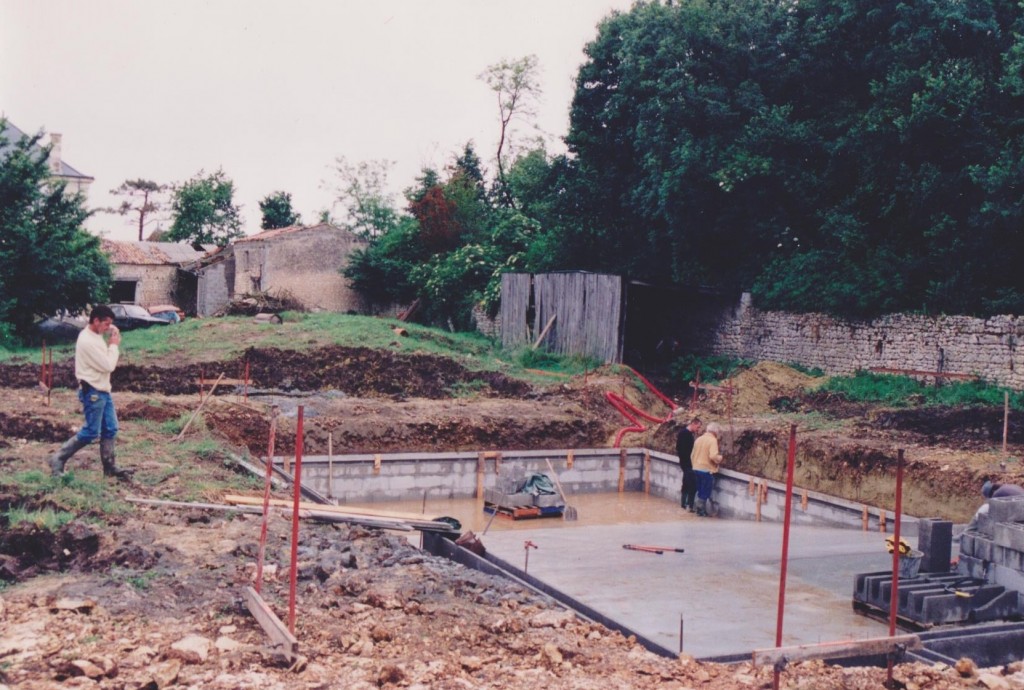
 The pool on the cottage side, and also the one on the chateau side, are situated in the only two places in the entire property where there is no rock. When the first lot of guests arrived the pool wasn't quite ready.  Mercifully they all had that good old British stiff upper lip, and they just bore with us till, on the third day of their stay, we were able to fill the thing up with water.  It took an entire day and night to fill.  The "hill" the far side of the pool is, of course, simply the earth that was dug out.  It now has a children's fort on the top of it, built by regular holiday-makers.  Loads of things like the derlict shed behind and the broken wall to one side had to be left for several years till we could afford it.
The second major item was the pointing and rendering of the exterior walls - and some of the interior ones too.   It was a massive job and big old Michel had already started hacking out the old, blackened render.  We had thought we would do this ourselves but mercifully one of our labourers had a brother who had all the specialist equipment precisely for that.  It cost a huge amount and made a serious dent in our budget, but it was well worth it for it saved many weeks in time, plus a great deal of energy and hassle.   Actually, they were a really good team - from Saintes I seem to remember - who turned up promptly every morning and worked hard and fast till the job was done.
All roofs had to come off, already broken or otherwise,  to be insulated and then laid with  flexible waterproof material before putting the old Roman tiles ontop.
Inside partition walls that we built had a  timber frame, then laid with insualtion & plasterboard, incorporating wiring and  plumbing as we went.   I loathe glass fibre - it gets everywhere - in to your clothes and eyes, and it feels itchy and uncomfortable and the only solution is not only a shower but a complete change of clothes too.   The French call it "laine de verre", meaning glass wool.
Some weeks we had up to fifteen extra people on the site, to include Michel's daughter who came to help me make curtains, and Corinne, the gipsy I mentioned earlier with her little girls.  The little girls ran around the site playing in the debris.  I bought a second-hand buggy for the baby and carted her back and forth with me when Corinne couldn't.  We put table and chairs in what is now cottage 2, a fridge and an old cooker, so that the men could make coffee and eat as they wished.  While the weather remained cold they lit a fire on the floor, there in the middle of the derelict room.
These were good, fruitful, positive days.
ouitside of our barn 001  The corner barn with a huge hole in the roof became our home for several years till we were able to convert it.  We sort-of camped in there from April-ish to mid-September or so, when the Chateau became available again.  The Chateau lettings went very well, despite several initial mistakes, and it was almost always full.  

All around was beaten earth and that summer was extremely hot.  Jake and I flung grass seed down in all the little front gardens - too late realizing that one packet was wheat !! - and it is surprising how much of it took - both the grass and the wheat!  Grass is good stuff.  It grows in all sorts of places, hot or cold,  and survives all sorts of abuse.  I like grass.
Jake and I were also in charge of buying the wherewithall to furnish the cottages, and we dashed about after I had picked him up from school, frantically ordering beds and mattresses (you couldn't do things on line), dozens of cups and plates and pillows.  We had a Chrysler Grand Voyager at that time and we were able to pile a great deal in, Jake frequently balancing buckets and plants and curtain rails on his lap.  We would unload it in to one of the cottages, where it always got in the way of the workers, and dash back to the shop for the next load.  Back and forth, half an hour in each direction.  Sometimes things were delivered, but usually delivery was too expensive or - more importantly - too slow.
Jake was great company, a smiley, happy little guy who joined in all this activity with as much energy as I did.
Everything had to be inexpensive and serviceable; it also had to be easily replaced.  A year later a really good shop opened in a neighbouring village, where you can buy almost anything and everything needed for a holiday cottages - from teaspoons to floor tiles and more.  But at that time I had to drive to Royan or Saintes and make my way to the relatively few suitable stores there were.
wm on sofa 001

Thundery-looking day that spring. A large part of the roof re-done and the exterior stonework cleaned up. I see there is a new door-frame in place (cottage 5), though none of the windows are in.  Mud and/or dirt everywhere.  When Jake and I were finally able to clear up the grounds, the cigarette ends alone filled a bucket or two despite my constantly asking the men to dispose of their butts properly.  
gites B 001  Ready for occupation. We made a mistake with that fencing, and once guest said it looked like pig-pens!!!  We cut them down to a better height the following year.  No grass - just scrub really.  It is interesting to look at this picture now when the trees we planted along the fencing have all grown up and the hollyhocks provide splashes of colour all summer long.  It was so bare then.
I opted for either yellow, orange or green everywhere downstairs and blue in the bedrooms.  All crockery had to be easily replaced, bearing breakages in mind, and for the same reason had to be cheap.  The cuttlery suffered from Yuri Gellar syndrome but - despite its flexible abilities - it is still going strong to this day.  Saucepans and bowls, bottle openers and kitchen implements, bins and doormats ... it is amazing how much we had to buy.
The furniture was inexpensive flat-pack pine - much to the fury of the men when they realized it all needed to be assembled.  Amid a hearty mix of grumbles and laughter, they cracked on with it.  William did a lot of it himself ... he'd have been 16 I think.  He was a brilliant help.  Sun loungers, garden furniture, parasols.  Pots of geraniums, curtains, tea towels. Bedding!  That first year - in fact for the first three years I seem to recall - the sheets, towels and pillow cases were all bought in charity shops when we were in the UK, and were an extraordinary mixture of colours and patterns.  It was all we could afford.  When guests arrived they were somewhat taken aback, but very few minded.
francoise 001  The first few years were incredibly hard work. With little money to spare I did all the cleaning of the cottages and Francoise (here, in red) did the Chateau.  Gosh, she was a tough little thing, tough as nails, hard working and strong even though she was small.  We went hell-bent-for-leather on changeover days.  During the week all the bedding had to be washed and ironed, regardless of the weather.  Nowadays I have an entire batallion of cleaning and outdoor staff and I farm-out the laundry.  But those first few years it was extraordinarily hard work.  But fun.  Lucrative fun.
The last cottage was ready just half an hour or so before the guests arrived.  The previous night we had worked till very late, painting walls, assembling furniture, putting curtains and pictures up.  We decided the simplest thing was to sleep in there and I stained and varnished the staircase as I worked my way backwards upstairs.  In the morning they were still sticky and I used a hair dryer to dry them off!
People could see we were working very hard.  The weather was great and the beach not far, so most guests were satisfied.  That first year there was just one woman who complained - I hadn't thought of coat hangers and she made a major issue out of it.   It is a pity when people make an issue over something small for it sort-of devalues any other issues that may crop up.  Oddly enough it is always the same type of person too.
At the end of that first week we stood in the darkening grounds one evening and looked at the lights in the pool and the barbeques sizzling in the little individual gardens, and listened to the low drone of voices of people as they cooked their meals and talked about their day ... and we felt proud.  Very proud indeed.

Part 21 to follow
 Catherine Broughton is a novelist. Her books are available on Amazon/Kindle or can be ordered from most stores & libraries.
vendredi 13 décembre 2013

An English family move to France ... Part 19.

Barns ripe for conversion

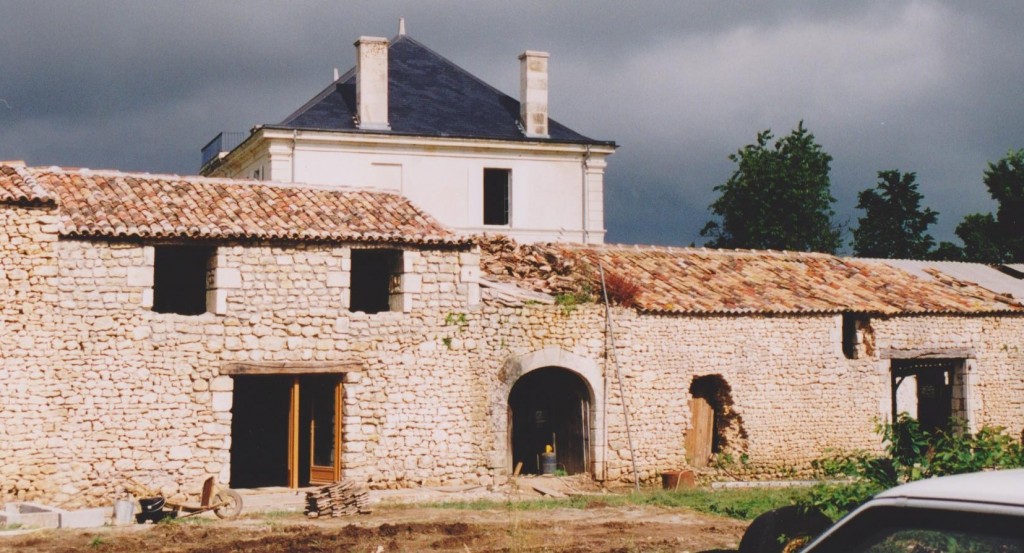
There were a lot of old barns to one side of the land, facing away from the Chateau. They were solid in that they were built of stone, 3 ft thick in many places, and had huge oak timbers to support bits of crumbling roof.  But otherwise they were derelict in the proper sense of the word.  The children played in them, along with loads of other children, and if they had a party it was in what they called "the party barn" which, many years later, became our house.   The grounds were two acres of so of scrub land, where William and his friends would go round and round in figures of eight in an old car we bought for him.  The car wouldn't go very fast (we made sure of that!) but they had a lot of fun.
My father had, off and on ever since we had bought the property, said we should convert the barns in to holiday cottages.  We had indeed made a few tentative enquiries, but it was agricultural land and could only be used for agriculture.
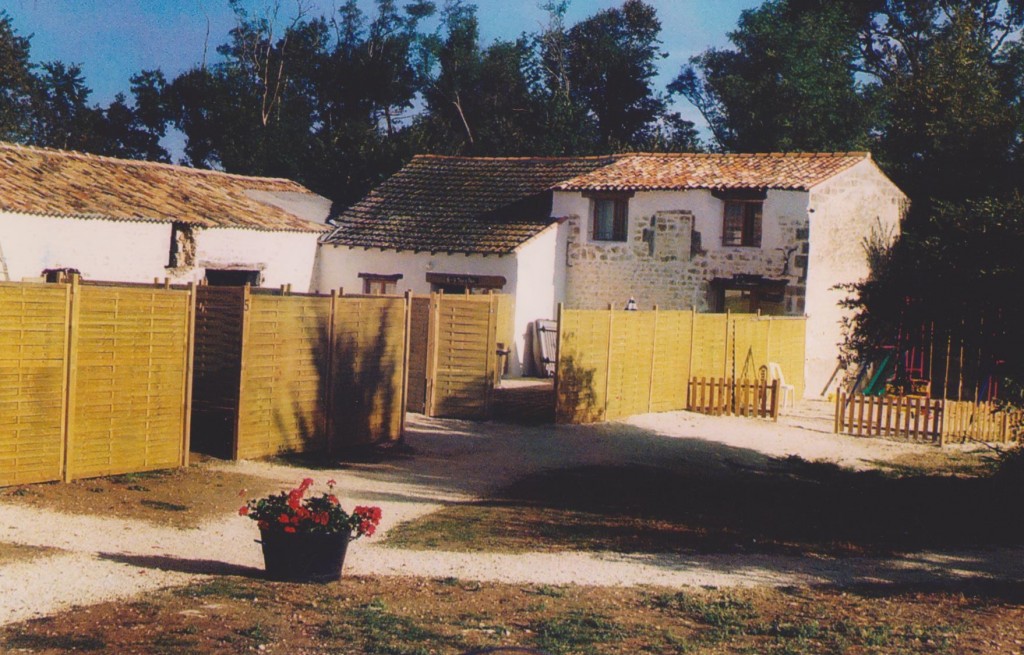
no.6 001  This is now cottage 6.  On the far left you can see the remains of a bread oven - there is a better picture in Part 20.  (Or is it Part 21?)

So, on the whole, we took it no further, despite my father periodically mentioning it again, and the barns fell further and further in to dereliction, and the children made more and more mess.
I bought the children "tamtams" which were little gadgets they could keep in their pockets and which would buzz if I wanted them to come in for supper - or whatever.  I seem to remember all I had to do was dial a number and the thing would buzz.  I soon replaced them with "tattoos" which were slightly more sophisticated in that I could dial a number and give a message to a bod on the line, and he would then transmit a written version of the message to whichever child I wanted to contact.
It seems crazy, but it is a very large property, and locating the children could take a long time.  Mobile phones, late to arrive in France and at first excruciatingly expensive and not very effective, soon replaced these little gadgets.  Pagers, I suppose we'd say in English.

Jinxed

I put Les Cypres on the market.  I just wanted to go home.  I didn't care if we ended up in a flat.  I just wanted to go.  I felt we had been sort-of jinxed ever since our arrival, and I  became obsessed with the idea of returning to England at last.  I packed things in to boxes, trawled through Sussex estate agent details, phoned mortgage companies ... when I look back on it now I realize I had a kind of nervous breakdown.  My determination to get us back to our roots, to get away from all the troubles I had endured, was overwhelming.  I hated, with a venom that was completely unreasonable, anything and everything that was French.  I made no further attempts at befriending anybody at all, regardless of their nationality.  This country, which in fact is a great country with every kind of convenience and beauty, seemed to me to be out to "get" me.  What do you mean, "get" you ?  asked my father.  I don't know, I said, I don't know...
Nor did I know how I would sell Les Cypres - way too big and needing far too much maintenance for 99.9% of buyers - and we would go and we would never ever come back.  It ate at me.  The way things do when you are hurt, and feeling very low, it ate at me.
One cannot reason with a person who has had a breakdown - not really.  Prompted by my father and Bruce, I made lists of all the good things about France - and the list went on and on for pages and by far outweighed advantages to moving to England.  I knew I was being nonsensical but I couldn't help it.  It was plus fort que moi, as the French say.
Meanwhile, however, we needed another income.
bruno 001  This was Bruno, one of our workers.  Actually he was quite frightened of George, but patted him bravely for this photo.  Dear Bruno!  Bruce sacked him over and over again, usually because he was drunk, and he would scurry round to me and ask me to get him his job back - which I did.  Sometimes he would stagger in with an appalling hangover, and if the weather was fine he would lie down on the front lawn, out of sight under the japonica bush and sleep it off.  He hoped Bruce wouldn't see him, and he knew that, at one stage or another, I'd creep over with coffee.  He hung on to that job really only because I liked him so much and because, when he was sober, he was a very good worker.
renov 2 001 This is now cottage 7.  We blocked up the window and opened two new windows each side - so that each bedroom had a window.  The original window had a timber shutter and would have been for throwing hay (or similar) out on to a cart.  There was a fine stone manger in this barn/cottage but, imaginative as we may be, and creative as we are, we just could not find a way of incorporating it in to the features of the house.  We kept the timber section, which now hangs on the wall there, but the stone section had to be hacked away.  There were also very nice old cobbles on the floor and, had the cottage been for our own occupation, we'd have kept them. However, they were too uneven for holiday-makers and we couldn't risk people tripping and breaking a limb.  I almost wept when the men poured the concrete over them, and I expect the 400 year-old cobbles wept too.

A French mayor

A new mayor was elected to the village and, persuaded by my father, we went along and asked again what the possibilities were for converting the barns in to holiday cottages.   With us we took a few outline sketches and plans, and a few guesstimates as to how many tourists the cottages would attract.
The Mairie  in our village is a large, square, unadorned and totally boring building, and the two ladies who work there have worked there since the year dot, complete with twin sets, thin lips and very short hair died mahogany-red.  Monsieur le Maire, a nice little man of uncertain age, sat behind his desk and listened to our idea, stroking his moustache and nodding and, to our surprise, replied that he would support a building application.
The village mayor has a totally different role in France to his UK counterpart and, although this has changed considerably in recent years, in those days he could wield quite a lot of power in one direction or another if he so wished.  He may not give building permission per se, but he can give his personal approval which, in turn, puts the onus on the local building authority.  They can refuse the application - which in our case they did - but the mayor can simply overturn their refusal - which he did.

Tourism in France

Tourism was by now an important aspect of the local economy.  From a smelly backwater, the whole area was rapidly emerging in to a desirable holiday destination, with excellent beaches and great weather.  Grotty little places like our village needed the tourist tax that holiday cottages would bring in, and needed the tourists to frequent the local (usually closed) restaurant and the village shops.
renov.1 001

Step One, of course, was to find the finance for the project.  We mulled over figures, changed them, added them up, deducted, multiplied, divided, then started again.  It was a huge project, the conversion of totally derelict barns in to eight holiday cottages.  Everything needed doing. Everything - roof, walls, floors, plumbing,wiring ...  And as is so often the way, such a lot needed to be cleared away or even totally demolished before we could start.  It was difficult to price out because there were so many unknowns... beams that appeared to be solid may not be, tiles that we hoped to re-use could break, walls and floors that seemed dry enough could be damp (in fact in what became cottage 6 we discovered several inches of water when it rained months later - previously we hadn't noticed it because it soaked away again in to the mud. But with tiles in situ it sat in delightful puddles all over, and the tiles had to be pulled up again , a diversion trench dug, and then the floor done all over again.  Disheartening ?  Oh yes.)
To save money we rented out the Chateau to holiday makers and we moved in to the one barn that we were not intending to convert.  Seriously, it was a barn.

Big projects

Sometimes I come across somebody who tells me they have been working hard on their house ... and I look at them and smile to myself, for they generally mean they are re-decorating or changing the kitchen.  This kind of work, I mean the kind we intended to take on, was a whole different ball game.
The discussing and negotiating with the banks was a whole different ball game too.  We were no longer asking for a loan to buy a small house; we needed a big loan, a really big one.  Furthermore, we faced two seemingly unsurmountable problems - one,  the aftermath of the storm and thence our relationships with banks was well sullied and two, "equity" does not mean anything in France.  Not the way it does in the UK.
They use the word "patrimoine"  for equity, and we had an excellent patrimione.  We had been at Les Cypres five years by this time, and we had paid off a large part of the small mortgage we had used for the purchase of the property in 1995.   The property had rocketed in value.  But that did not count.
self B 001
But we also had two things in our favour.  One, I knew the banks, I knew who to approach, what the interest rates were, which areas of the project could or could not be financed, how to put the dossier together, which way to go.  I was knowlegeable and energetic.   Two, because of Bruce's abilities we were able to start on aspects of the work that made it look as though we had already invested quite a lot of money in the project.  Banks like that kind of thing.  Actually, of course, we had genuinely already invested a lot in the property - it was just that it hadn't been with cottages in mind.  Furthermore, Bruce could not only actually do most of the work himself, from the point of view of capability, he could oversee all the other work too.  The project would therefore cost us around £50 000 less.

Crisis.

It was now sometime around September I think.  Perhaps October.  There was a lot of mud everywhere.  Bruce and his men chipped away at whatever they could in the barn area, slowly advancing it against all odds.  All the old jointing on the outside walls had to be cleaned out,  then the stones re-jointed and bleached.  It was a massive task.  We ran out of money.  The insurances had finished paying for the storm damage and that, in turn, meant that we could no longer pay the men.  What could be repaired on the rental flats had been done, and some of them since sold.  If we laid off the men we couldn't get any work done.  If we kept them we couldn't pay them.
We met with the men and explained the situation - and do you know what ?  Each and every one of them voted to keep working with no pay till we got the loan in - when we would pay them.  We warned them that it could be months.  They trusted us, admired Bruce, liked us.  They were amazing.  We were a team.  We have lost touch with all of them now.  I wonder how they are and what they are doing ?

A bank loan in France

I went from bank to bank, sometimes as many as four in one day.  Things were not computerized yet in France ... they were very late with that.  That was a mercy, though at the time the only thing that particularly mattered was that we should not be in "interdiction bancaire" which means one is blacklisted at the Banque de France.  Against all odds we were not in interdiction - luck more than design!
Although I was invariably in jeans with my hair usually scooped up in to a pony tail, I was nonetheless very professional.  I made it clear within the first two minutes that I was not some silly woman who had no idea.  I knew the law, I knew the rates, I knew the possibilities.  My French had become very good.  Sometimes it occurred to me that I knew better than the bank manager.  That has been the case many times since.  I had the facts and figures at my finger tips.  I am not saying that in order to impress, I am just saying what was.  It was precisely this sort of thing that made us a success in France where so many fail.  You cannot be hesitant and unsure, you cannot be a shrinking violet, you have to be strong, self-confident and determined.  And that applies to all walks of life, all situations.  It is the difference between success and failure.
gites BB 001  William, aged 13 or 14 or so.
But the weeks went on and no bank would go with us.   I made appointments, got together revised paperwork, new estimates, discussed things by phone, faxed a zillion forms, on and on and on to each and every bank in the area.  I drove to banks in La Rochelle, Saintes, Royan and everywhere in-between.  We went down to Bordeaux to meet a financier who promised us the earth and gave us great hope - and then we simply never heard from again.  We contacted a financier in the UK, travelled to Portsmouth to meet him, only to find he was a trickster. It was exhausting and very disheartening.  What made it so much worse was that the bank manager I saw was usually unable to approve such a loan himself (or herself, though I think they were all men) because, by local standards, the £200 000 we needed was a massive sum of money.
Often enough the manager I saw was keen on the project, liked the idea, liked me, even came to look at the property.  But Head Office, wherever that may be, invariably turned down the application after months and months of waiting.  They always took months.   They never asked for more information or for an interview or to see the property - so what the months were about I have no idea.  In some cases I think the dossier got simply shelved and forgotten about.
It was an extremely fraught time.  I had to find a bank somehow.  The men had to be paid, we had to be paid, we needed a new income and - equally importantly - I could see, within the confines of the project, a passport home.
Part 20 to follow                  to follow this story go to turquoisemoon