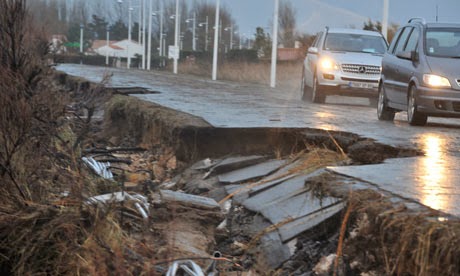
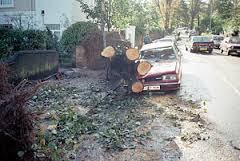
samedi 14 décembre 2013

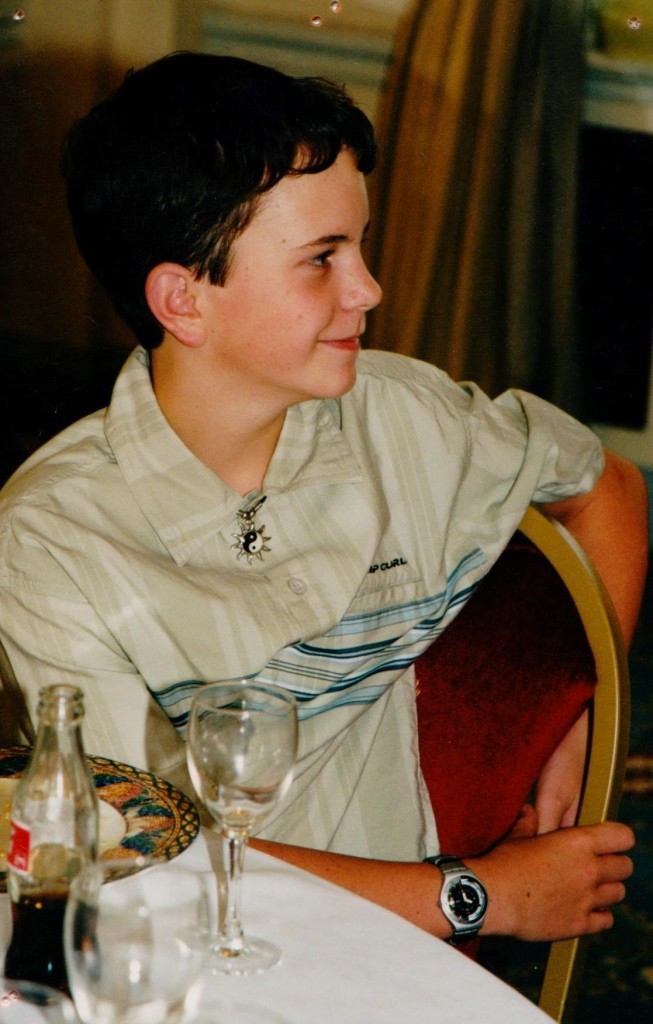
jakey 001  Jake when he was about 10.
The children were growing up.  The elder two caused that usual adolescant mixture of joy and fury, temper and sulks, utter and complete selfishness and sudden and unexpected spurts of kindness and cooperation.  And more.  Much more.  I won't say those years were "normal" because they weren't, and some of the events took me years to recover from - in fact, were the greatest tests of my life - but I have written a whole book about it and I won't go in to it here.
I continued with my rounds of the banks. Phoned to see if they had got an answer for me, phoned the next one, then the next.  I saw a financier in La Rochelle who put far more energy in to trying to (unsuccesfully!) get me in to bed with him than dealing with my dossier, and another on the island here who told me that no bank anywhere in the world was ever going to loan anybody such a massive sum.
"It's not a massive sum!" I wailed, "it is the price of a very ordinary house in England!"
"But this is France," he replied with a logic that was infuriating.

Money laundering

My father put up some money so that we could continue with the work.   It was now March.  The first signs of spring were arriving and, if we didn't start to advertise the cottage holiday lets very soon, we would miss the season altogether.  And then another year would go by.  I was beside myself.  We owed so much money to the men, to my father, to the suppliers, and to our very selves.  We had to get this loan one way or another and we even travelled to Paris to see a north African gentleman who, we discovered, wanted to launder his money through us.
" Typical!" I spat. "At last we find somebody willing to put up the money - and he has to be a b....y criminal!"
My mother, bless her, trying to encourage me, said:
"Don't worry about your looks, my dear, they will come back once you can relax again."
Oh, thanks mummy!  I had no idea my looks had "gone" !
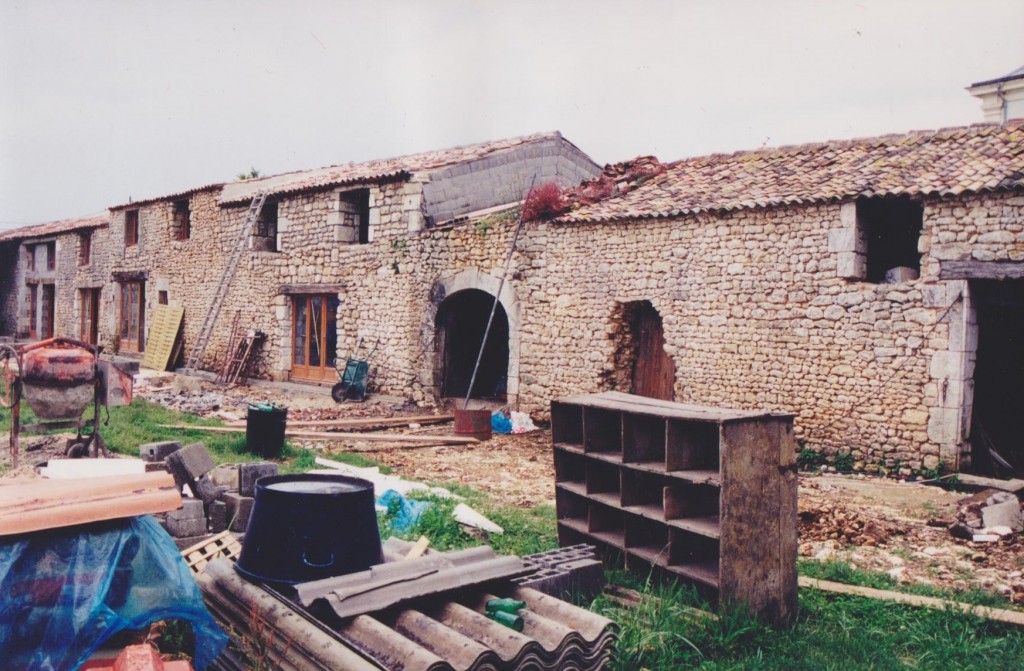
renov 3 001  The stone walls.  Each and every stone had to be picked around the joints so that it could be re-pointed, and then cleaned off.  This picture shows about two thirds of the extent of the walls - it was a labour-intensive job.  And just clearing away all the junk ! - there were mountains of it.
And it was that same week that at last we got the loan.  Of all the big nationwide banks I had applied to, and all the local banks, it was a small unheard-of bank in Rochefort.
We have never moved so fast.  We placed advertisements in the UK and very rapidly had bookings for all the cottages for the summer.  Internet was in its infancy and ads went in to glossy magazines.  The phone rang constantly.  We even rigged up a loudspeaker outside for the phone so that we could hear it ring and rush to deal with an enquiry.  We worked day and night, seven days a week, for three months.  And in those three months we created six cottages - floors, ceilings, roof, plumbing, wiring ... all of it, to include raising the roof in two places.

Major building work

There were two really very major works.  One was with the drainage because the land is solid rock.  I spent time phoning round to find the appropriate builder - they call that sort of work terrassement in France - you need to know this kind of stuff because you can waste hours and hours phoning the wrong people.  Initially a man said he would do it with a mini-digger.  He came round to look at the site, but Bruce told him he wouldn't be able to do it, the ground was far too hard. And sure enough the man couldn't and made only a five-minute attempt.   More time wasted. So Bruce hired a big compressor and two road drills - more phone calls, more trips in to town, more time - and it took 4 men 4 days to dig the trenches through solid rock.  We were amazingly lucky that there was mains drainage to connect to in the road that ran past.
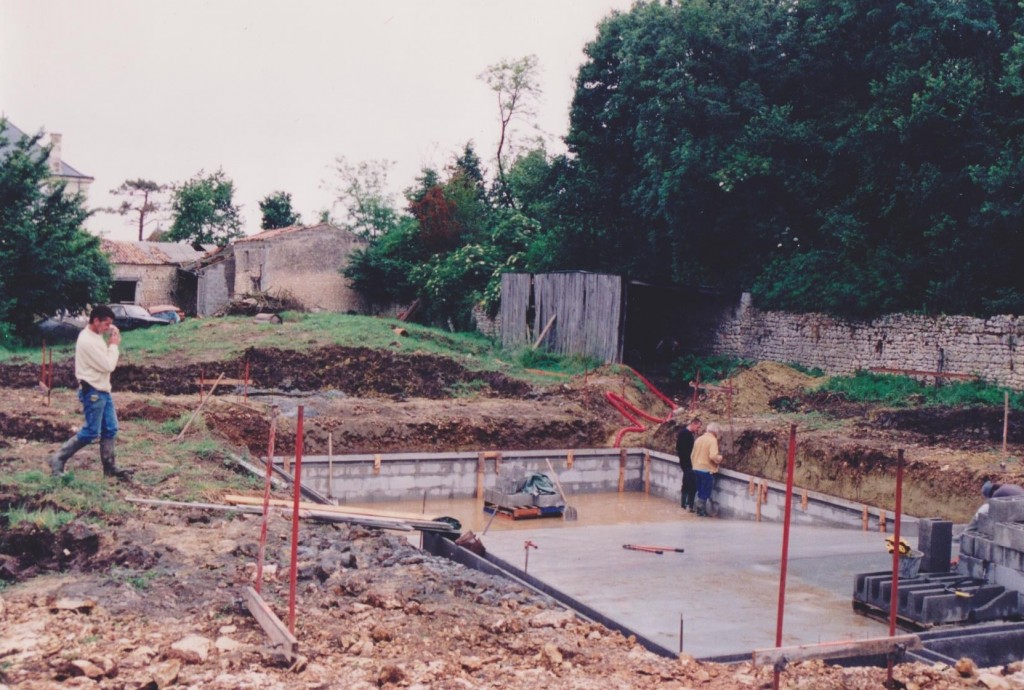
renov 4 001
 The pool on the cottage side, and also the one on the chateau side, are situated in the only two places in the entire property where there is no rock. When the first lot of guests arrived the pool wasn't quite ready.  Mercifully they all had that good old British stiff upper lip, and they just bore with us till, on the third day of their stay, we were able to fill the thing up with water.  It took an entire day and night to fill.  The "hill" the far side of the pool is, of course, simply the earth that was dug out.  It now has a children's fort on the top of it, built by regular holiday-makers.  Loads of things like the derlict shed behind and the broken wall to one side had to be left for several years till we could afford it.
The second major item was the pointing and rendering of the exterior walls - and some of the interior ones too.   It was a massive job and big old Michel had already started hacking out the old, blackened render.  We had thought we would do this ourselves but mercifully one of our labourers had a brother who had all the specialist equipment precisely for that.  It cost a huge amount and made a serious dent in our budget, but it was well worth it for it saved many weeks in time, plus a great deal of energy and hassle.   Actually, they were a really good team - from Saintes I seem to remember - who turned up promptly every morning and worked hard and fast till the job was done.
All roofs had to come off, already broken or otherwise,  to be insulated and then laid with  flexible waterproof material before putting the old Roman tiles ontop.
Inside partition walls that we built had a  timber frame, then laid with insualtion & plasterboard, incorporating wiring and  plumbing as we went.   I loathe glass fibre - it gets everywhere - in to your clothes and eyes, and it feels itchy and uncomfortable and the only solution is not only a shower but a complete change of clothes too.   The French call it "laine de verre", meaning glass wool.
Some weeks we had up to fifteen extra people on the site, to include Michel's daughter who came to help me make curtains, and Corinne, the gipsy I mentioned earlier with her little girls.  The little girls ran around the site playing in the debris.  I bought a second-hand buggy for the baby and carted her back and forth with me when Corinne couldn't.  We put table and chairs in what is now cottage 2, a fridge and an old cooker, so that the men could make coffee and eat as they wished.  While the weather remained cold they lit a fire on the floor, there in the middle of the derelict room.
These were good, fruitful, positive days.
ouitside of our barn 001  The corner barn with a huge hole in the roof became our home for several years till we were able to convert it.  We sort-of camped in there from April-ish to mid-September or so, when the Chateau became available again.  The Chateau lettings went very well, despite several initial mistakes, and it was almost always full.  
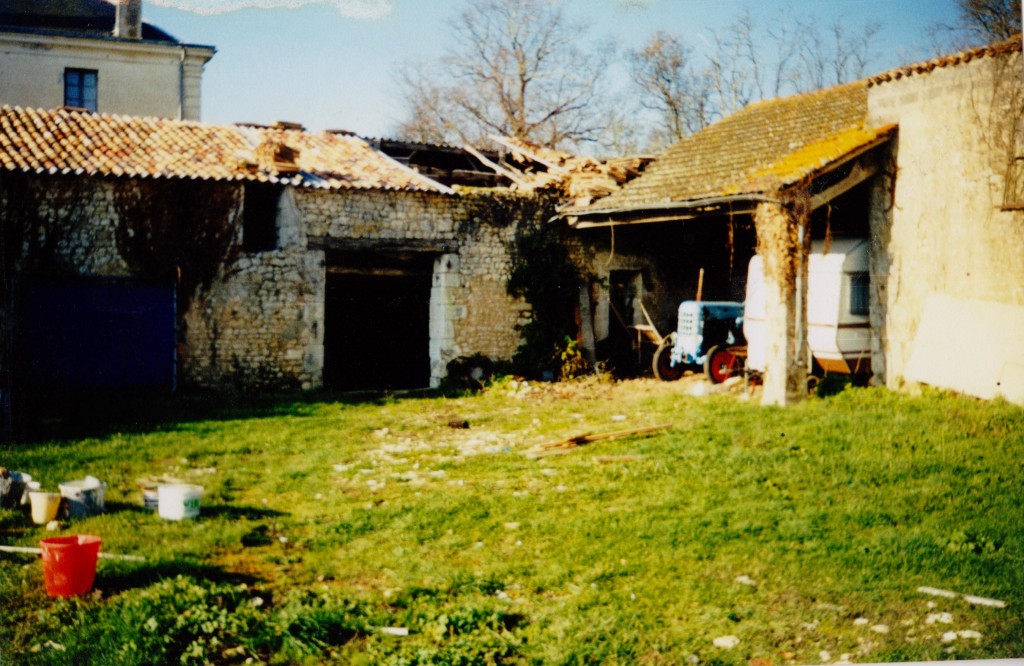
All around was beaten earth and that summer was extremely hot.  Jake and I flung grass seed down in all the little front gardens - too late realizing that one packet was wheat !! - and it is surprising how much of it took - both the grass and the wheat!  Grass is good stuff.  It grows in all sorts of places, hot or cold,  and survives all sorts of abuse.  I like grass.
Jake and I were also in charge of buying the wherewithall to furnish the cottages, and we dashed about after I had picked him up from school, frantically ordering beds and mattresses (you couldn't do things on line), dozens of cups and plates and pillows.  We had a Chrysler Grand Voyager at that time and we were able to pile a great deal in, Jake frequently balancing buckets and plants and curtain rails on his lap.  We would unload it in to one of the cottages, where it always got in the way of the workers, and dash back to the shop for the next load.  Back and forth, half an hour in each direction.  Sometimes things were delivered, but usually delivery was too expensive or - more importantly - too slow.
Jake was great company, a smiley, happy little guy who joined in all this activity with as much energy as I did.
Everything had to be inexpensive and serviceable; it also had to be easily replaced.  A year later a really good shop opened in a neighbouring village, where you can buy almost anything and everything needed for a holiday cottages - from teaspoons to floor tiles and more.  But at that time I had to drive to Royan or Saintes and make my way to the relatively few suitable stores there were.
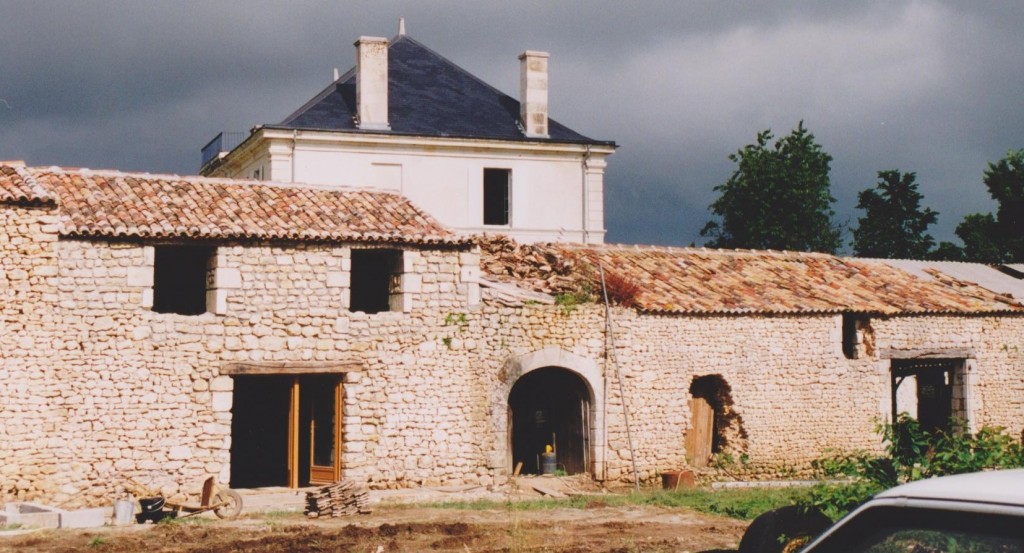
wm on sofa 001

Thundery-looking day that spring. A large part of the roof re-done and the exterior stonework cleaned up. I see there is a new door-frame in place (cottage 5), though none of the windows are in.  Mud and/or dirt everywhere.  When Jake and I were finally able to clear up the grounds, the cigarette ends alone filled a bucket or two despite my constantly asking the men to dispose of their butts properly.  
gites B 001  Ready for occupation. We made a mistake with that fencing, and once guest said it looked like pig-pens!!!  We cut them down to a better height the following year.  No grass - just scrub really.  It is interesting to look at this picture now when the trees we planted along the fencing have all grown up and the hollyhocks provide splashes of colour all summer long.  It was so bare then.
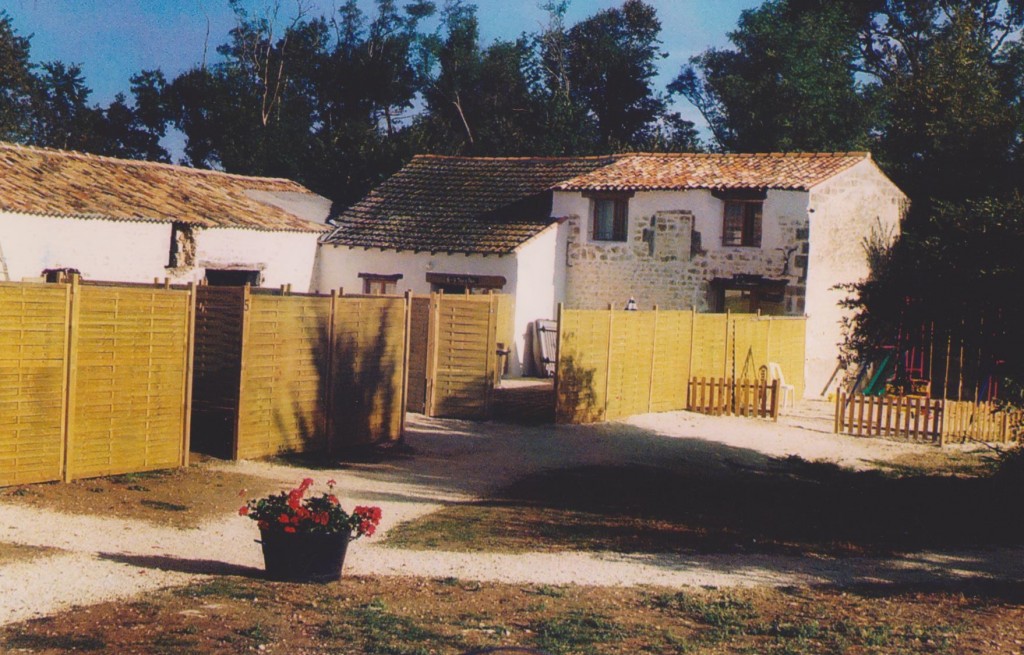
I opted for either yellow, orange or green everywhere downstairs and blue in the bedrooms.  All crockery had to be easily replaced, bearing breakages in mind, and for the same reason had to be cheap.  The cuttlery suffered from Yuri Gellar syndrome but - despite its flexible abilities - it is still going strong to this day.  Saucepans and bowls, bottle openers and kitchen implements, bins and doormats ... it is amazing how much we had to buy.
The furniture was inexpensive flat-pack pine - much to the fury of the men when they realized it all needed to be assembled.  Amid a hearty mix of grumbles and laughter, they cracked on with it.  William did a lot of it himself ... he'd have been 16 I think.  He was a brilliant help.  Sun loungers, garden furniture, parasols.  Pots of geraniums, curtains, tea towels. Bedding!  That first year - in fact for the first three years I seem to recall - the sheets, towels and pillow cases were all bought in charity shops when we were in the UK, and were an extraordinary mixture of colours and patterns.  It was all we could afford.  When guests arrived they were somewhat taken aback, but very few minded.
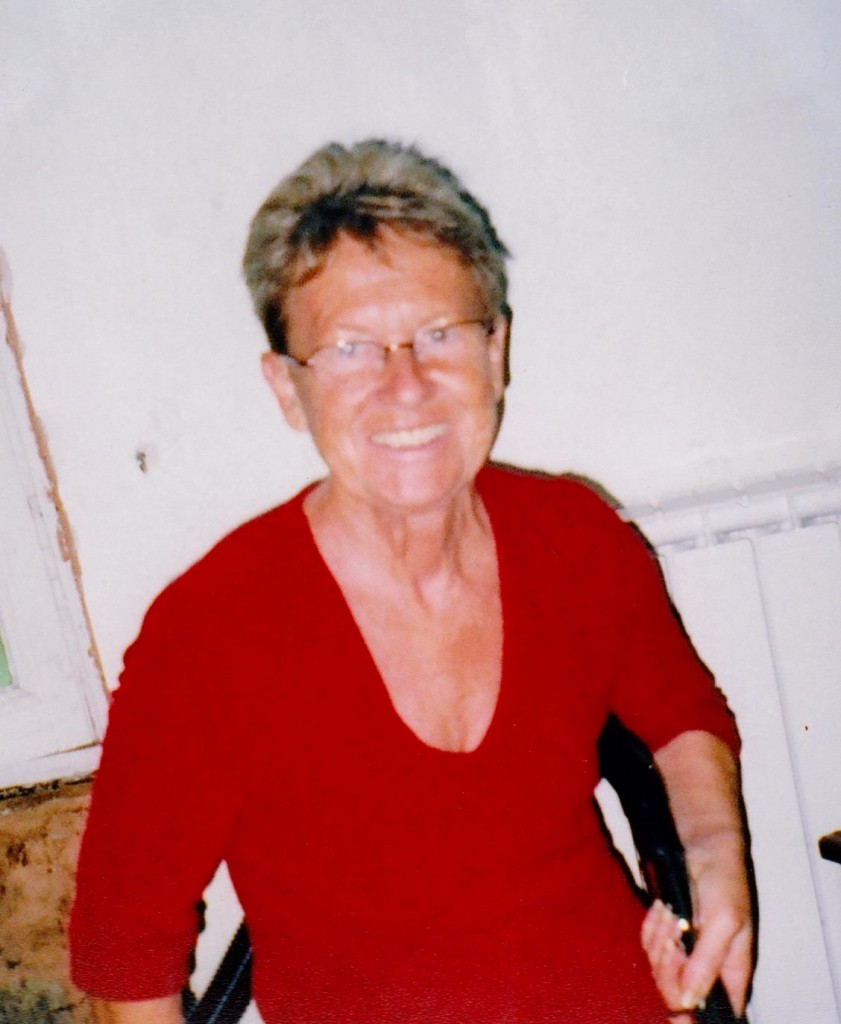
francoise 001  The first few years were incredibly hard work. With little money to spare I did all the cleaning of the cottages and Francoise (here, in red) did the Chateau.  Gosh, she was a tough little thing, tough as nails, hard working and strong even though she was small.  We went hell-bent-for-leather on changeover days.  During the week all the bedding had to be washed and ironed, regardless of the weather.  Nowadays I have an entire batallion of cleaning and outdoor staff and I farm-out the laundry.  But those first few years it was extraordinarily hard work.  But fun.  Lucrative fun.
The last cottage was ready just half an hour or so before the guests arrived.  The previous night we had worked till very late, painting walls, assembling furniture, putting curtains and pictures up.  We decided the simplest thing was to sleep in there and I stained and varnished the staircase as I worked my way backwards upstairs.  In the morning they were still sticky and I used a hair dryer to dry them off!
People could see we were working very hard.  The weather was great and the beach not far, so most guests were satisfied.  That first year there was just one woman who complained - I hadn't thought of coat hangers and she made a major issue out of it.   It is a pity when people make an issue over something small for it sort-of devalues any other issues that may crop up.  Oddly enough it is always the same type of person too.
At the end of that first week we stood in the darkening grounds one evening and looked at the lights in the pool and the barbeques sizzling in the little individual gardens, and listened to the low drone of voices of people as they cooked their meals and talked about their day ... and we felt proud.  Very proud indeed.

Part 21 to follow
 Catherine Broughton is a novelist. Her books are available on Amazon/Kindle or can be ordered from most stores & libraries.

vendredi 13 décembre 2013

An English family move to France ... Part 19.

Barns ripe for conversion

There were a lot of old barns to one side of the land, facing away from the Chateau. They were solid in that they were built of stone, 3 ft thick in many places, and had huge oak timbers to support bits of crumbling roof.  But otherwise they were derelict in the proper sense of the word.  The children played in them, along with loads of other children, and if they had a party it was in what they called "the party barn" which, many years later, became our house.   The grounds were two acres of so of scrub land, where William and his friends would go round and round in figures of eight in an old car we bought for him.  The car wouldn't go very fast (we made sure of that!) but they had a lot of fun.
My father had, off and on ever since we had bought the property, said we should convert the barns in to holiday cottages.  We had indeed made a few tentative enquiries, but it was agricultural land and could only be used for agriculture.
no.6 001  This is now cottage 6.  On the far left you can see the remains of a bread oven - there is a better picture in Part 20.  (Or is it Part 21?)

So, on the whole, we took it no further, despite my father periodically mentioning it again, and the barns fell further and further in to dereliction, and the children made more and more mess.
I bought the children "tamtams" which were little gadgets they could keep in their pockets and which would buzz if I wanted them to come in for supper - or whatever.  I seem to remember all I had to do was dial a number and the thing would buzz.  I soon replaced them with "tattoos" which were slightly more sophisticated in that I could dial a number and give a message to a bod on the line, and he would then transmit a written version of the message to whichever child I wanted to contact.
It seems crazy, but it is a very large property, and locating the children could take a long time.  Mobile phones, late to arrive in France and at first excruciatingly expensive and not very effective, soon replaced these little gadgets.  Pagers, I suppose we'd say in English.

Jinxed

I put Les Cypres on the market.  I just wanted to go home.  I didn't care if we ended up in a flat.  I just wanted to go.  I felt we had been sort-of jinxed ever since our arrival, and I  became obsessed with the idea of returning to England at last.  I packed things in to boxes, trawled through Sussex estate agent details, phoned mortgage companies ... when I look back on it now I realize I had a kind of nervous breakdown.  My determination to get us back to our roots, to get away from all the troubles I had endured, was overwhelming.  I hated, with a venom that was completely unreasonable, anything and everything that was French.  I made no further attempts at befriending anybody at all, regardless of their nationality.  This country, which in fact is a great country with every kind of convenience and beauty, seemed to me to be out to "get" me.  What do you mean, "get" you ?  asked my father.  I don't know, I said, I don't know...
Nor did I know how I would sell Les Cypres - way too big and needing far too much maintenance for 99.9% of buyers - and we would go and we would never ever come back.  It ate at me.  The way things do when you are hurt, and feeling very low, it ate at me.
One cannot reason with a person who has had a breakdown - not really.  Prompted by my father and Bruce, I made lists of all the good things about France - and the list went on and on for pages and by far outweighed advantages to moving to England.  I knew I was being nonsensical but I couldn't help it.  It was plus fort que moi, as the French say.
Meanwhile, however, we needed another income.
bruno 001  This was Bruno, one of our workers.  Actually he was quite frightened of George, but patted him bravely for this photo.  Dear Bruno!  Bruce sacked him over and over again, usually because he was drunk, and he would scurry round to me and ask me to get him his job back - which I did.  Sometimes he would stagger in with an appalling hangover, and if the weather was fine he would lie down on the front lawn, out of sight under the japonica bush and sleep it off.  He hoped Bruce wouldn't see him, and he knew that, at one stage or another, I'd creep over with coffee.  He hung on to that job really only because I liked him so much and because, when he was sober, he was a very good worker.
renov 2 001 This is now cottage 7.  We blocked up the window and opened two new windows each side - so that each bedroom had a window.  The original window had a timber shutter and would have been for throwing hay (or similar) out on to a cart.  There was a fine stone manger in this barn/cottage but, imaginative as we may be, and creative as we are, we just could not find a way of incorporating it in to the features of the house.  We kept the timber section, which now hangs on the wall there, but the stone section had to be hacked away.  There were also very nice old cobbles on the floor and, had the cottage been for our own occupation, we'd have kept them. However, they were too uneven for holiday-makers and we couldn't risk people tripping and breaking a limb.  I almost wept when the men poured the concrete over them, and I expect the 400 year-old cobbles wept too.

A French mayor

A new mayor was elected to the village and, persuaded by my father, we went along and asked again what the possibilities were for converting the barns in to holiday cottages.   With us we took a few outline sketches and plans, and a few guesstimates as to how many tourists the cottages would attract.
The Mairie  in our village is a large, square, unadorned and totally boring building, and the two ladies who work there have worked there since the year dot, complete with twin sets, thin lips and very short hair died mahogany-red.  Monsieur le Maire, a nice little man of uncertain age, sat behind his desk and listened to our idea, stroking his moustache and nodding and, to our surprise, replied that he would support a building application.
The village mayor has a totally different role in France to his UK counterpart and, although this has changed considerably in recent years, in those days he could wield quite a lot of power in one direction or another if he so wished.  He may not give building permission per se, but he can give his personal approval which, in turn, puts the onus on the local building authority.  They can refuse the application - which in our case they did - but the mayor can simply overturn their refusal - which he did.

Tourism in France

Tourism was by now an important aspect of the local economy.  From a smelly backwater, the whole area was rapidly emerging in to a desirable holiday destination, with excellent beaches and great weather.  Grotty little places like our village needed the tourist tax that holiday cottages would bring in, and needed the tourists to frequent the local (usually closed) restaurant and the village shops.
renov.1 001

Step One, of course, was to find the finance for the project.  We mulled over figures, changed them, added them up, deducted, multiplied, divided, then started again.  It was a huge project, the conversion of totally derelict barns in to eight holiday cottages.  Everything needed doing. Everything - roof, walls, floors, plumbing,wiring ...  And as is so often the way, such a lot needed to be cleared away or even totally demolished before we could start.  It was difficult to price out because there were so many unknowns... beams that appeared to be solid may not be, tiles that we hoped to re-use could break, walls and floors that seemed dry enough could be damp (in fact in what became cottage 6 we discovered several inches of water when it rained months later - previously we hadn't noticed it because it soaked away again in to the mud. But with tiles in situ it sat in delightful puddles all over, and the tiles had to be pulled up again , a diversion trench dug, and then the floor done all over again.  Disheartening ?  Oh yes.)
To save money we rented out the Chateau to holiday makers and we moved in to the one barn that we were not intending to convert.  Seriously, it was a barn.

Big projects

Sometimes I come across somebody who tells me they have been working hard on their house ... and I look at them and smile to myself, for they generally mean they are re-decorating or changing the kitchen.  This kind of work, I mean the kind we intended to take on, was a whole different ball game.
The discussing and negotiating with the banks was a whole different ball game too.  We were no longer asking for a loan to buy a small house; we needed a big loan, a really big one.  Furthermore, we faced two seemingly unsurmountable problems - one,  the aftermath of the storm and thence our relationships with banks was well sullied and two, "equity" does not mean anything in France.  Not the way it does in the UK.
They use the word "patrimoine"  for equity, and we had an excellent patrimione.  We had been at Les Cypres five years by this time, and we had paid off a large part of the small mortgage we had used for the purchase of the property in 1995.   The property had rocketed in value.  But that did not count.
self B 001
But we also had two things in our favour.  One, I knew the banks, I knew who to approach, what the interest rates were, which areas of the project could or could not be financed, how to put the dossier together, which way to go.  I was knowlegeable and energetic.   Two, because of Bruce's abilities we were able to start on aspects of the work that made it look as though we had already invested quite a lot of money in the project.  Banks like that kind of thing.  Actually, of course, we had genuinely already invested a lot in the property - it was just that it hadn't been with cottages in mind.  Furthermore, Bruce could not only actually do most of the work himself, from the point of view of capability, he could oversee all the other work too.  The project would therefore cost us around £50 000 less.

Crisis.

It was now sometime around September I think.  Perhaps October.  There was a lot of mud everywhere.  Bruce and his men chipped away at whatever they could in the barn area, slowly advancing it against all odds.  All the old jointing on the outside walls had to be cleaned out,  then the stones re-jointed and bleached.  It was a massive task.  We ran out of money.  The insurances had finished paying for the storm damage and that, in turn, meant that we could no longer pay the men.  What could be repaired on the rental flats had been done, and some of them since sold.  If we laid off the men we couldn't get any work done.  If we kept them we couldn't pay them.
We met with the men and explained the situation - and do you know what ?  Each and every one of them voted to keep working with no pay till we got the loan in - when we would pay them.  We warned them that it could be months.  They trusted us, admired Bruce, liked us.  They were amazing.  We were a team.  We have lost touch with all of them now.  I wonder how they are and what they are doing ?

A bank loan in France

I went from bank to bank, sometimes as many as four in one day.  Things were not computerized yet in France ... they were very late with that.  That was a mercy, though at the time the only thing that particularly mattered was that we should not be in "interdiction bancaire" which means one is blacklisted at the Banque de France.  Against all odds we were not in interdiction - luck more than design!
Although I was invariably in jeans with my hair usually scooped up in to a pony tail, I was nonetheless very professional.  I made it clear within the first two minutes that I was not some silly woman who had no idea.  I knew the law, I knew the rates, I knew the possibilities.  My French had become very good.  Sometimes it occurred to me that I knew better than the bank manager.  That has been the case many times since.  I had the facts and figures at my finger tips.  I am not saying that in order to impress, I am just saying what was.  It was precisely this sort of thing that made us a success in France where so many fail.  You cannot be hesitant and unsure, you cannot be a shrinking violet, you have to be strong, self-confident and determined.  And that applies to all walks of life, all situations.  It is the difference between success and failure.
gites BB 001  William, aged 13 or 14 or so.
But the weeks went on and no bank would go with us.   I made appointments, got together revised paperwork, new estimates, discussed things by phone, faxed a zillion forms, on and on and on to each and every bank in the area.  I drove to banks in La Rochelle, Saintes, Royan and everywhere in-between.  We went down to Bordeaux to meet a financier who promised us the earth and gave us great hope - and then we simply never heard from again.  We contacted a financier in the UK, travelled to Portsmouth to meet him, only to find he was a trickster. It was exhausting and very disheartening.  What made it so much worse was that the bank manager I saw was usually unable to approve such a loan himself (or herself, though I think they were all men) because, by local standards, the £200 000 we needed was a massive sum of money.
Often enough the manager I saw was keen on the project, liked the idea, liked me, even came to look at the property.  But Head Office, wherever that may be, invariably turned down the application after months and months of waiting.  They always took months.   They never asked for more information or for an interview or to see the property - so what the months were about I have no idea.  In some cases I think the dossier got simply shelved and forgotten about.
It was an extremely fraught time.  I had to find a bank somehow.  The men had to be paid, we had to be paid, we needed a new income and - equally importantly - I could see, within the confines of the project, a passport home.
Part 20 to follow                  to follow this story go to turquoisemoon

lundi 25 novembre 2013

It happened like this...an English family moves to France. Part 17


Apparently the storm was called Martin.  I wonder who decides on the names ?  And why call a storm Martin for goodness’ sake ?  Call it Dracula, call it Frankenstein or Medusa or Gorgon – or even Cerberus.  But don’t call it Martin !   
On the evening of 28th December 1999, the biggest storm in recorded history hit the Charente Maritime.  We knew nothing about it.  In the South Pacific and in various parts of Africa or Central America we were quite often aware of potential storms.  But France ? Nah !

December 1999

As we sat around in my mother-in-law’s house in England, discussing post-Christmas calories and New Year resolutions, the phone rang.  It was my little cleaning lady, Francoise.  She was staying in our house with George.
“Madame!” she wailed down the line, “there is a storm!  I opened the windows to pull the shutters in , and now I cannot close the windows again!”
“Oh Francoise,” I tried to calm her, “just ask a neighbour to help …?”
“You don’t understand Madame!” she screeched.  ”This is a big storm!  A very big storm!  One of your chimneys has come down!”

We phoned Michel.
“Eh oui,” he confirmed, “it is very dangerous.  Water is coming in downstairs in my house and I have moved everything upstairs.  The telephone lines will be down any minute …”
“Seriously serious?  I mean, should we dash back ?”
“I have never seen the like … ” and the line went dead.

How bad was it ?

We spent a fretful night trying to sleep.  At first light the following morning we loaded the bemused children and our luggage in to the car, my mother-in-law dashed about making sandwiches, and we set off for France.  In the frosty darkness the headlights scanned the road as we neared the coast; a fox ran across in front of us, the children went back to sleep.  It is funny how far away Dover seemed when in a hurry.  It is often like that.  A journey that you would normally consider just a bit boring takes on proportions over and beyond the norm.  I have to admit that mostly I felt cross.  It couldn’t be that bad.  What was the fuss ?  The ferry seemed to be operating as normal, the sea was not overly choppy, Calais was fine … but as we passed Paris  and the Charentes drew closer, it was astonishing.  Trees were down everywhere.  Big lorries had been blown over on to their sides.  Hundreds of crashed cars, pylons down, houses crumbled, roofs gone, trees, trees and more trees lying all over, like huge injured creatures waving in their death throes … people were about, some wandering shell-shocked as they looked at the broken world around them, but most were working hard, shoving trees and branches out of the way so that traffic could move.  Fire trucks and army vehicles were everywhere. France has a fantastic emergency service system.
The trip that usually took 8 hours from Calais to our house took over 20 hours as we sat in never-ending queues while roads were cleared, other roads closed, bridges condemned and thousands of army troops mobilized.

Emergency services in France were excellent.

You have to hand it to the French.  Within a matter of hours they had swung in to action.  Help came in from neighbouring countries and even as far as Canada, with generators and roofing contractors.  Army tents, despite high winds and bucketing rain, appeared.   Thousands of people were without water, gas or electricity (in fact 3.4 million were without electricity) at the coldest time of the year.  It was the worst energy disruption in Europe ever.
As we drove along it looked like a scene out of a war film, and we gazed in dumb silence at mile after mile of blitzed trees and buildings, crushed vehicles and, as we neared the coast, boats blown up out of the water on to the roads.  Pavements and roads were broken up.  Thousands of little seaside businesses had lost everything in a matter of minutes.  Over a hundred people were killed.
The day ended early, raining and bleak.  Very few lights were on.  Factories had, their walls broken, regurgitated their wares out in to the car parks.  Gaping holes in roofs and walls, like missing teeth, grinned hideously. Traffic jams everywhere with priority given to army and emergency vehicles.  All sorts of things were strewn over the fields and the roads – fabric and papers, broken bits of doors and windows, roof tiles, even clothes.

Like a knife, the storm had sliced through sections of the land, leaving others completely untouched.  You could see forests where it looked as though some giant lawnmower had passed along one edge, smashing all the trees down in a neat line, leaving all the others tall and straight and untouched.  It was the same in some of the streets – one side with houses broken and crumbling, the other side they still had their Christmas lights swinging incongrously.

Trees and more trees

On either side of the motorway, as we sped down, ever further south, more and more trees lay.  Mile upon mile upon mile of toppled trees, from the small saplings to huge pines.   It was amazing how quickly the army shifted them out of the way so that traffic could pass.  A real and impressive feat of organization and manpower.
I kept thinking it’ll be all right.  I reassured Bruce that it would be all right.  We reassured each other that it would be all right.  We chatted with the children.  We put tapes on.   It couldn’t be that bad.  After all, almost each time we stopped on the motorway for food and petrol the building was only slightly damaged, sometimes even intact.  Only one stop could not give us any petrol, and at only one place were we diverted off the motorway via a small town which, also, seemed to be intact.
So it was bound to be all right.

We tried to remain positive, cheerful.  Francoise had always been a terror for exaggerating.  Always.  Poor old thing, she has nothing else in her life, so she exaggerates …  Chimney down, my foot!  How would she know ?  Unless she went outside in the (apparently) “dreadful” storm, she’d have no idea whether or not the chimney was down.  Daft woman, bless her  …

The chateau

And as we saw Les Cypres at last rise up on the grey and darkening horizon ahead of us, for a wonderful moment I thought I was right.  There it is!  I exclaimed!  Untouched!  Silly Francoise!
But as we drove closer we could see that not one, but two chimneys had come down.  A large part of the roof was off.  The huge iron gates had been ripped off their hinges.  The barns, which we had recently started to re-roof now had almost no roof at all.  And our trees, our lovely trees, were all down.  We stared in silence.
We couldn’t drive in because of the fallen trees, so we parked on the village road and walked round.  It was now almost totally dark, and because there were not even any street lights, the house looked not only gloomy but ghostly against the night sky.  A tree had fallen against our front door, but William climbed in one of the burst-open windows and let us in the back.
We stood in the black and silent hall.
“Francoise!” I called.
Francoise … echoed the house.
“George!” called the children.
There was no sign of Francoise.  George emerged from his basket in the kitchen, trembling and cowed.  I could smell that he had crapped indoors.  He wagged his tail nervously, trying to tell us that it wasn’t his fault, he had been locked in, too frightened to go out anyway, he was sorry.
“It’s OK, George,” we told him, “it doesn’t matter on this occasion.  You’re a good boy.”
Funny how he seemed to understand that he was forgiven.

We made our way in the darkness, with the help of a couple of torches and a candle, round each room in case Francoise was lying unconscious somewhere.  It was difficult to see, but almost every window was broken and in a few places doors had come off their hinges.  A clothes’ horse, where I had left a few things drying, had been blown up against a door and had somehow wedged itself against it so that I had to kick it down. At the other side of the room a pair of boxer shorts were hooked, like a joke, to the window handle.
You always think you will wail if something like this happens, but you don’t.  Part of it is shock, I think, and part of it is knowing that wailing will only make matters worse, especially where the children were concerned.  We were the grown ups, and grown ups take charge.  So take charge we had to.

Grown-ups make the decisions

It was sometime around midnight by now.  We decided that there was no point in trying to stay there with windows open to the elements, no electricity and unable to see the extent of the damage.  So, having ascertained that Francoise was not there, we decided to drive the half hour to Saintes and stay in one of our properties, a flat that happened to be empty.  There was no furniture but we could sleep on the floor. I located the appropriate key, grabbed a few sheets and duvets and the wherewithall to make tea in the morning.  Very important to me, tea in the morning.
George, still nervously wagging his tail, trying to check that he truly wasn’t in trouble, climbed gratefully in to the car with us.  The bloomin’ dog, still concerned, decided to creep up on to the bed with us once we had gone to sleep.  A Great Dane is not good at creeping.  It was totally impossible to shove him off again.  He worriedly licked Bruce’s face, then my hands, and no way would he budge till I fetched a sleepy Jake who, after trying to get George back on to his blanket on the floor, persuaded the poor dog in to bed with him instead.


We were up at first light again.  Saintes itself was relatively unscathed, it seemed.  We stocked up with food in the supermarket and made our way back to Les Cypres, arriving just as the cloud cleared, the incessant rain eased and the sun came out.  I hoped it was an omen.
Well, in some ways it was.  As we clambered, dog and all, out of the car, Michel appeared, carrying a spade and several buckets.
“Figured we’d need these,” he said.
“Took me over an hour to get here,” he added.

The damage was heartbreaking

In daylight we could better see the extent of the damage.  For me the part that hit me the most was all the stuff lying all over the garden.  It was the easiest to deal with, and arguably the least important thing, but to this day it is like a photo etched in to my memory.  Mostly roof slates, there were also bits of curtain, broken bits of caravan, the dustbins, various ornamental pots and plants, and the children’s trampoline for some reason best known to itself had landed on the roof of Francoise’s little car.   The roof slates, like hundreds of bits of grey confetti, were strewn all over the front lawn and the tiles off the barns likewise lay strewn everywhere.  Hundreds of them.  All around, toppled trees, their branches sticking out so that they had to be climbed through, or climbed over, lay with their roots exposed in great slabs of earthy underbelly.
A noise made me turn, and there was Albert, a hand saw in one hand and a pickaxe in the other.
“Expect you need me?” he asked.

One by one the men turned up.

Despite impossible roads and major problems in their own houses, they turned up to help.  Not one of their own houses had escaped but, as they explained, there was nothing to be done.  There were already no tarpaulins, no roof tiles, no roofers available, nor would there be for many weeks.
Our generator, kept precisely for this sort of emergency, had been stolen, presumeably during the night.  One worker, by the name of Eric, hadn’t turned up, and we were fairly sure it was him.  Only one of the men would have known where it was kept.

Somebody put on a radio.  A girl with two children from the gipsy camp arrived, looking for work.  Along with the men, she and the children started picking up the debris.  It is an ill wind that brings nobody any good, for the damage provided work not just for this woman, whose name was Corinne, but for thousands of people all over the area.  Corinne, in fact, worked for us off and on for several years, constantly pregnant.  She died very young, aged around 26 I think, and already the mother of five little girls.  I went to her funeral and rumours were rife about suicide, drug overdose and even murder.  I didn’t want to know.
I found a note wedged under a stone by the front door:  ”Monsieur, Madame,” it read (in French) “here in the village we are so saddened to see the terrible blow your house has taken, and our hearts go out to you and wish you courage in the months to come.  It was so good to see the old chateau live again after so many decades of neglect, and we so admired your work and your entreprise.  As we all re-build in the wake of the storm, please know that we think of you.”
This thoughtful and heart-warming message encouraged me and I silently sent out a thank-you to whoever had written it.  Jake and I went indoors and lit the fire in the kitchen.  We had a big stock of candles ready for nightfall.  I made large pots of hot soup for everybody.   Bruce hammered boards over the windows.    I picked up wet and torn things.  Tried to unpack our suitcases.
And I wandered around my house.

The storm had raged indoors.

The huge windows that Francoise had been unable to close had banged around all night.  The balcony doors had blown in.  Pictures had come off the walls, carpet and wallpaper was drenched in almost every room.  Ornaments lay smashed on the floor.  Every single window was broken, shutters lay hanging dangerously, or they had come off altogether.  Everything was wet.  Papers and photos I had left sitting on the bureau were strewn everywhere.
I cleared up George’s mess from the night before and listened to the children tell me what was broken in their rooms.  I wondered how all our tenants had fared, who had been injured, who had escaped.  I made tea, reassured the children, reassured Bruce, reassured myself.
I felt my strength topple at the edge of my being, grabbed on to it, stood it up straight, watched it start to topple again, stood it up straight again.  Like a naughty child who won’t do as he is bid, my strength kept wavering. I could feel my shoulders slump, I put them back.  There was no point in being weak.  But there was a lot of point in being strong.
Cry ?  No, I didn’t cry.

Part 18 to follow

If you are enjoying this series, please share it!
- See more at: http://www.turquoisemoon.co.uk/blog/it-happened-like-this-an-english-family-move-to-france-part-17-the-storm/#sthash.ILBP85HJ.dpuf


jeudi 21 novembre 2013

It happened like this...an English family moves to France. Part 16


This shot of me was taken (I presume by Bruce) while we were caravanning in Spain.  

Teenagers

The top floor at Les Cypres became almost like the local youth club.  I have always liked children.  Children of any age, including teenagers, though in my teaching days there were plenty of moments I didn’t like them at all.  William had zillions of friends, some from his school and some from the village.  They poured in our front door, perhaps ten or fifteen of them at a time, and made their way up the two staircases to the top floor where all three children’s bedrooms were, plus a large living area/play room, two shower rooms with WCs and a spare room.  The kids that came from the village must have been awe-struck at first, though it didn’t occur to me at the time.  The kids from the school were rather more accustomed to large houses.

Rules about kids and cigarettes

I had to lay down a few strict rules about alcohol, cigarettes and noise.  William taught them all to drink tea the English way and at some stage in the evening, as Bruce and I sat infront of the TV, I would be aware of some clattering going on in the kitchen while one kid or another made fifteen mugs of English tea.  And then, an hour or so later more clattering as the empty mugs were brought down again and stashed in the dishwasher.
We kept out of the way, but if one of the kids spotted me he or she would say a polite “bonsoir Madame“, perhaps even come and shake my hand or – deary me – give me a bisou.  If we went out for the evening I supplied several packets of pasta and jars of pasta sauce, and all these teenagers would crowd in to the kitchen and eat.  It was almost always cleared up.  Well, their version of clearing up, which was OK by me.

 The kitchen. There are a lot more copper pots hanging up now, and we have re-painted and changed the curtains since, but this is more-or-less how it is today.  See part 12 for how it looked when we bought the property.  We kept an ye olde worlde style to the room, with simple timber units and old dressers.  Although one can juxtapose old with new, as indeed we have done in the house we now live in, this property would not have leant itself to it. 

The kitchen from the other end
In the hall we had an electric bell for calling the children to come downstairs when required.  One ring was for Pippa, two for William, three for Jake and a long continuous one for all of them.   Actually, my book “A Call from France” was originally named “The Calling Bell” for just that reason.  I cannot abide parents who scream up the stairs at their children, though in this huge house that would anyway have been pointless, especially if the kids had music on.

Our lives straightened out

As our lives straightened out, we were able to finance a few staff to help around the property.  I had a cleaning lady called Francoise for years and years.  She was a small, wiry woman with extremely short hair (very typical of French women in this area) She was a sex-maniac well in to her seventies, and would wear the most kinky underwear imaginable, all of which she would show me, whether in a bag or on her body.  She was not a good cleaner, but she was punctual and relatively honest, and very willing.  She got older and older and more and more daft, and finally I had to let her go.   She had a kind of mental breakdown at the end and had to go to a phsyciatric hospital.  I went to visit her several times and then I sent Christmas cards (even though the French send New Year cards rather than Christmas) and post cards for a long time, but never heard from her again.

 Our gardener, Vanina, still with us today.  I had gone in to the Town Hall in the village and asked the woman there if she knew of a man for the grounds – general small DIY, gardening etc – which she didn’t.  As I left, this young woman, then about 26, caught up with me and asked “does it have to be a man?”  I have since often joked that she is our best man here.
We also had Michel (featured in Part 7) and this chap, Albert.   He was divorced with two children, a nice, gentle man, hard working, strong despite being no bigger than a tadpole, a bit too fond of the bottle.  He worked for us for about two years I suppose till he got a position in Paris where the money was better and he could better provide for his kids.  I helped him with his Court case for custody of his children who were aged about 6 and 9 I think.  His ex-wife was an alcoholic and, poor thing, she killed herself before the case went to Court.

 Albert sitting at our kitchen table.  The French do not do cups of tea or coffee the way we do.  If you offer a workman a cup of tea or coffee in France they will answer “… si vous voulez …” (if you wish).  But all our workers took to our British ways and very soon expected tea and coffee breaks – which was fine.   When everybody was at work on our own house, we all used to sit around that long table at lunch time, me and Bruce and four or five men, and I’d dish up soup from a big tureen and the men would hand the baguettes around.  In the winter there was a fire blazing.  They were comfortable, encouraging times.

  Lunch in Cap Ferret – Pippa, two of my neices, and my brother-in-law, Brian.
I was far happier.  Life took on a steadiness.  We had plenty of work, the children were well, we had a few friends.  We were not rich, but we were not poor.  We lived comfortably, could afford holidays, and I enjoyed the freedom of having neither boss nor clients to pander to.  The tenants kept me busy enough, as did the house and the children.  Bruce always had plenty of work but no longer had to work on Saturdays just to keep us alive and, although we frequently put up with, or dealt with, complicated and stressful situations, we were street-wise in the French system and knew how to deal with things.

dinner on a “bateau Mouche” in Paris.


Bruce & George in Monaco


  Where most people spend any money they may have on new kitchens or bathrooms, we spent ours on trips abroad.  We had both been born and bred on the move, so to speak, and to this day I would by far prefer a trip to Burma or Peru than any amount of smart kitchen!  This photo was at the Grand Canyon.
It’s interesting how one changes.  What only a few years earlier would have sent me in to a frenzy of irritation or worry, was now water-off-a-duck’s-back.  With the tenants I saw every kind of scenario possible, from flood of tears to wild temper, from drunken rantings to abject terror.  I was able to leave the tenants behind not just physically, when I drove away, but mentally too, so that their troubles didn’t weigh on me and the troubles they caused me weighed even less.  I wished them well, of course, but I did not take my work home as it were.
Troubles and worries vary enormously according to what you are accustomed to.  Stress is relative.  What is a problem for one person is not so for another.  One thing I learnt, and it is something I have taught my children, is that whatever the problem is, this time next year the chances are you won’t even remember it.  We had been through a lot of stressy scenarios and, although of course we didn’t want any more, we were better equipped to handle any that came our way.  From time to time I want to exclaim to a friend “is that supposed to be a problem ?!!” … but I don’t.  Because for them it is a problem, sometimes a real one, but I have already been there and done that …

Social workers and social cases.

I got to know the local social workers (who, oddly enough always had some kind of a defensive attitude towards me, as though they needed to stick up for the tenant when there was in fact no need to) and made my way in and out of the social system, helping people apply for the various aids available to them, even making phone calls for them and setting up meetings.
Sometimes tenants moved out after a short time, others stayed for years.  One old gent died there in his flat and it was only when I noticed a bad smell that the poor old thing was found – I called les pompiers in and they had the gruesome job of dealing with it.   The smell lingered for weeks and the son, a man living in the north of France, caused me a lot of problems because he thought he could get a “free” flat somehow by trying to move in when my back was turned.
Another case was a very young couple whose baby died.  Both were extremely slow-witted (that is probably not the politically correct way of saying it?  I mean no offence!  But if you think about it, it only means that their wit was slow – which it was – even though they were actually nice people)  and under “tutelle” which is a very good system in France where a knowledgeable and competent person is put in charge of the slow-witted one, and the latter knows to do nothing without a go-ahead from the other.  It works well.  But this young couple didn’t have the sense to contact anybody when the baby appeared to sleep all the time; it didn’t occur to either of them there was something the matter.  At the inquest (which I attended in solidarity for the couple) the woman even exclaimed quite crossly that she was hardly going to wake the baby if he was asleep.  They had three more children in quick succession, and a nigh-on permanent social worker with them.  It is very sad – probably good-hearted people but so lacking in sense that all they could perform were basic animal functions. Does that sound mean ?  I am not being mean, just telling it how it is.

My mother in old age – she was about 88 when I took this.
My days were spent viewing potential new properties, seeing the tenants about one thing or another, raising my children, running our home.  I did the book-keeping for the business and paid Bruce’s men on Fridays.  Money was a constant juggling act.  Sometimes we were left, after paying the men, with just a fiver for ourselves.  Yet we always pulled through, paid for things, never borrowed.

Our social life

We had people over to dinner at odd intervals, and from time to time we were invited back.  We went away a lot.  At every opportunity we loaded the caravan and set off, frequently within France, but usually over the border in to Andorra or Spain. We went to England at least once a year and looked up our friends and sat in cosy Sussex pubs with them …  the homesickness that had never really left me surfaced, then died away again, only to re-surface later, up and down, back and forth …
Having said that, if somebody asks me where I am from I usually reply that I was born in South Africa and that I have lived all over the place.  That is odd, because I was homesick for England, for Sussex, for my old friends – things that bore no relation to my years in Africa.  Perhaps that is precisely why: I did not really know where I was from and hankered after a base that I thought I had found in Sussex, and that had now gone.

  My father on the beach at Marennes, preparing for an oil sketch, George at his side.  I cannot say that my father had any specific talent for painting, but he produced lots of pleasant little oil-on-board pictures, harmless and quiet representations of what he saw.  Hey, he was a doctor, not an artist.  I loved what he drew.
The children tested us with lots of teenage trauma problems.  Family came out to stay and went away again.  My father came frequently because my mother was doing the St Jacques de la Compostella walk with a friend.  Those were precious times with my old daddy, a doctor, but keen on drawing and painting.  Just this morning somebody asked me at what stage I started writing and drawing, and it was around then, sitting on the beach with my father, that I picked up a biro again – after years and years of not drawing – and started to scribble little sketches.

Busy women

I sigh at people who say “I haven’t got time for …” because we all have time for whatever we really want to do.  Say you don’t want to alott time to this or to that, say you do not wish to fit such-and-such in to your schedule, but don’t say you haven’t got time.  I had not fitted drawing in to my very hectic life; it had been an unimportant aspect of the things I liked to do or not do.  But once I started scribbling again I found I really enjoyed it, and I produced lots of little water-colour pictures to go with stories I had told the children when they were little – bunnies and birdies and chickies – that sort of thing.  I also did a large collection of sketches on the islands in the summer months – simple water-colours of hollyhocks climbing the old stone walls of island buildings, blue skies, hazy sunny days.   Quite often the owner of whatever I was sketching would ask to keep it.  The rest were lost in a storm.  A great deal of stuff was lost in a storm.
This was 1999.  On 28th December 1999 we were in England celebrating Christmas and New Year.
By midnight we had lost almost everything we owned.


If you are enjoying this series – please share it!
Part 17  to follow
- See more at: http://www.turquoisemoon.co.uk/blog/it-happened-like-this-an-english-family-move-to-france-part-16-happy-days/#sthash.hOCF3n1T.dpuf